Super Bowl advertising doesn’t start on game day. Pre-releases and teasers have become part of the ritual—expected by audiences, carefully planned by brands, and watched closely across the industry. These early spots do more than preview what’s coming. They help define the creative playbook brands carry forward long after the Big Game ends.
As of February 3, 2026, 22 brands have released a total of 23 pre-releases. Looking at the five most likeable reveals a range of creative approaches—from nostalgia and humor to sincerity and spectacle—each signaling how brands intend to connect emotionally before the Super Bowl spotlight fully turns on.
#1: Pepsi Leans on Familiar Characters—With a Cultural Wink
Likeability: 728 (13% Above Norm*)
Pepsi’s Super Bowl LX pre-release leans into something instantly recognizable—but not originally its own. The spot features polar bears long associated with Coca-Cola, recontextualized here as they drink Pepsi Zero Sugar, paired with a classic track from Queen. The result is a clever and deliberate play on familiarity, nostalgia, and category memory.
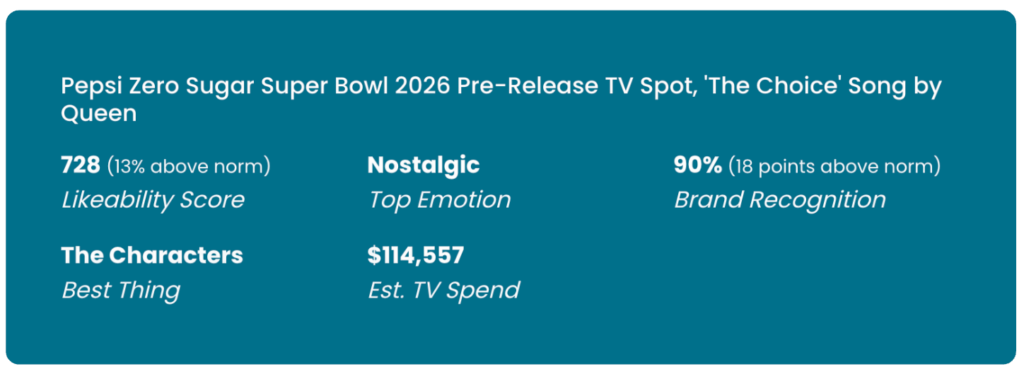
But the twist lands in the final moments, when it becomes clear that Pepsi isn’t just borrowing a familiar visual, it’s subverting it. The spot closes with a nod to the viral Coldplay concert scandal drawing a clear line between nostalgia and provocation by using a competitor’s most iconic characters to make a category-level statement. Early performance signals reflect the strength of that approach: Likeability is high and Brand Recognition is well above the Super Bowl norm.
#2: Toyota Pulls Heartstrings With the RAV4
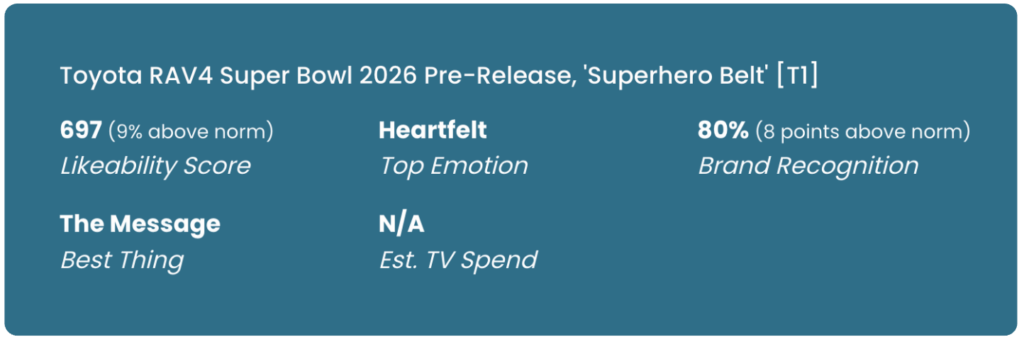
Likeability: 697 (9% Above Norm*)
Toyota’s RAV4 pre-release reflects meaning-led storytelling, centering on earnest emotion and message rather than grandeur or surprise.
This kind of creative doesn’t go for shock value; it aims to ground the moment. In early performance signals, the message emerges as the most cited Single Best Thing, paired with strong Brand Recognition.
It’s a reminder that not every Super Bowl ad needs to shout with celebrity star power, wild stunts, and/or outlandish humor. Some are built to resonate quietly—and stay with audiences long after the final whistle. These brands use the Big Game as a moment to reinforce values rather than chase virality.
Last year, four of the top 10 most likeable ads of Super Bowl LIX took a serious, emotionally resonant approach, moving beyond humor to relay deeper themes. Brands like Pfizer, Budweiser, and Jeep earned Likeability scores in the 90th percentile and up, proving emotional ads can stand out in a high-energy Super Bowl.
#3: Dove Stakes a Claim on Meaning
Likeability: 690 (7% Above Norm*)
Dove’s pre-release leans into inspiration and message over entertainment. “This Game Is Ours” centers on female empowerment, positioning the brand within the broader cultural significance of the Super Bowl rather than the spectacle itself.
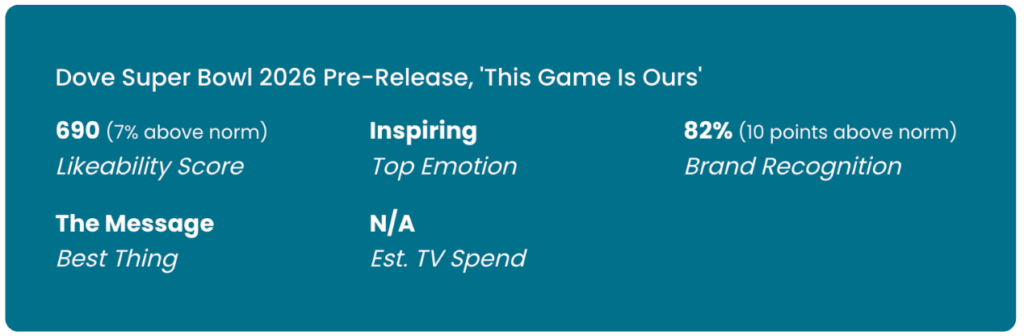
Viewers called out the Message as the primary driver of Likeability, with Inspiring emerging as the top emotional signal. It’s a continuation of Dove’s long-standing creative posture—and a further reminder that purpose-led storytelling can still resonate, even amid the noise and theatrics of Super Bowl season.
#4: Bud Light Brings the Party Back
Likeability: 685 (7% Above Norm*)
Bud Light’s pre-release returns to one of the category’s most reliable Super Bowl formulas: humor, celebrity, and cultural familiarity. Featuring Shane Gillis, Post Malone, and Peyton Manning—set to a Whitney Houston track—the spot prioritizes dramatic moments and instantly recognizable visuals designed to land quickly with a broad audience.
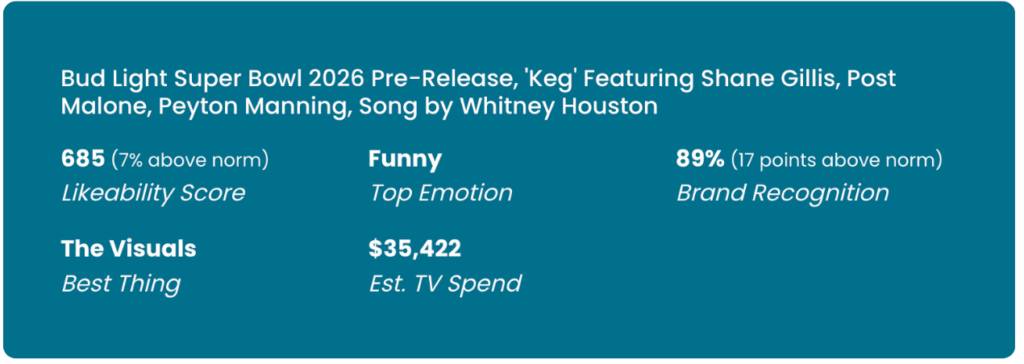
Early Creative Assessment metrics reflect that strategy. Humor emerges as the dominant emotional response, while visuals are cited as the standout creative element. This isn’t subtle storytelling; it’s social, loud, and built for mass appeal—with a high Likeability score to show that the approach is already paying off.
#5: Hellmann’s Knows the Power of a Good Track
Likeability: 668 (4% Above Norm*)
Hellmann’s rounds out the top five by putting music front and center.
Featuring Andy Samberg and Elle Fanning, the spot leans comedic, but what stands out most isn’t the cast. It’s the soundtrack. Music emerges as the top-cited element driving viewer response, paired with Funny as the dominant emotional signal.
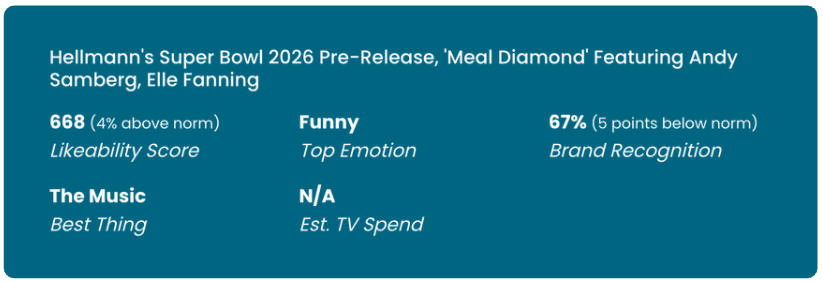
Music creates momentum early, anchoring attention before the influx of Big Game ads. And while Brand Recognition trails slightly behind other pre-releases, the creative signals suggest Hellmann’s is prioritizing memorability and mood.
Unlock VIP Access to the Super Bowl LX Ad Center
Don’t wait for kickoff on February 8th. Unified creative and audience metrics for every teaser and pre-release are available now in iSpot’s VIP Ad Center. After the Big Game, it features our full ranking of every official game-day spot.
Want a Full Big Game Ad Performance Recap?
Register for our post-Super Bowl webinar with AdAge and GM where we’ll recap Super Bowl LX ad performance and unveil our new AI platform that forever changes how brands create, measure, and optimize video ads.
Glossary of Terms
Likeability Score: Measures the extent to which Creative Assessment survey respondents like an ad. Scores range from 1-950 and are compared to a norm of the last five Super Bowls, the average of which is 641.
Top Emotion: We measure 57 emotional reactions to an ad derived from hundreds of Creative Assessment survey respondent verbatim comments. The Top Emotion represents the reaction with the strongest signal and is at minimum stronger than 75% of all ads for that specific emotion.
Brand Recognition: Measures the strength of a brand’s and/or product’s presence in the creative. Equals the percent of survey respondents that accurately identified a brand (unaided) after watching an ad. A difference of +/-3% is statistically significant. The norm is 74% taking in account the last 5 Super Bowls.
Best Thing: Creative Assessment survey respondents are asked to choose their favorite aspect about the ad. Options include: Characters, Visual Scenes, Music, Brand, Product Itself, Deal or Offer, Message, and None.
Est. TV Spend: Est. TV Spend is calculated by multiplying the impressions by the cost per 1,000 viewers (CPM) divided by 1,000. It provides a foundation for an apples-to-apples comparison across all media units and advertisers.