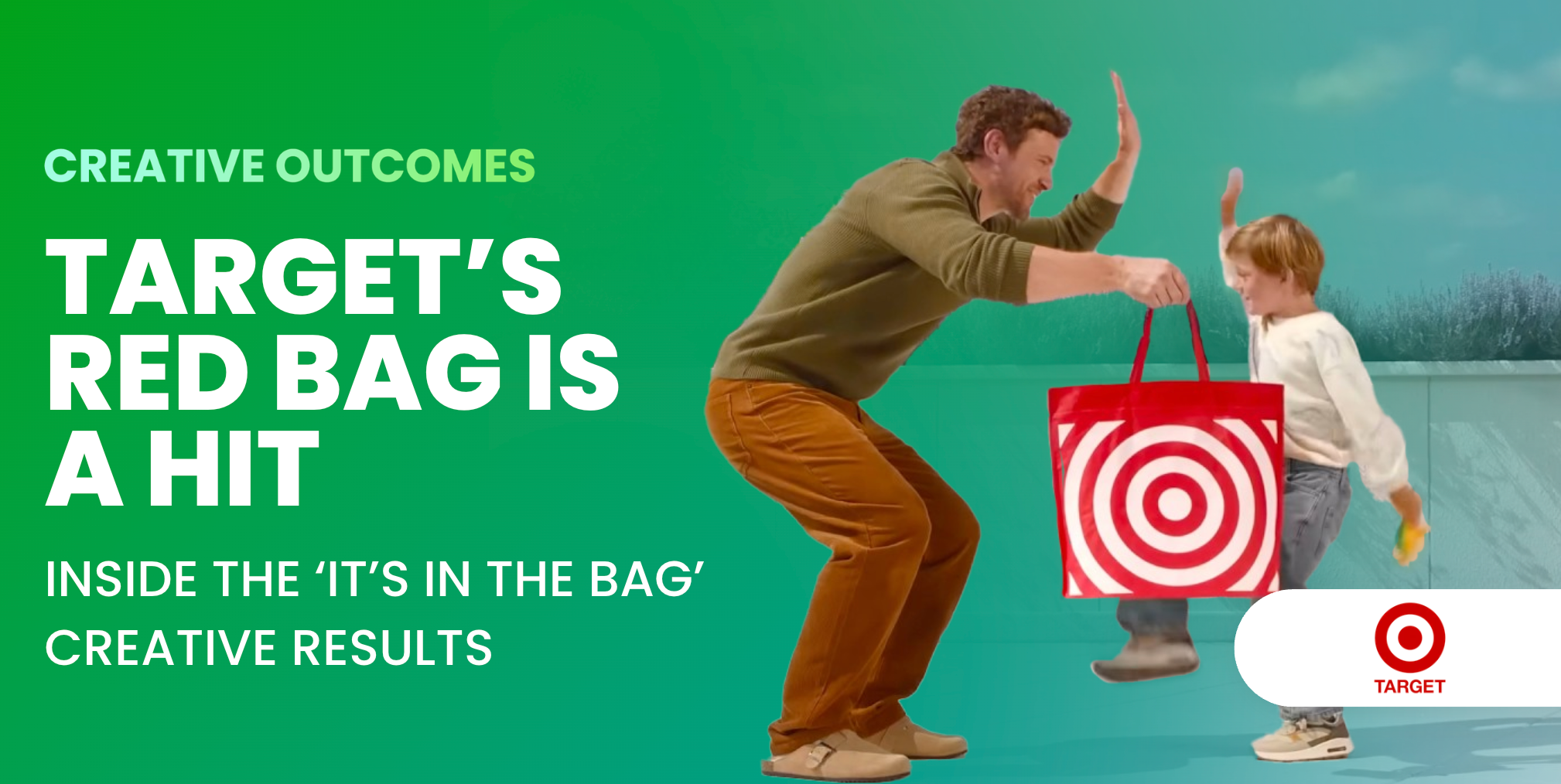
Target has launched its new national campaign, “Inside Out,” which highlights how everyday purchases connect to the personal lives and individual styles of its shoppers. One of the campaign’s most successful spots is “It’s In the Bag.” Anchored by the retailer’s familiar red plastic tote, the creative moves through a series of stylish vignettes set to Raye’s track “Joy”.
The effort leans into Target’s long-standing mission of bringing accessible, modern design to low-price merchandising across a wide range of categories, including apparel, home goods, personal care, snacks, and party decorations.
Here’s what iSpot’s Creative Assessment platform revealed on actual viewer response to the spots.
The Details:
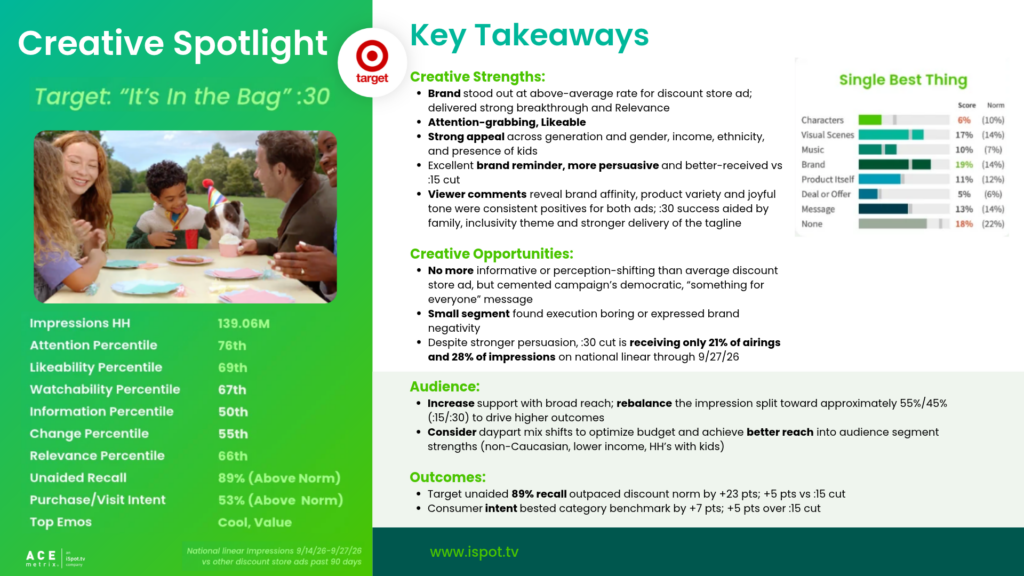
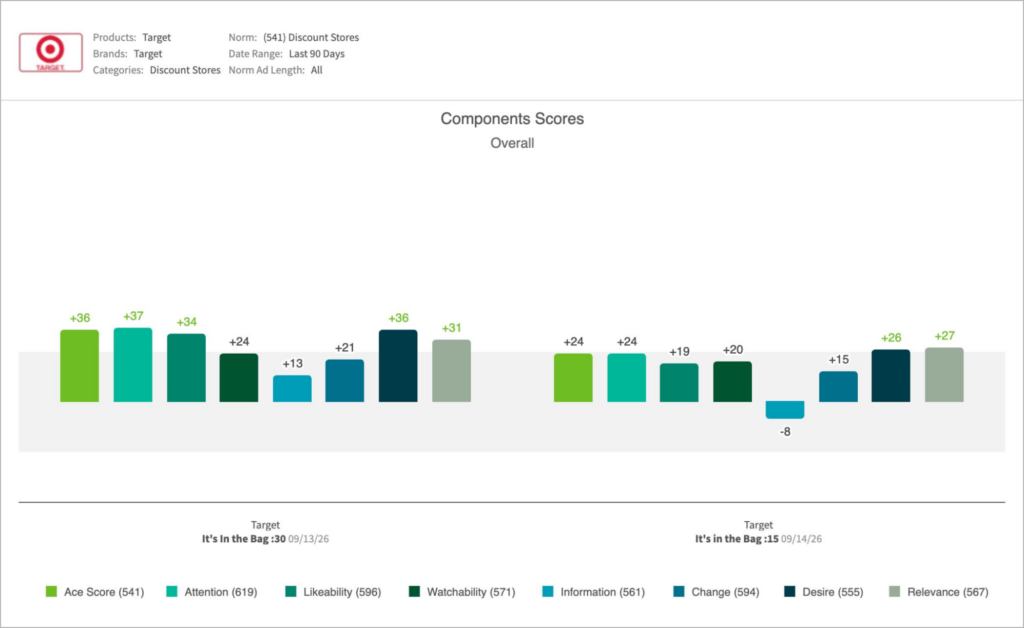
- The :30 “It’s In the Bag: was a clear above-norm performer vs the :15 cut, with overall response (as measured by Ace Score) landing +36 pts above the discount store 90-day norm, in the 68th percentile:
- It won both on creative measures and commercial impact. Achieving above-norm breakthrough (Attention and Likeability) and Relevance, the :30 also sparked above-norm Desire and Top 2 Box intent of 53%, beating category norms by +7 pts and the :15 by +5 pts.
- Visual scenes and the music helped, but placed within the normative range for the category with a 17% Single Best Thing Rating (norm 14%) and 10% (norm 7%), respectively. The brand itself was the hero, leading Single Best Thing choice at 19% vs. a 14% norm (+5 pts). Branded bags and packed products drove a concept that was built around Target.
- The ad worked less hard on Information or perception shifts. Change (+21 pts) and Information (+13 pts) were both at norm. The spot built want more than it taught.
- It won both on creative measures and commercial impact. Achieving above-norm breakthrough (Attention and Likeability) and Relevance, the :30 also sparked above-norm Desire and Top 2 Box intent of 53%, beating category norms by +7 pts and the :15 by +5 pts.
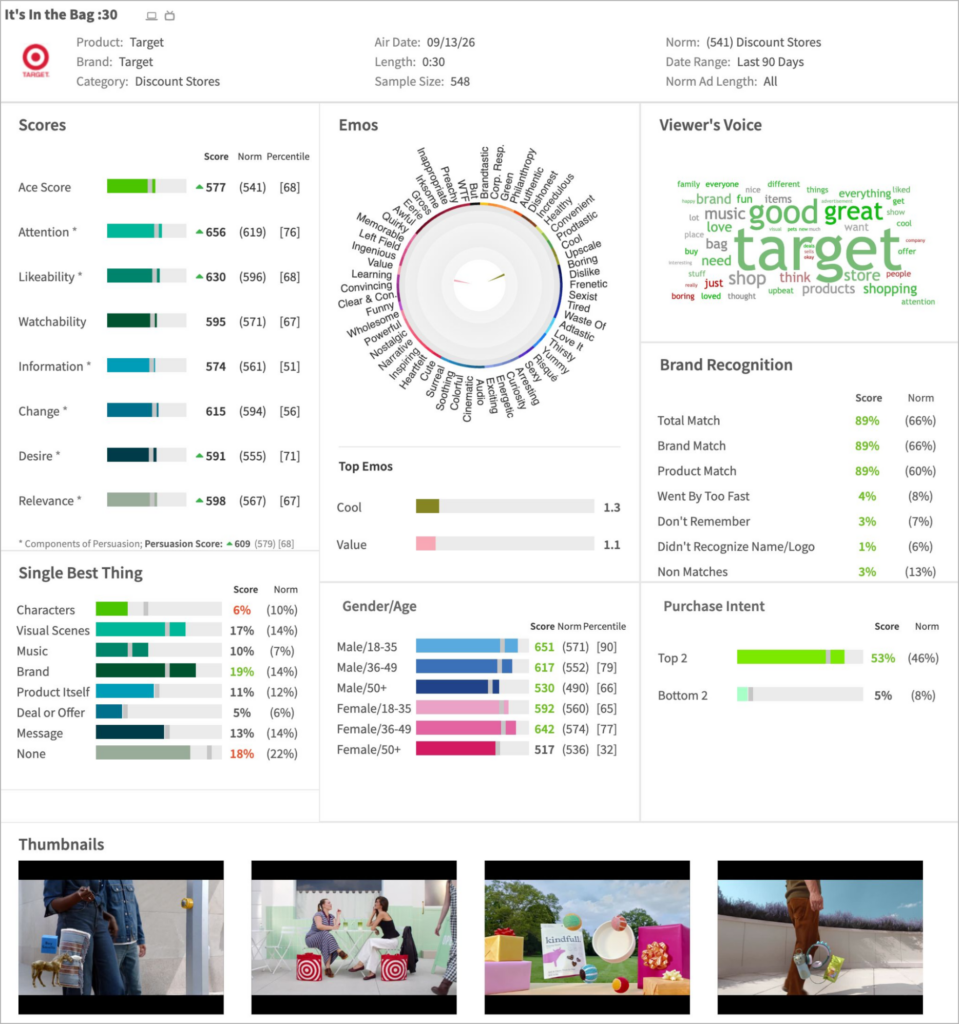
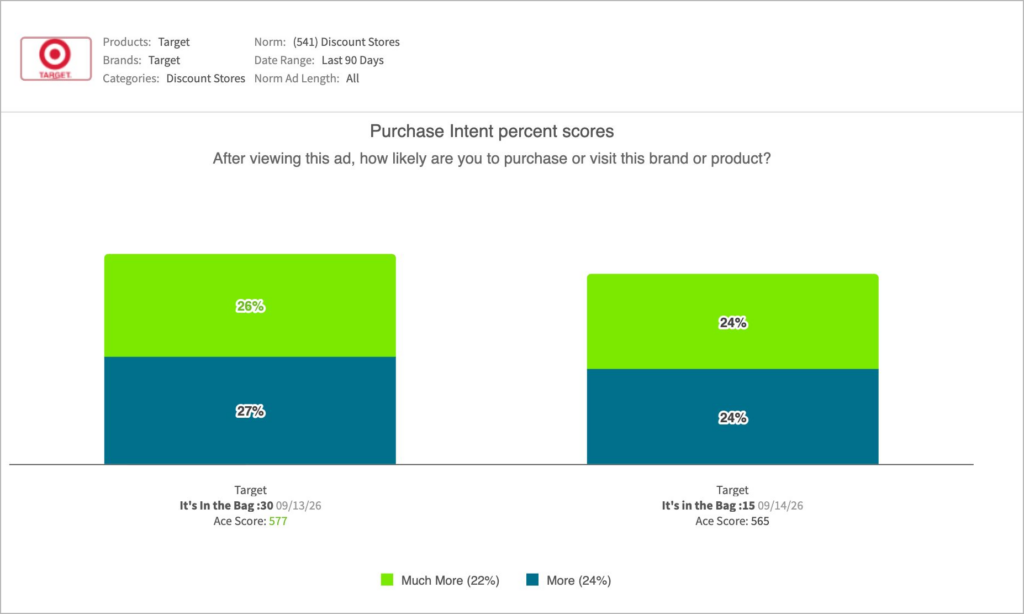
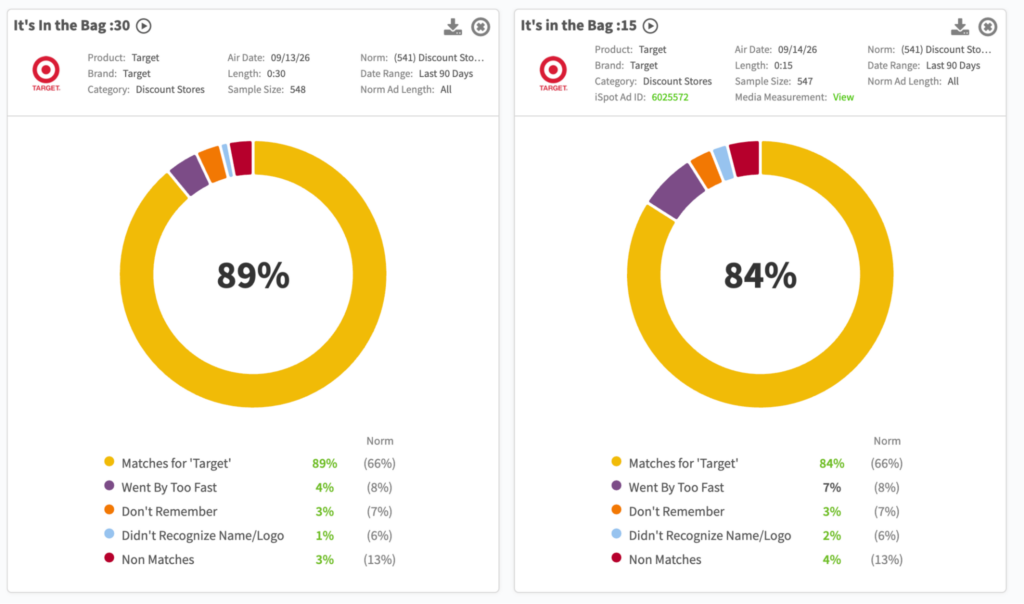
- Brand linkage was exceptional as 89% easily recalled Target as the advertiser (unaided) after a single view vs. a 66% norm (+23 pts) and 84% for the shorter form ad:
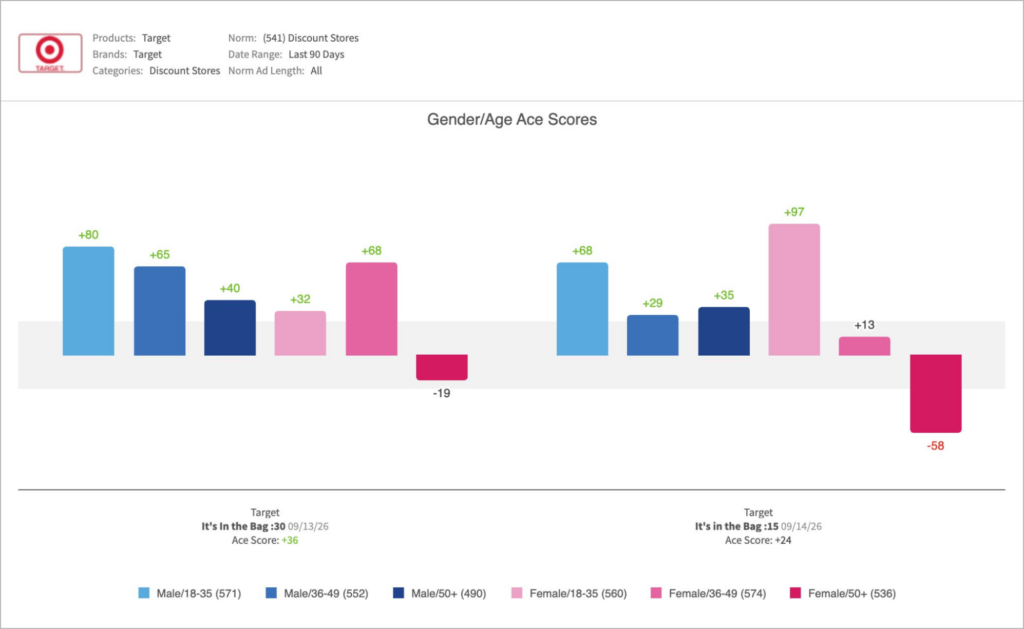
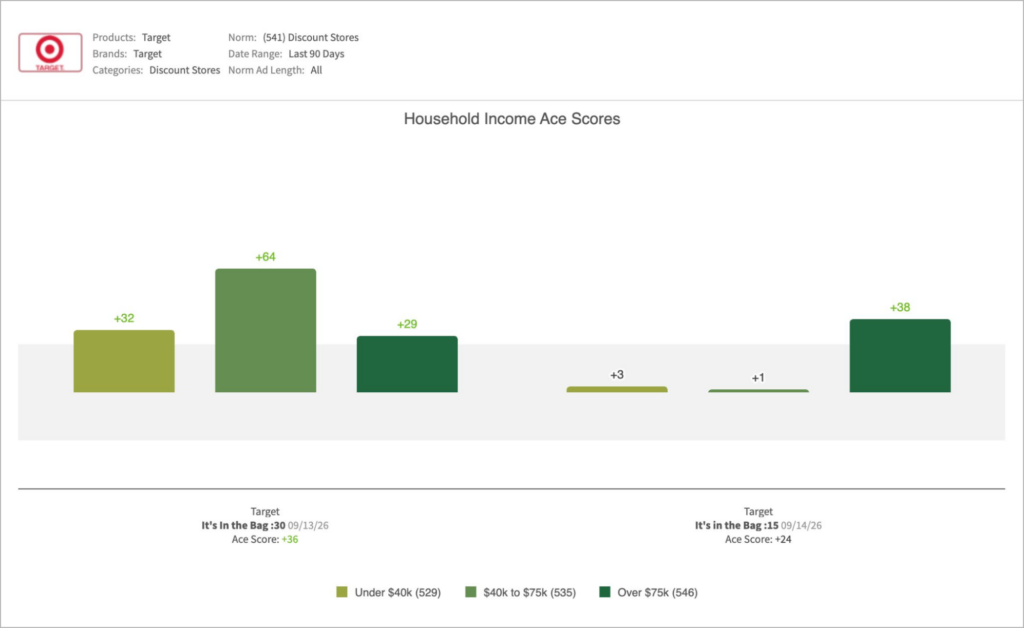
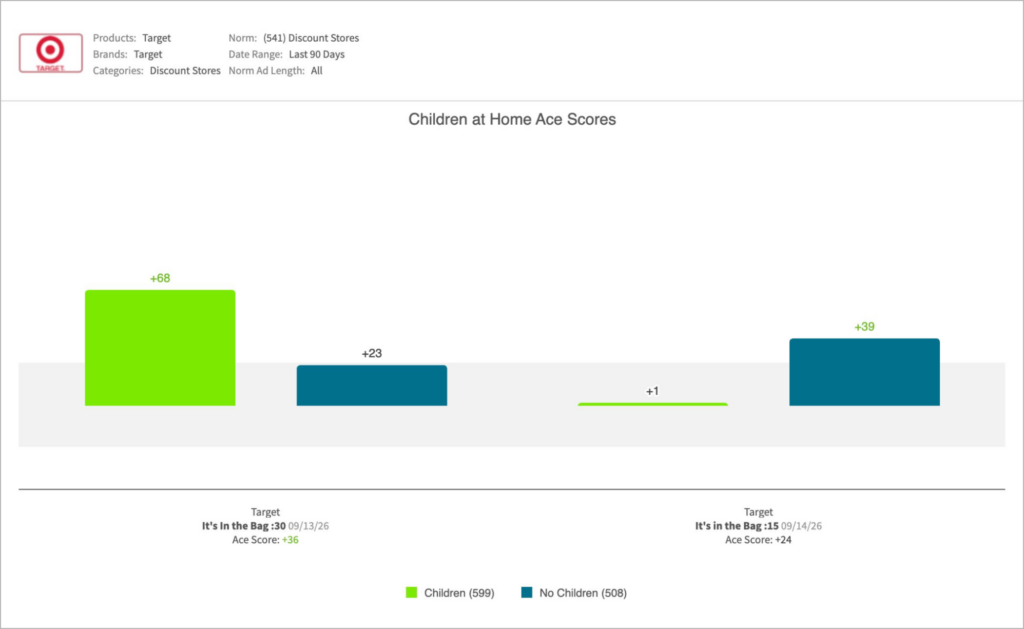
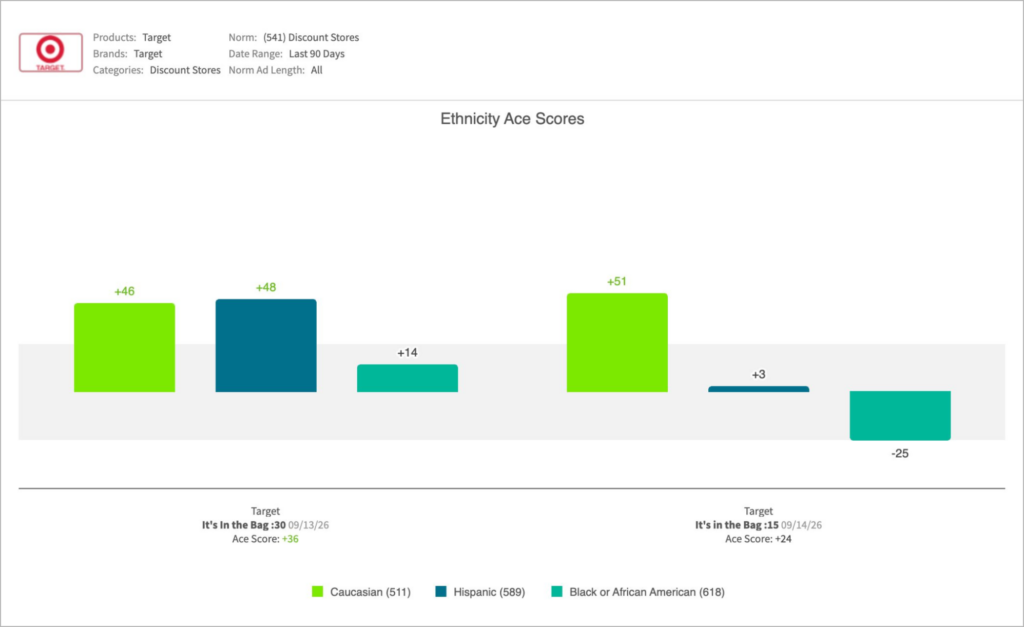
- The :30 also worked harder at the democratization message as it boasted above-norm strength across gender and generation, income level, ethnicity, and presence of children while the :15 showed relative weaknesses across multiple consumer segments.
- As such, Target might consider favoring the :30 in forward media rotations, possibly shifting some budget from the :15 to the :30 and aiming the shorter cut at viewers 18-35 where it shone.
- The :30 also worked harder at the democratization message as it boasted above-norm strength across gender and generation, income level, ethnicity, and presence of children while the :15 showed relative weaknesses across multiple consumer segments.
- iSpot’s SAGE Creative AI agent identified the themes driving purchase intent success and weakness across the two spots:
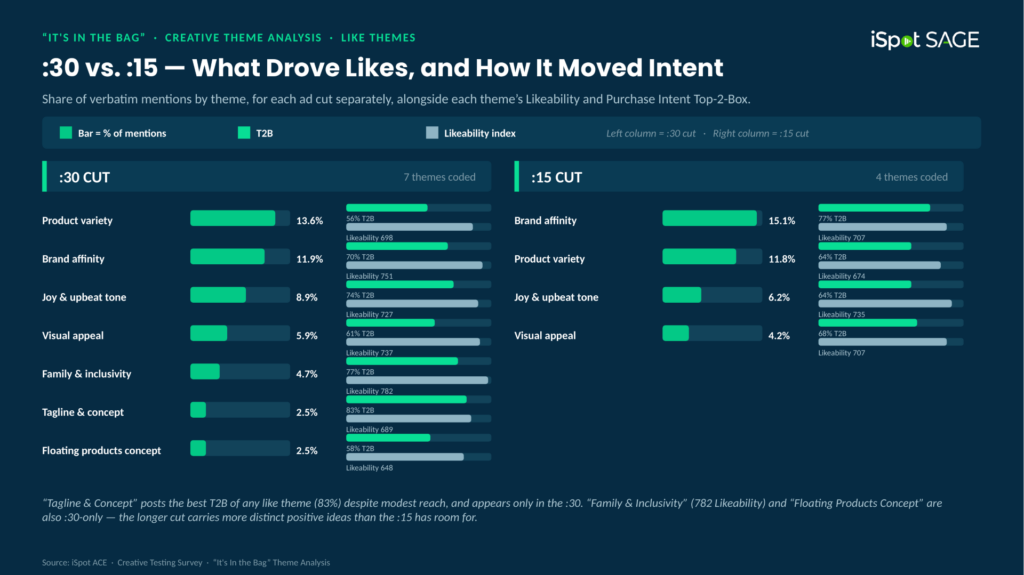
- Brand affinity, product variety, and joy/upbeat tone were the three most prevalent themes of the campaign, present in both ads. Visual appeal was also consistent across spots. Although the :15 reached more brand affinity respondents (15.1% vs. 11.9%) it came at lower engagement (707 vs. 751 Likeability). The “invisible bag” concept showing products was noted as creative and unique and the vibrant colors and dynamic visuals were consistently praised.
- The :30 had a clear edge in family and inclusivity (4.7%, Likeability 782, Top 2 Box purchase intent 77%) — a theme entirely absent from the :15 data. This spot successfully communicated Target’s diverse product range and of course, the inclusion of pet products was particularly well-received.
- The tagline and concept theme among viewers of the :30 produced the highest Top 2 Box intent of any positive theme in the entire table at 83% with 0% Bottom 2 Box — meaning nearly every respondent who consciously recognized the campaign concept moved toward purchase intent. The concept reinforced Target’s positioning as having “something for everyone” as intended. Neither theme surfaced in the :15 data, making this a genuine differentiator for the longer cut.
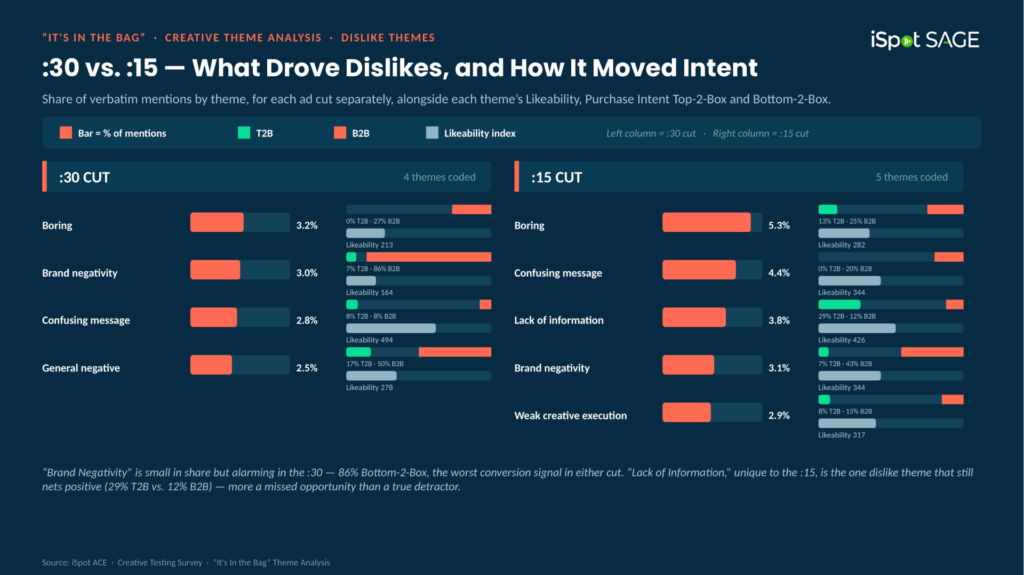
- The :30’s dislike profile was narrower in theme count but more intense where it hit (brand negativity Bottom 2 Box theme intent of 86%). The :15’s dislike profile was broader — more themes, more confusion, more boredom — but with less extreme rejection. Neither cut solved the brand negativity objection; they just distributed it differently.
- Brand affinity, product variety, and joy/upbeat tone were the three most prevalent themes of the campaign, present in both ads. Visual appeal was also consistent across spots. Although the :15 reached more brand affinity respondents (15.1% vs. 11.9%) it came at lower engagement (707 vs. 751 Likeability). The “invisible bag” concept showing products was noted as creative and unique and the vibrant colors and dynamic visuals were consistently praised.
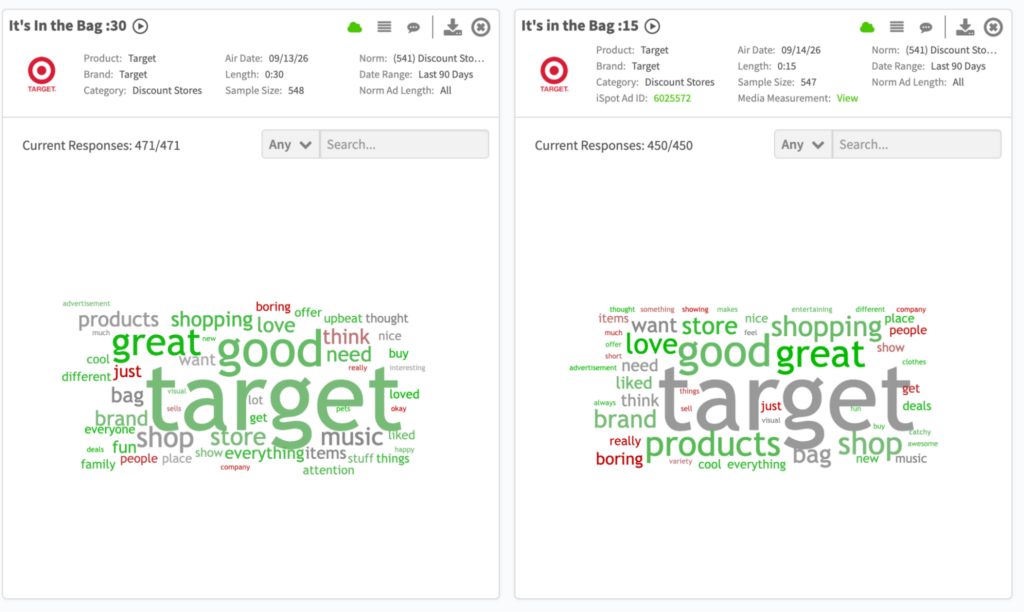
Sample comments on the :30 “It’s In the Bag”
“I think they did very well. Good background music, good pictures, good examples of what they have to offer and overall good production that really catches the eye, with all the different colors and people doing different things.”
Male 18-35
“Unmistakably target and clever idea for the video.”
Male 36-49
“That Target has much to shop for and you can fill your bag with an assortment of items.”
Male 50+
“The ad is mood boosting. Seeing all those happy people walking around, it looks like they grabbed a good deal.”
Female 50+
“I don’t care. Target is racist.”
Female 18-35
“Confused for the 1st 1/2 of the ad then bored the 2nd 1/2. I know it was for Target, but whatever message they wanted to convey about Target was not received.”
Male 18-35
“As usual for this company it’s aimed at social media and those influenced by it. One of the reasons I rarely if ever shop at this company.”
Female 50+
“I love how the ad included your furry family members, not just pets, in the ad so it’s something for everyone, not just a target group.”
Female 36-49
“I think the advertiser wants you to know that they offer a wide variety of products that are unique to you.”
Female 18-35
“Hell yes I’m going to Target today.”
Male 36-49
“Great ad for Target. I loved the music and upbeat presentation. Each product image was clean and clear. People were smiling and happy. Target logo everywhere A+.”
Female 50+
“The ad was trendy and exciting. It makes me want to go see what I can get a good deal on at Target.”
Female 36-49
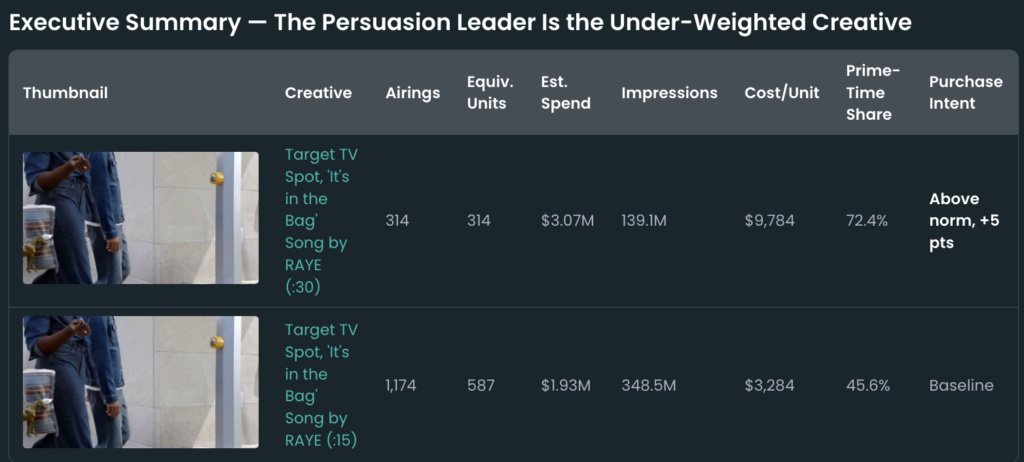
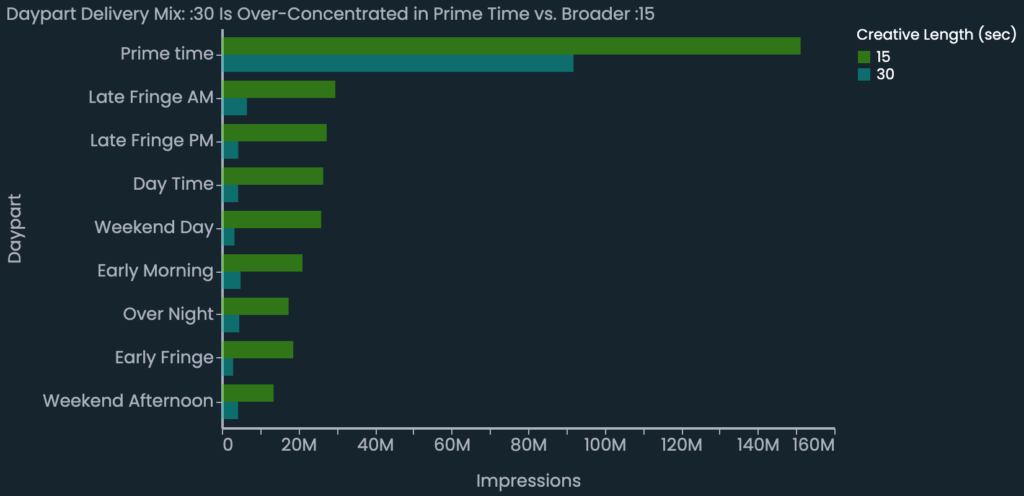
- iSpot’s SAGE Media AI agent indicates that Target’s strongest persuasion asset (the :30, which beat the :15 by +5 intent points at an above-norm level and out-indexed across income, ethnicity, presence of kids, and age/gender) received only 21% of airings and 28% of impressions on national linear through 9/27/26:
- Target might rebalance the impression split toward approximately 55%/45% (:15/:30) as the :30 is the campaign’s validated intent driver (+5 pts, above norm); starving it at 28% of impressions leaves persuasion on the table. The brand could fund the shift by trimming the :15’s lowest-value dayparts (Over Night, Late Fringe), not its prime/reach base.
- Target might also move about 15%–20% of the :30’s prime-time weight into Early Morning, Day Time, and Weekend Day — dayparts where the :15 is already proving efficient.
- Target might rebalance the impression split toward approximately 55%/45% (:15/:30) as the :30 is the campaign’s validated intent driver (+5 pts, above norm); starving it at 28% of impressions leaves persuasion on the table. The brand could fund the shift by trimming the :15’s lowest-value dayparts (Over Night, Late Fringe), not its prime/reach base.
Ineffective creative, even if delivered to the right audience, results in missed opportunity and performance shortfalls. Great creative delivered poorly also results in failed campaigns.
Schedule a demo to find out how your brand can partner with iSpot to quickly solve both challenges simultaneously, delivering high-performing creative while boosting the effectiveness of planning and in-market execution to achieve—and outperform—campaign objectives.
Creative Agency: Mythology