To provide dedicated support for small and medium-sized enterprises, Mastercard has launched the Mastercard Collection for Business, a specialized suite of products designed to deliver enhanced cyber protection and expanded digital tools. Developed from global “Dreamonomics” research indicating that smaller business owners seek predictable, protected, and manageable growth, the rollout encompasses three targeted offerings: Business Growth, Business Lifestyle, and Business Security.
Accompanying the product release is “Dreams,” a multi-channel campaign developed with creative agency McCann that extends the brand’s enduring “Priceless” platform to celebrate entrepreneurial ambition. Spotlighting real-world enterprises such as The Meat Hook and Noble Signs, the campaign highlights practical solutions for everyday operational challenges with the tagline “Building your dream business. Priceless.”
Here’s what iSpot’s Creative Assessment platform revealed on actual viewer response to the spots.
The Details:
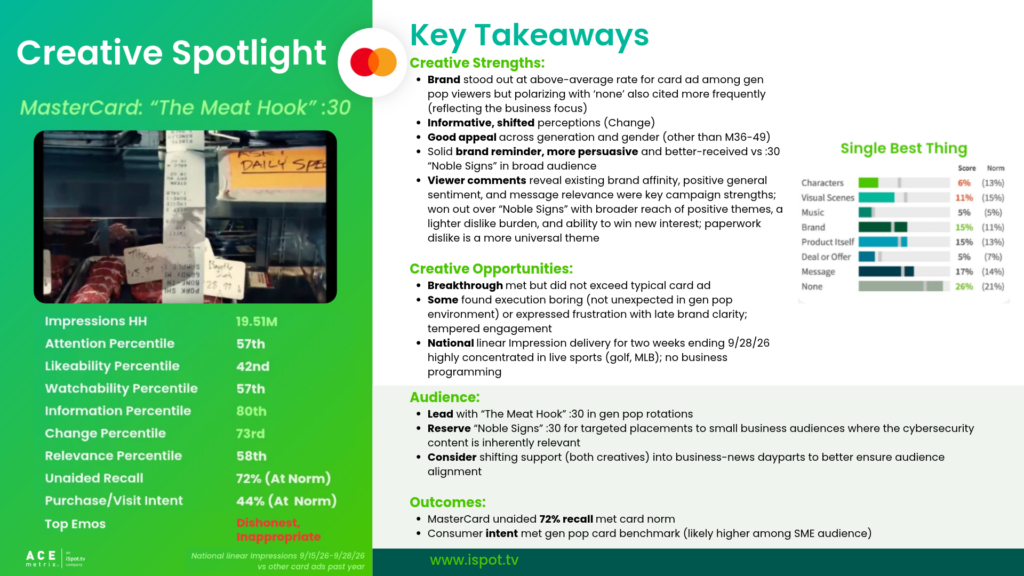
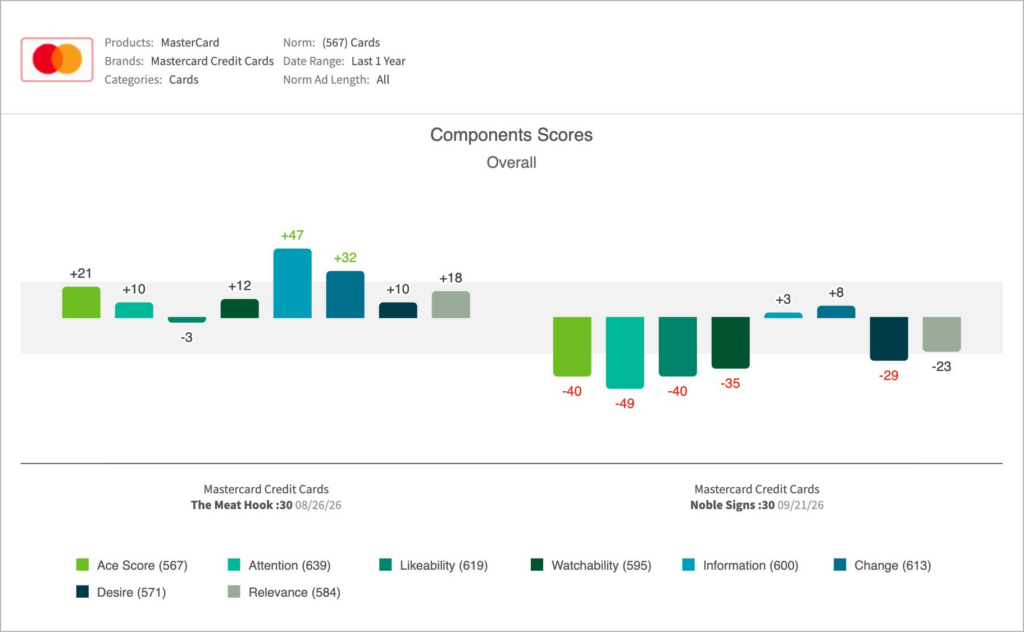
- “The Meat Hook” :30 was a solidly at-norm performer overall across the gen pop audience, but showed strength in Information (+47 pts over norm) and Change (+32 pts), indicating that U.S. viewers found the invoice-payment message genuinely novel and perceived Mastercard as moving in a new direction:
- Attention, Likeability, Watchability, and Relevance landed in the normative range for cards (past year benchmarks), indicating the creative held up well against the category’s historical average.
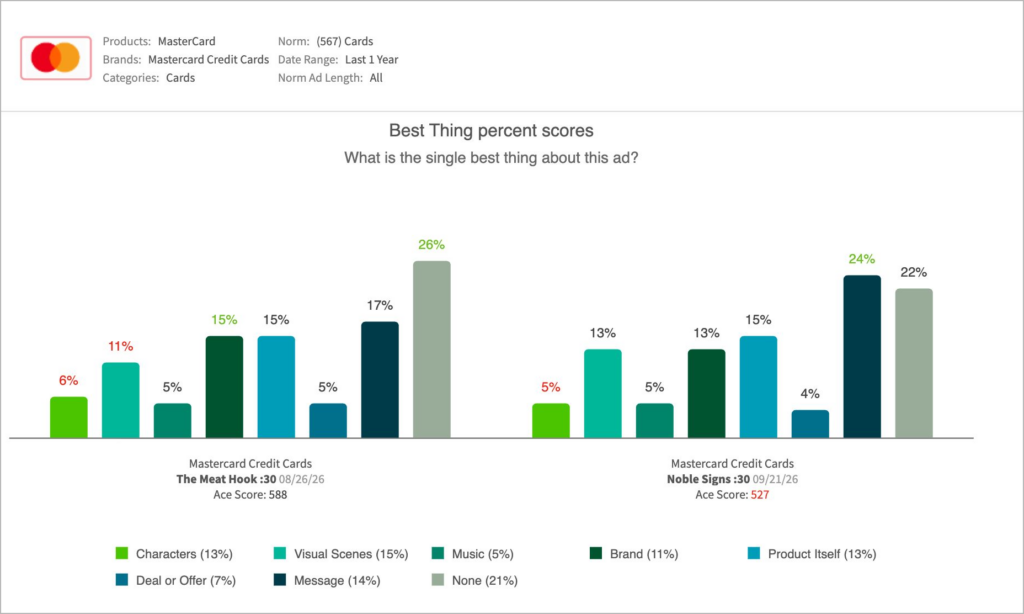
- The broad audience reported a normative level of purchase/visit intent, which is a solid signal given that not all viewers are SME owners. This aspect was reflected in split ratings of the Single Best Thing about the ad, with both the brand and ‘none’ more impressionable to the broad audience.
- “The Meat Hook” earned at- to above-norm response across age/gender other than males 36-49 signaling an appropriateness for broad reach media if desired, with the best audience being boomer males and women 36-49.
- Attention, Likeability, Watchability, and Relevance landed in the normative range for cards (past year benchmarks), indicating the creative held up well against the category’s historical average.
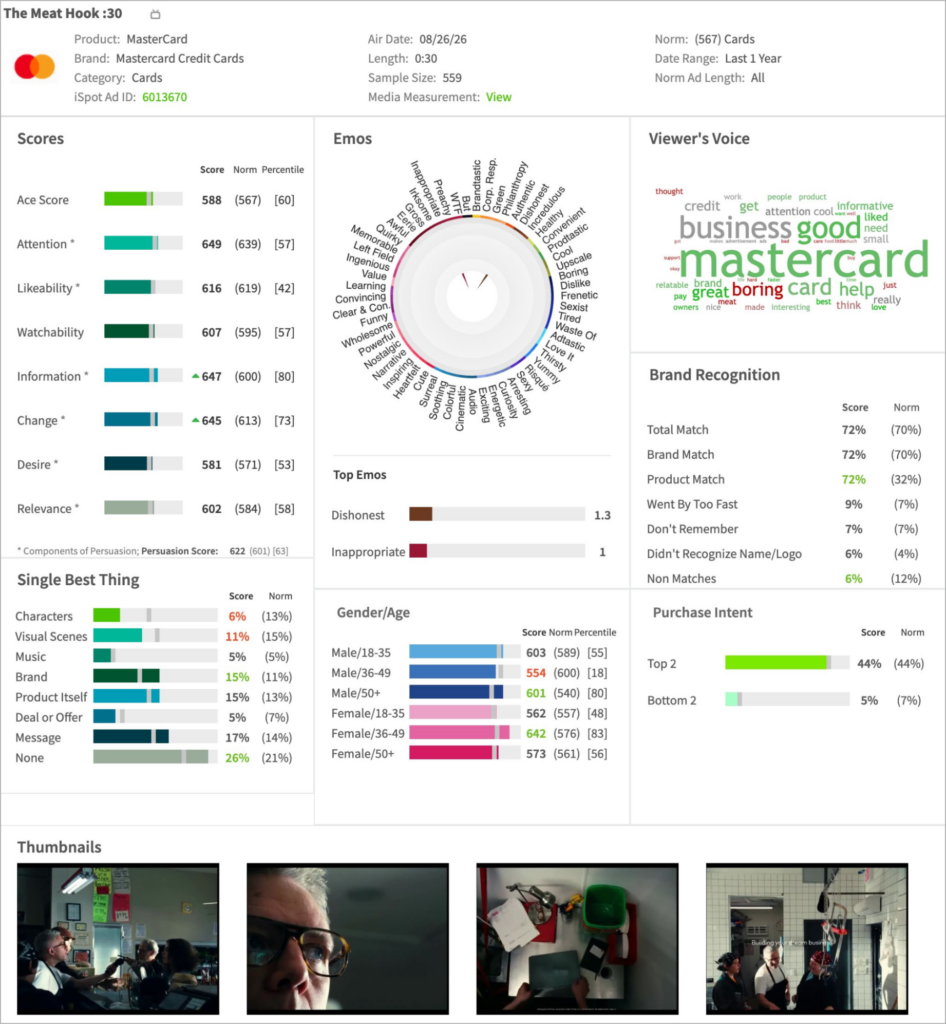
- The creative resonated across American political parties and kept negative-leaning sentiment (in this case, Dishonest and Inappropriate signals) to low levels:
- In comparison, “Noble Signs” was a below-norm creative on core engagement metrics within the broad audience, but its message was significantly more impressionable vs the average card ad:
- iSpot’s SAGE Creative AI agent identified the themes driving gen pop purchase/visit intent success and weakness across the two spots:
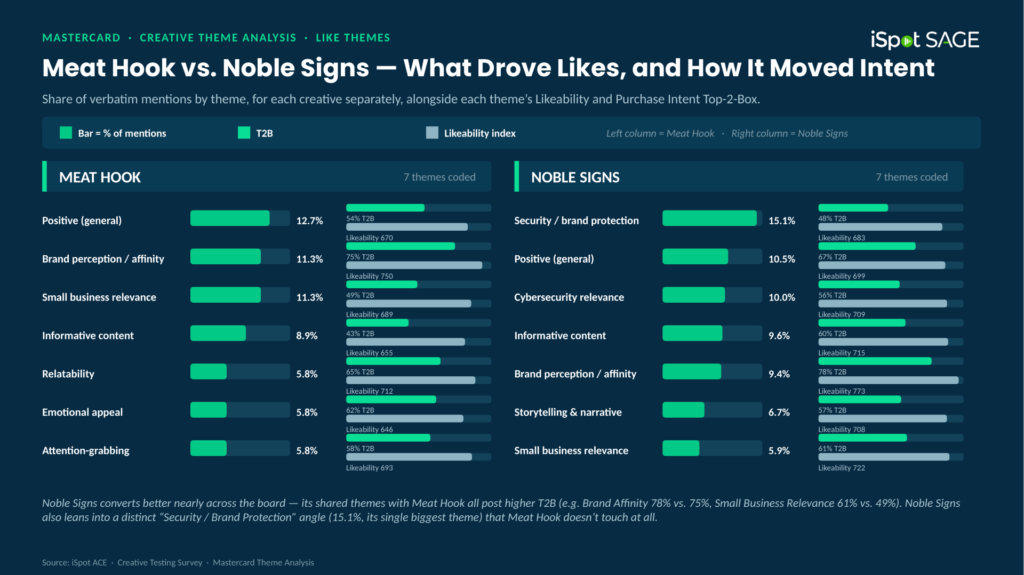
- Overall positive sentiment and references to message relevance (small business relevance, relatability, security/brand protection, cybersecurity relevance) were common across the campaign.
- “Noble Signs” actually produced the single strongest theme in the study — Brand Affinity (773 Likeability, 78% Top 2 Box) — so on a theme-by-theme basis, this ad may appear to be the stronger creative. “Meat Hook” won overall anyway, for three reasons:
- Broader reach, not just higher peaks. “Noble Signs'” individual like themes scored higher on Likeability and Top 2 Box, but “Meat Hook’s” like themes collectively reached more respondents. A wider base of positive reactions beats a narrower set of stronger ones.
- A lighter dislike burden. “Meat Hook” simply carried less negative-theme weight overall, which matters as much as the positive side does.
- New persuasion, not just existing loyalty. “Noble Signs'” top theme (Brand Affinity) likely reflects people who already liked the brand walking in — reinforcement, not conversion. “Meat Hook’s” relatability theme (5.8% share) told the opposite story: 65% Top 2 Box with zero Bottom 2 Box, a signal it connected with potentially new interest rather than just echoing people who were already fans.
- Broader reach, not just higher peaks. “Noble Signs'” individual like themes scored higher on Likeability and Top 2 Box, but “Meat Hook’s” like themes collectively reached more respondents. A wider base of positive reactions beats a narrower set of stronger ones.
- Overall positive sentiment and references to message relevance (small business relevance, relatability, security/brand protection, cybersecurity relevance) were common across the campaign.
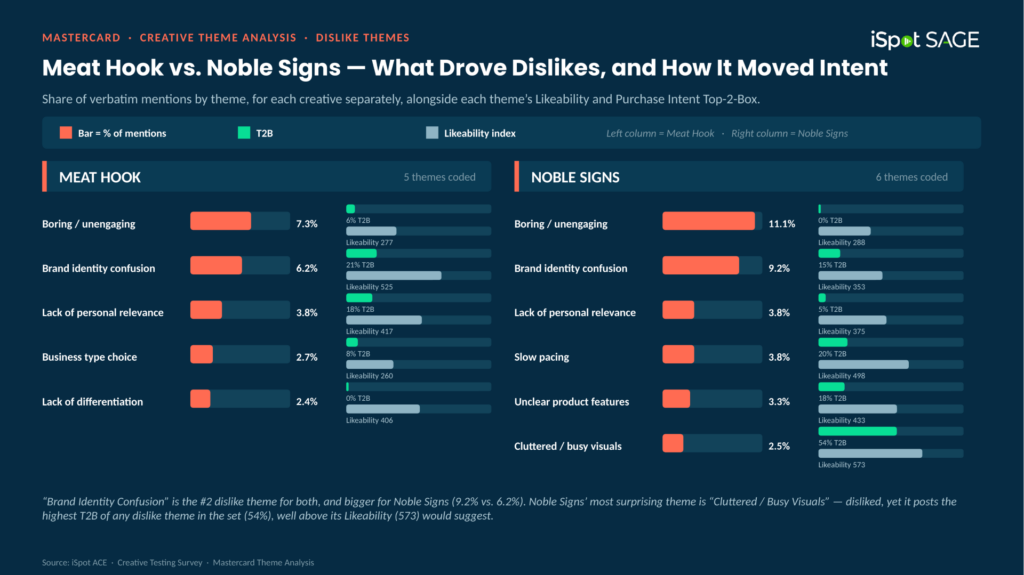
- Boring was the most prevalent negative-leaning theme in both ads, and it was the single most damaging theme in the whole study for “Noble Signs” specifically (11.1% share, 0% Top 2 Box). Relevance scores among viewers who called the ads boring were nearly identical for both (265 “Meat Hook,” 264 “Noble Signs”) — low enough to suggest these viewers were saying the content simply didn’t apply to their lives, echoing the separate “lack of personal relevance” theme:
- Since both ads target small business messaging, this is largely an artifact of testing against a general population. Retesting specifically among small business owners/managers could shrink or eliminate both themes but if ads are aired in broad audience media, the concern is worth noting.
- Brand identity confusion was the second common weakness — and it hit “Noble Signs” harder (353 Likeability, 15% Top 2 Box among viewers who raised it) than “Meat Hook” (525 Likeability, 21% Top 2 Box). Adding the Mastercard name in text on the opening branding screen could be considered as a quick edit, so viewers would immediately know what they’re watching and could process the rest of the ad with that context set.
- Since both ads target small business messaging, this is largely an artifact of testing against a general population. Retesting specifically among small business owners/managers could shrink or eliminate both themes but if ads are aired in broad audience media, the concern is worth noting.
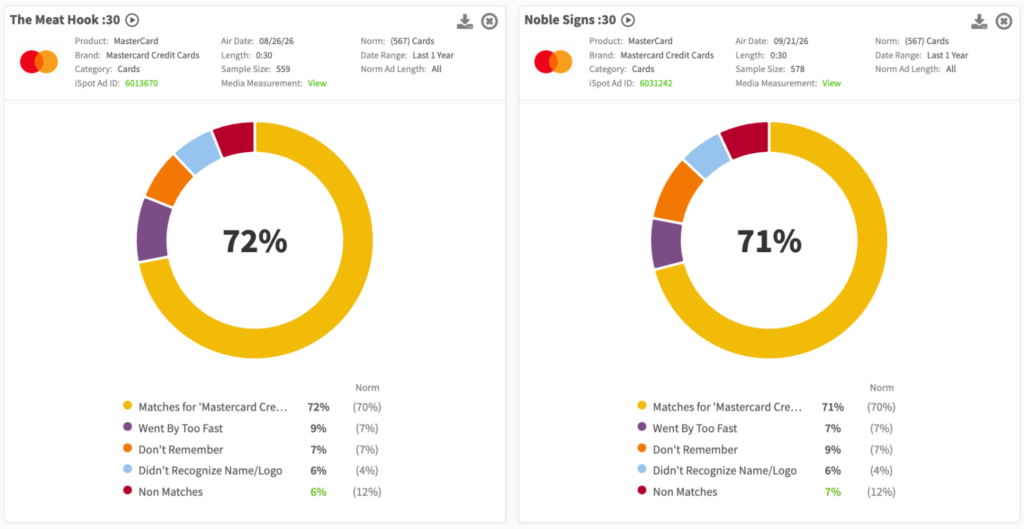
- Although brand identity confusion surfaced in viewer comments, it was referencing this sentiment as a response earlier in the viewing experience. By the end of both spots, seven in ten easily identified MasterCard as the advertiser:
- Comments on the :30 “The Meat Hook” suggest that the core narrative was strong but could benefit from sharper execution, earlier branding, and more explicit benefit communication to reach its full potential.
- The small business narrative strongly resonated, particularly the depiction of operational challenges and the nostalgic, authentic setting.
- Existing Mastercard customers expressed strong satisfaction and the ad reinforced their choice.
- Although viewers grasped that Mastercard helps businesses, specific benefits were sometimes unclear and the branding came too late for full engagement. For some, the muted, documentary-style aesthetic might have been too subdued for capturing attention in a cluttered media environment. While authenticity is valuable, engagement is still key, suggesting non-skippable media if careful targeting is not feasible.
- Some objections to the meat shop setting were also seen, but other viewers found it added to their interest.
- Comments on the :30 “The Meat Hook” suggest that the core narrative was strong but could benefit from sharper execution, earlier branding, and more explicit benefit communication to reach its full potential.
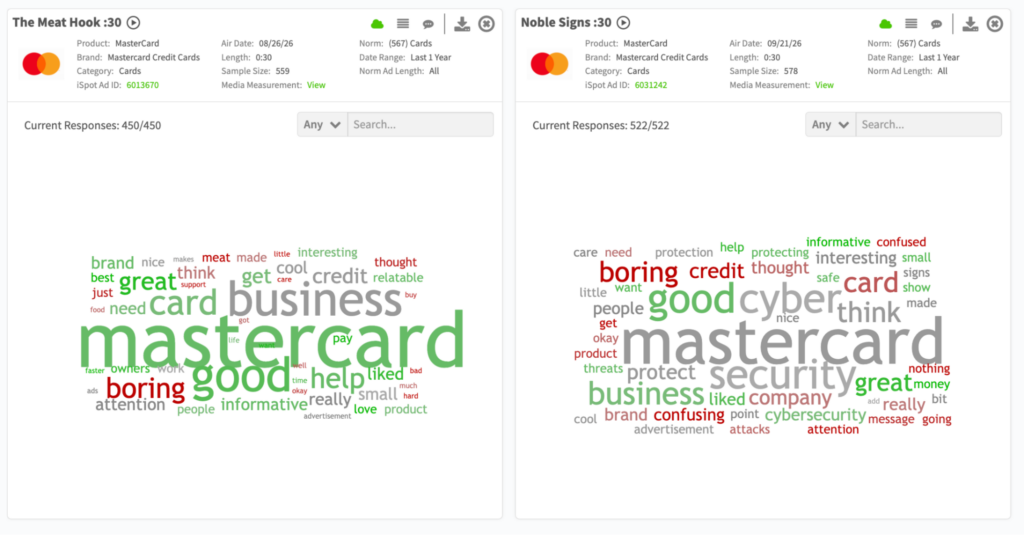
Sample comments on the “The Meat Hook” :30
“This ad was very informative, and it shows that Mastercard can provide specialized solutions that are tailored towards your business.”
Female 50+
“I like how it was a quick story line to why someone would need their card. It’s a relatable situation and debt happens to a lot of small business owners. It was cute to watch.”
Female 18-35
“I think it’s a perfect representation of Mastercard and how it supports small businesses.”
Male 36-49
“I did not like it for the pure fact of not being able to understand what it was advertising at first. It left me confused.”
Female 18-35
“I liked the ad. I just honestly don’t even know what it was for.”
Male 36-49
“Raw meat is not appealing to me. I admire the idea of a work ethic. I’m not sure if the ad is talking about the business using Mastercard for accounts payable or for its customers to use when paying the business.”
Female 50+
“I think this was a very good and relatable Mastercard commercial especially for individual owners with a business.”
Male 36-49
“I liked seeing the business owner succeed, felt his frustration with all of the paperwork.”
Female 50+
“I like ads like these because they have a full story to grab your attention.”
Male 18-35
“Mastercard is a great brand, but the ad was really boring and uninformative.”
Male 36-49
“When it got half-way through the ad it really made me listen because at that point I knew it was about a card. The first half I did not know what it was about at all.”
Female 50+
“I plan on starting my own food truck and could definitely use Mastercard to help me figure out payroll.”
Male 50+
“This ad was perfect. It was captivating, relatable and intriguing. I wouldn’t be bothered by this ad popping up for me.”
Female 36-49
- iSpot’s SAGE Media AI agent evaluated the campaign delivery over the two weeks ending 9/28/26:
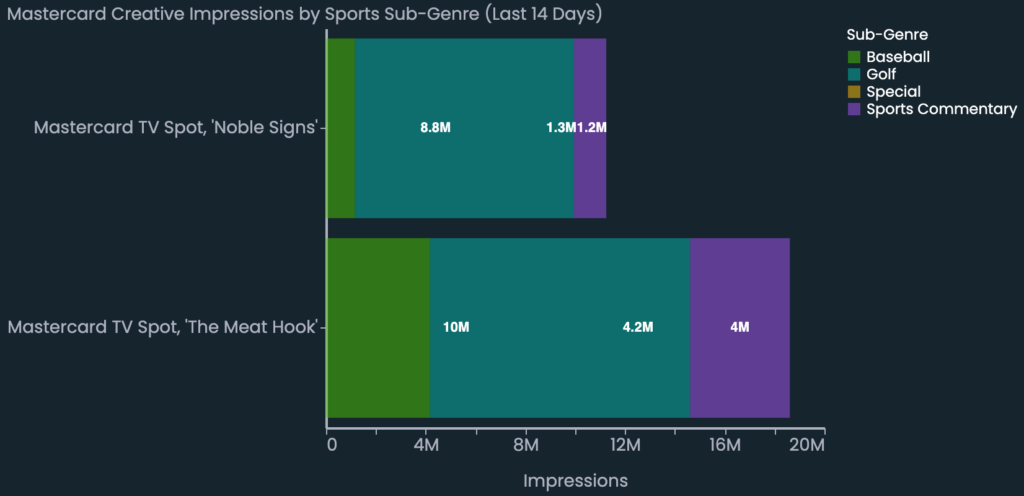
- Both creatives ran in a near-pure live sports environment — the 2026 Presidents Cup / PGA Tour golf on NBC and Golf Channel, plus MLB Network baseball and studio commentary. This is a broad-reach, affluent-skewing gen-pop buy but is not a purpose-built small-business-owner (SBO) placement.
- Since “The Meat Hook” won on gen-pop response and intent, this is the better spot for broader reach audience placements. The paperwork-overwhelm narrative translated broadly because administrative burden is a near-universal experience, not exclusive to business owners.
- Mastercard might shift incremental weight from MLB studio-commentary inventory (Quick Pitch, MLB Central/Now/Tonight — high airing counts, lower per-airing SBO relevance) into live golf windows (Presidents Cup, PGA Tour, DP World Tour) where feasible.
- The brand might also consider extending both creatives into morning and evening business-news dayparts to close the biggest SBO coverage gap; this is where owners/decision-makers concentrate outside sports.
- Both creatives ran in a near-pure live sports environment — the 2026 Presidents Cup / PGA Tour golf on NBC and Golf Channel, plus MLB Network baseball and studio commentary. This is a broad-reach, affluent-skewing gen-pop buy but is not a purpose-built small-business-owner (SBO) placement.
- Based on results from the first “Dreams” creatives, future small-business creative should identify the human tension at the center of the story and feature those that resonate beyond business owners in broad audience media for best results:
- For “Noble Signs” specifically, the brand could consider tightening the cybersecurity reveal. The slow pacing dislike theme (3.8%, Likeability 498) and unclear product features theme (3.3%, Likeability 433) both point to the same issue: the transition from craft storytelling to the cybersecurity message took too long, and the “My Cyber Risk” tool is not explained with enough specificity to satisfy viewers who want to understand what Mastercard is actually offering.
Ineffective creative, even if delivered to the right audience, results in missed opportunity and performance shortfalls. Great creative delivered poorly also results in failed campaigns.
Schedule a demo to find out how your brand can partner with iSpot to quickly solve both challenges simultaneously, delivering high-performing creative while boosting the effectiveness of planning and in-market execution to achieve—and outperform—campaign objectives.
Creative Agency: McCann