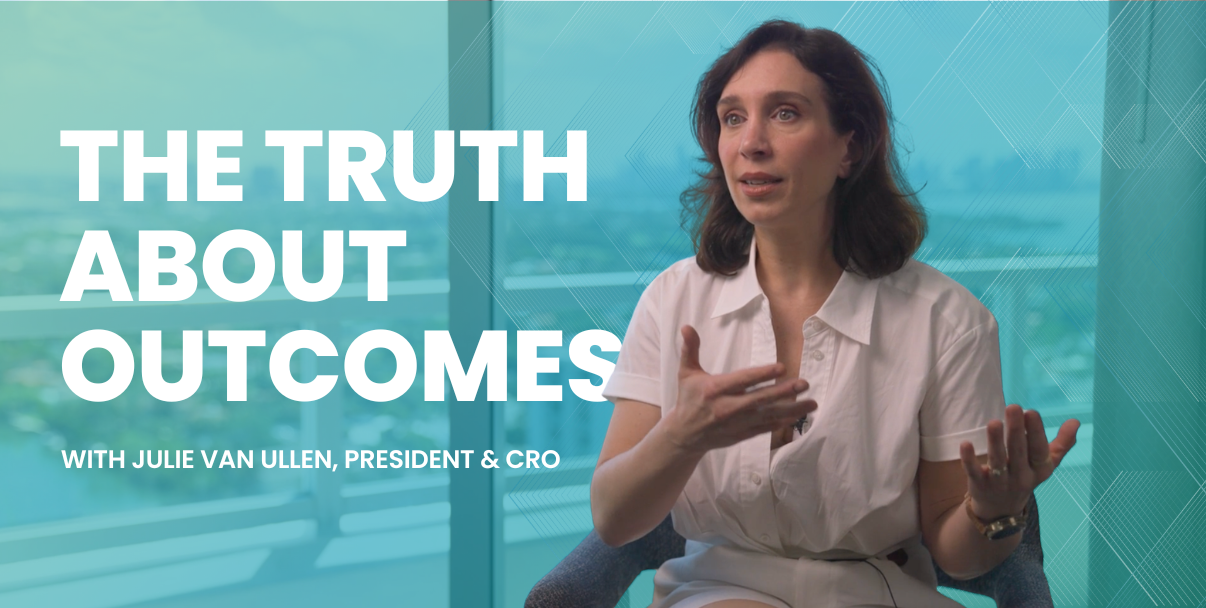
As the television landscape continues to evolve rapidly with linear, streaming and social video, outcomes and optimization have quickly become all the rage. We sat down with iSpot President and CRO Julie Van Ullen to discuss the importance of understanding outcomes, new currencies, and more in a fragmented media landscape.
Julie spoke directly to the importance for marketers to understand the differentiation between true outcomes – something iSpot is alone measuring in the market – and search signals. She also touches on the value of understanding different currencies and how iSpot SAGE is unique from other chatbots, built on decades of creative metadata and allowing users to understand this data with simple language.
Watch the interview with iSpot President & CRO, Julie Van Ullen. Full transcript below.
Everyone’s talking about outcome measurement. Where does that iSpot sit in all this?
Julie Van Ullen: When you think about outcomes and how iSpot differentiates itself from signal, you have to really understand what an outcome is. If you ask a marketer what an outcome is, I think most of them would answer that it is the inevitability of getting to or an effective sale or in-store visit. Now, those things don’t necessarily happen on the back of every ad.
In order to understand real outcomes and action on them, we need to understand the impact and effectiveness of the creative – all the way through the media and audience strategy. Some of the challenges and complexity in the outcome marketplace today are walled gardens which are effectively grading their own homework.
It’s hard to know how much you can rely on what’s happening there or how duplicated that might be with some of your other investments. Beyond that, there are a lot of point solutions that market themselves as outcome based companies that are really just noise. Say for example, search spikes – an interesting signal, a linear specific signal. But it’s just one signal in a greater landscape of a marketer really needing to understand what’s happening with their creative, their audiences, and how that’s transforming into outcomes, and then what to do with that, how to act on that data in real time.
iSpot has been garnering more than decades worth of data in the creative and the audience space. We are able to do the first and initial very hard work of measuring the ads properly in the first place. That’s the first step to proper outcome measurement anyway.
For example, how did the creative work? How did the targeting and demographic targeting work along with the creative? And what did that produce?
Once you can do that and you have all of that data, then–whether it’s through pixel integrations, first party integrations with the brands themselves, or third party data integrations to understand things like offline sales–we are then able to make those connections real.
We are able to make them scaled. We work with over 400 brands, with every publisher and platform in the market, so they are able to not only understand how it is working for them, but also how it is working for their competitors and how they adjust their strategies in real time.
That is fundamentally the real definition of outcomes and something that iSpot alone is doing in the market.
There’s a lot of talk about new currencies. How is iSpot thinking about currency today?
JVA: Currency in the television marketplace is an interesting topic and something that’s top of mind for us. And like everything, I try to simplify. If I think about currency and what that has meant to the television industry for a very long time, it has been about program level currency.
It’s been buying shows and how much reach those shows have with certain demographics, which speaks, unfortunately, very little to the impact of the ads and the ad performance within those shows. When we think about currency and alternative currency providers, obviously Nielsen has been a big player in that game.
VideoAmp is another big player in that game as an alternative currency–not really something that iSpot is terribly interested in. And I’ll tell you why. Fundamentally, what matters to us and what has always mattered to us is how the ad spot itself performs. What makes that particularly interesting is how well that jibes with impression-level measurement.
As we move more towards streaming, we have a more of a digitized approach to measurement. If you want to call us the currency of anything, we would maybe proudly call ourselves the currency of ad effectiveness. Because when you are a partner like us who works with so many brands–over 400 brands–that depth, that scale of understanding, and the trust that those brands put in us to understand how their ad spots are performing.
To me, that becomes a currency, but a very different type of currency than what we traditionally think about when we talk about alternative currency.
Talk to me about SAGE. What is iSpot’s position when it comes to AI?
JVA: Our AI platform is called SAGE. It’s a super purposeful name. We called it SAGE because a SAGE person is somebody who knows all. It is a person that you can turn to for trustworthy intelligence. And iSpot approaches the AI landscape exactly the way I think intelligent companies are because, truthfully, anybody can create a chatbot.
AI chatbots are a dime a dozen. What matters with AI is the data that sits behind it. That is why I’m here with iSpot today. I’m so incredibly passionate about the treasure trove and the decade’s worth of creative metadata. I’m also so passionate about the audience performance data across linear and streaming that then feeds this AI machine to help brands understand not only how their own ads are working, but also how their competitors’ ads have been working in market, how their investments have been akin-to or dissimilar-to, dependent on what their strategy may be with their industry at large, or with people that might not even be considered competitors who they just think are doing really cool things.
AI for iSpot does something really special, which is to take data that otherwise would have been very hard to query, and makes it easy for anyone to have a conversation with and understand what has been working for their brand. It gives them suggestions for how they could change their creative or how they could change their media investment strategy.
In tandem, what works for certain demos? What doesn’t? Where have your competitors been investing in the last 60 days, two years, three years? Whatever you want to know. It has been collecting that data for so long, and you can get that answer to help you learn from your own successes or failures, learn from the successes and failures of your competitors, and put something really unique into the market that hits the nail on the head.