OpenAI has reached a significant leadership transition as Kate Rouch steps down from her role as Chief Marketing Officer to focus on her health recovery. Gary Briggs, the former CMO of Meta, returns to the company as interim CMO to lead the department and recruit a permanent successor.
Despite aggressive advertising efforts, including back-to-back Super Bowl appearances, OpenAI’s creative has faced a common “AI paradox.” While tools like ChatGPT and other AI engines are designed to be revolutionary, many early ads struggled to resonate with human consumers, at times missing key advertising best practices. However, recent efforts such as ChatGPT’s “Family Farm” :30 spot indicate a strategic shift toward more grounded, emotional storytelling that frames AI as a “co-creator” in relatable “everyday magic moments”.
Here’s what iSpot’s Creative Assessment platform revealed on actual viewer response to the spot.
The Details:
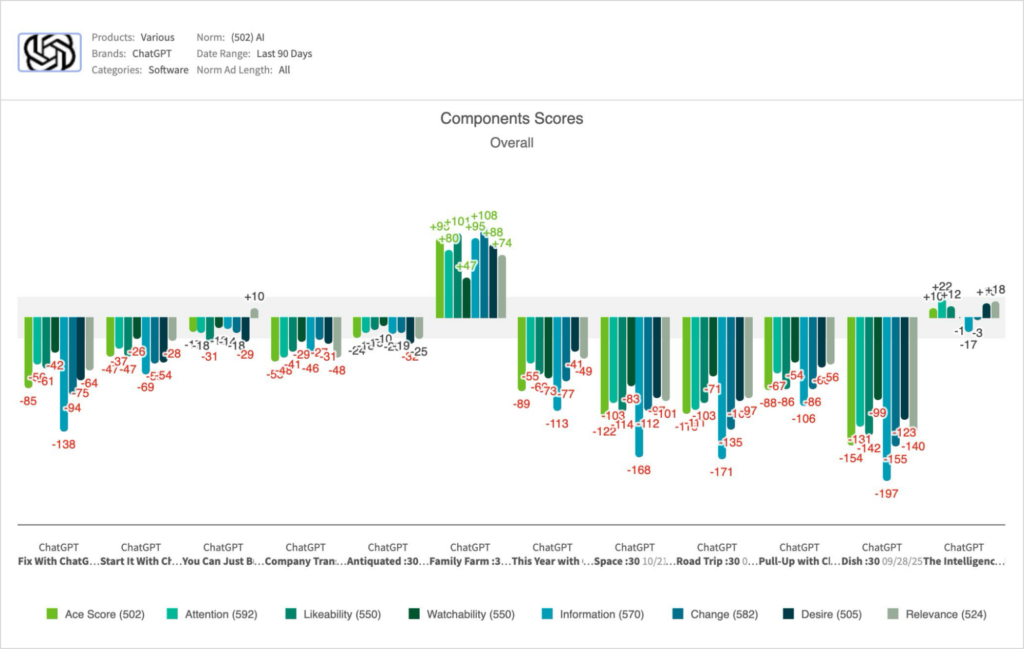
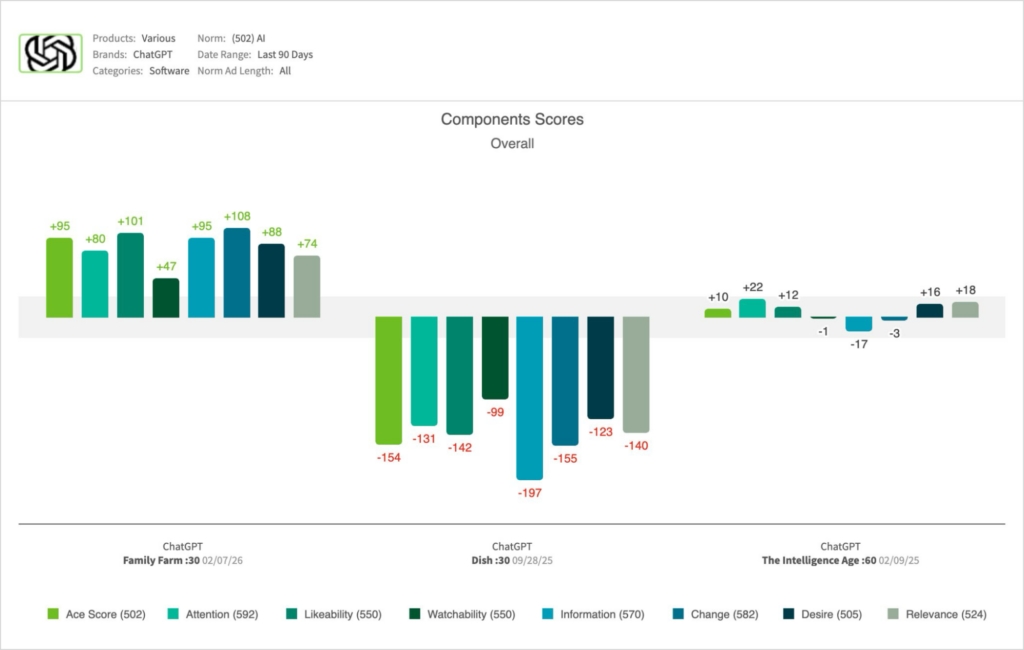
- iSpot has human-tested twelve of ChatGPT’s ads between the 2025 Super Bowl and February 15, 2026, and just one (“Family Farm”) outperformed the most recent 90-day benchmark for AI software ads, and one delivered normative performance (2025 Super Bowl’s “The Intelligence Age”). The rest underperformed category norms with actual consumers (most by a wide margin):
- ChatGPT ads are arrayed by air date (most recent first) in the top chart below, and scores are indexed to AI software category norms (90-days).
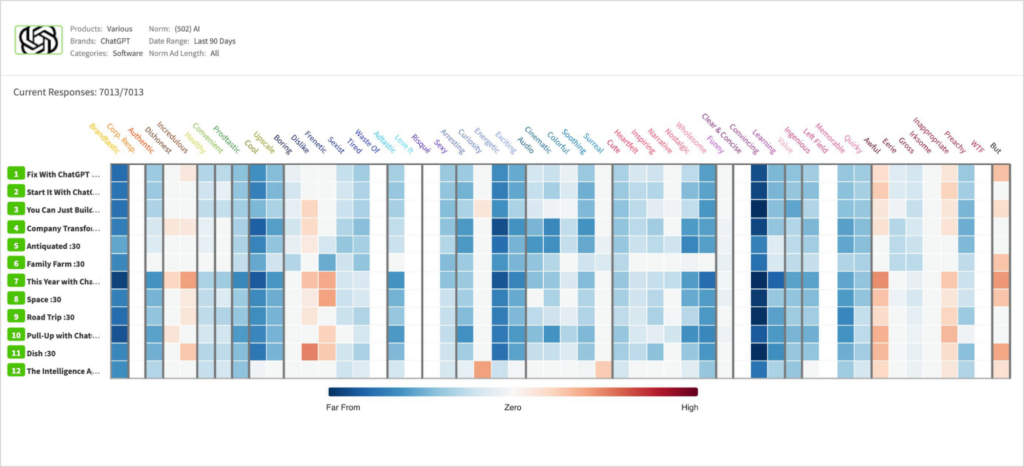
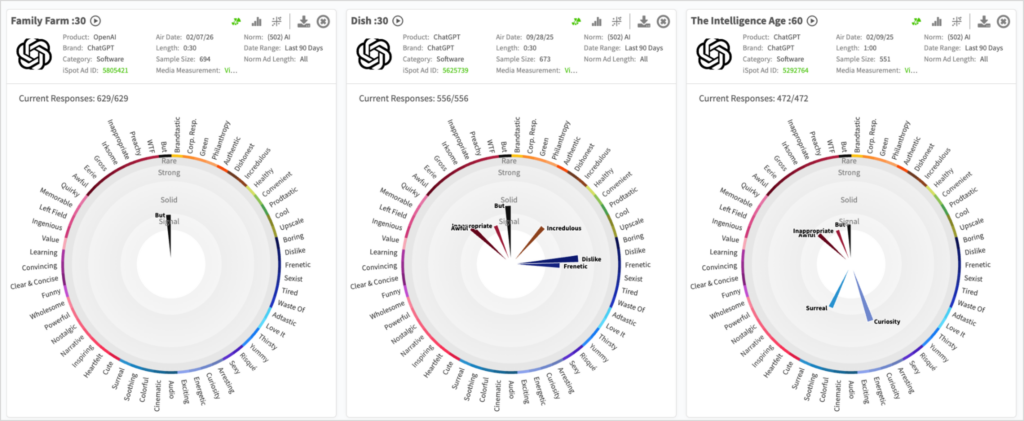
- The key sticking point for underperforming ads could be related to the ‘language’ aspect of LLM’s in general in that many of the brand’s ads featured long strings of text superimposed over background graphics, most of it very difficult to see and read – leading to a message and benefit that went undelivered. We consistently see human consumers generally reacting poorly to being required to read large blocks of text in video ads. The audience often perceives this approach as somewhat lazy, unoriginal, or simply frustrating, and sparks negative emotional associations (even if it reflects typical chatbot outputs). iSpot contrasted the emotional profile of ChatGPT’s best-received ad (“Family Farm”) over this time period, lowest-performing ad (“Dish”), and an average ChatGPT ad (“The Intelligence Age”) below.
- While creatives and other industry commentators reacted more positively to these spots, consumer response is based on actual perception among those without industry bias or perspective and is a truer measure of end customer success. As AI becomes better understood (and experienced) by the masses, these perceptions will change so it is key to keep in mind that reactions here reflect the state of mind of consumers at the time the ads originally aired.
- “The Intelligence Age” sparked Curiosity effectively while also achieving breakthrough (Attention and Likeability) and Relevance within the normative range. The storytelling in “Family Farm” easily outpaced performance norms by largely avoiding negative response while the ads performing less successfully featured the small font text scrolls, which consistently evoked negative emotion.
- ChatGPT ads are arrayed by air date (most recent first) in the top chart below, and scores are indexed to AI software category norms (90-days).
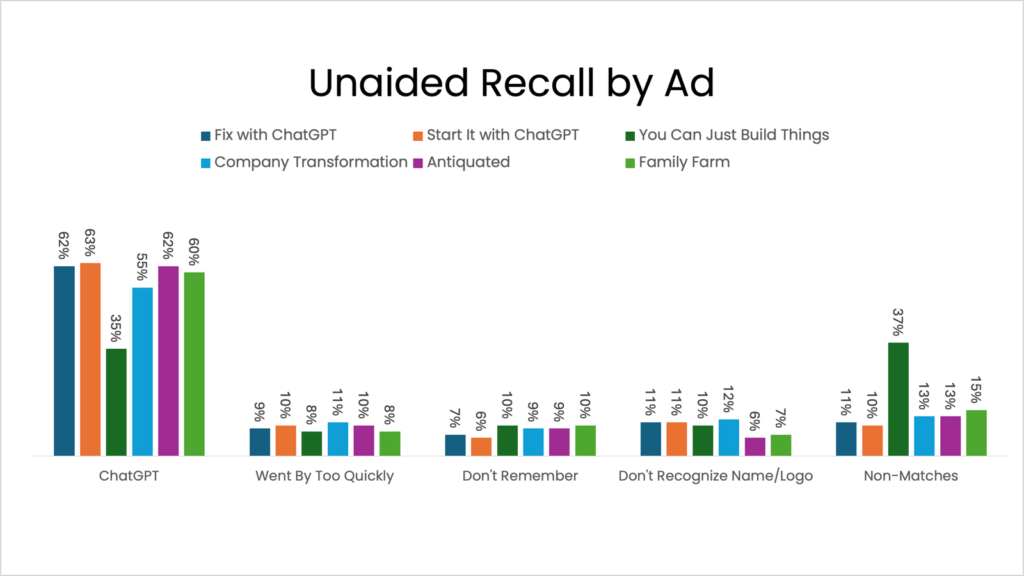
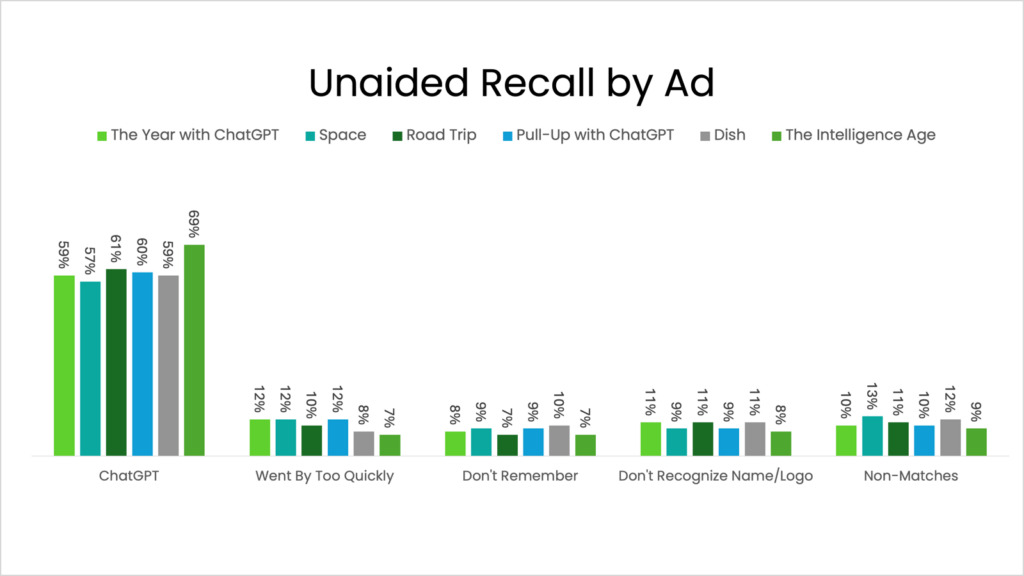
- Branding clarity resulted in the strongest recall among viewers of the 2025 Super Bowl spot, “The Intelligence Age,” which saw 69% recall ChatGPT on an unaided basis, and met the 70% benchmark set by all AI software ads over the period:
- The 2026 Big Game spot, “You Can Just Build Things” saw more non-matches as a portion of viewers recalled the Codex brand.
- Most other ChatGPT ads did not cement the brand as successfully as the average category spot – a softness the brand can address in forward creative. More plentiful and earlier branding instances, a variety of branding devices, and longer on-screen presence are all options that would support consumer retention.
- The 2026 Big Game spot, “You Can Just Build Things” saw more non-matches as a portion of viewers recalled the Codex brand.
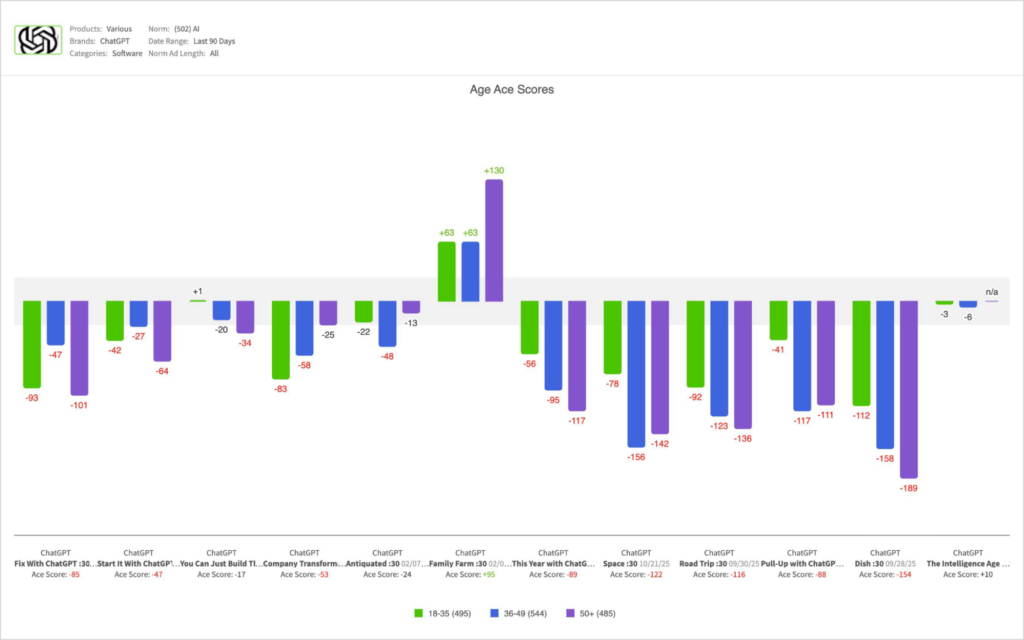
- Age of viewer did not move any of the ads significantly from positive to negative territory or vice versa, signaling a universal issue for consumers viewing the ChatGPT spots so far:
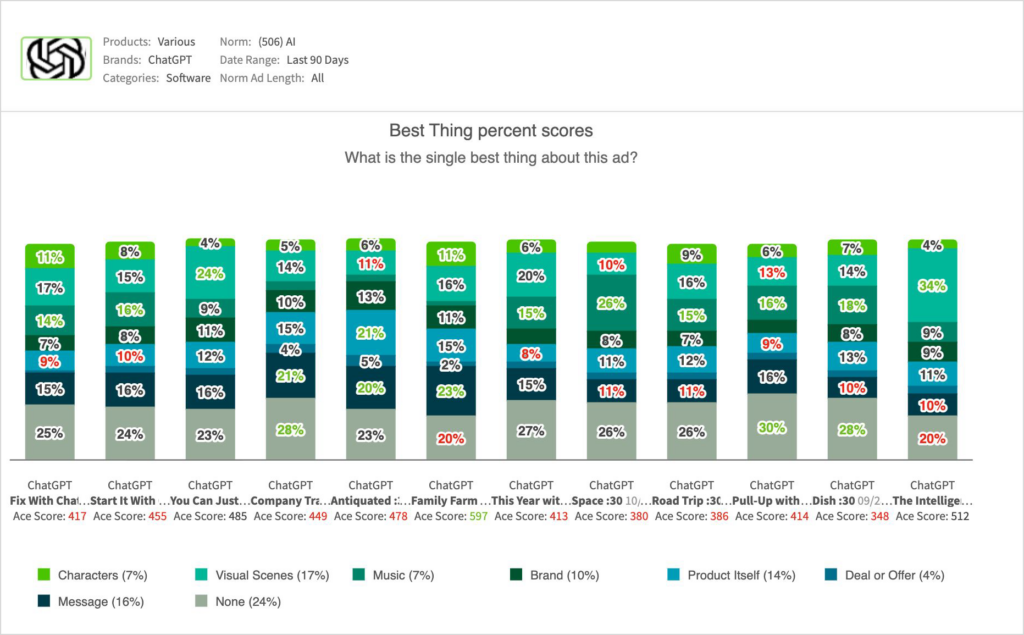
- When asked to name the Single Best Thing about each spot (each ad was tested with a unique live sample of at least 500 individuals at the time of launch), seven spots saw 25% or more of all viewers select “none” – underscoring the disconnect.
- “Family Farm” achieved success through a message that viewers recognized and characters that engaged, while both Super Bowl ads relied on visuals more than the average AI software spot (with the 2025 ad finding more success).
- When asked to name the Single Best Thing about each spot (each ad was tested with a unique live sample of at least 500 individuals at the time of launch), seven spots saw 25% or more of all viewers select “none” – underscoring the disconnect.
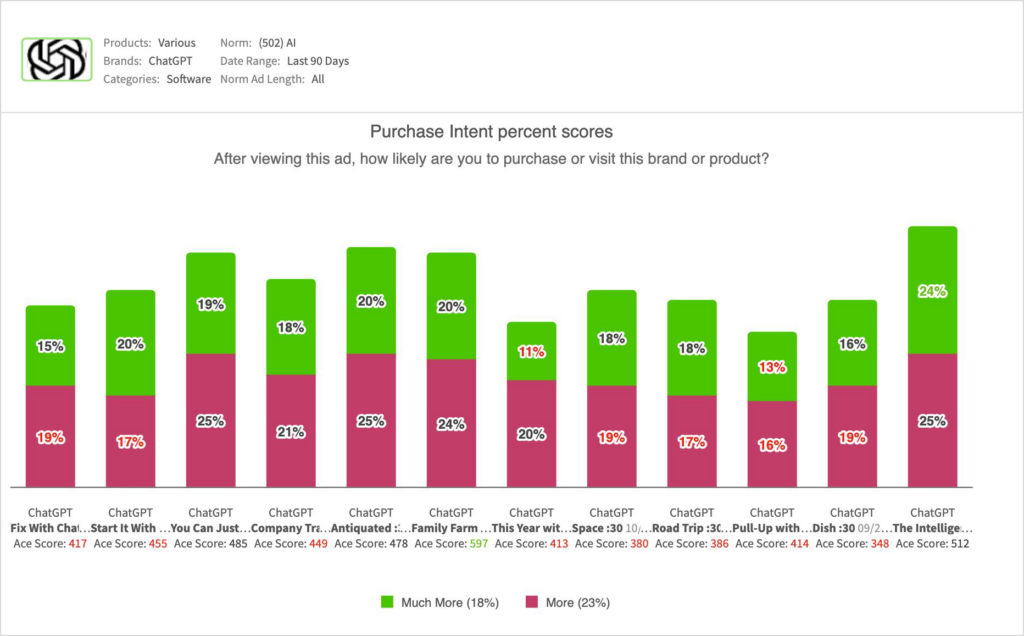
- Persuasive ability also varied across the ads, with “The Intelligence Age” convincing the largest proportion of viewers to purchase/visit, at an above-norm 49% more/much more likely (benchmark at 41%):
- The text scroll ads were consistently less successful in encouraging further consideration among consumers; another indication of the issues viewers had with these executions. There is a clear opportunity for a fresh campaign with strong branding clarity and creatives that offer both information and ease of comprehension (and fewer to no scrolling text).
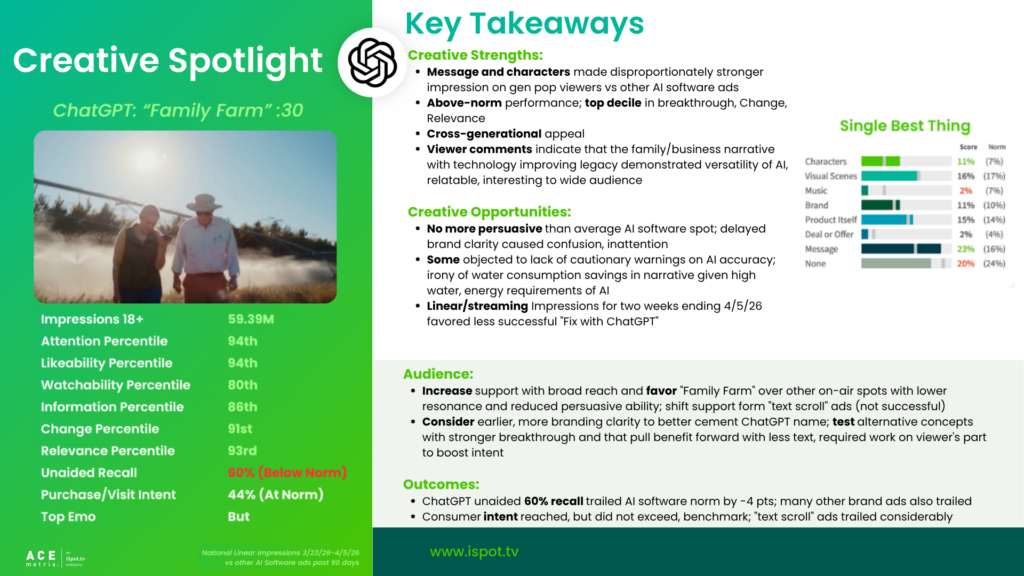
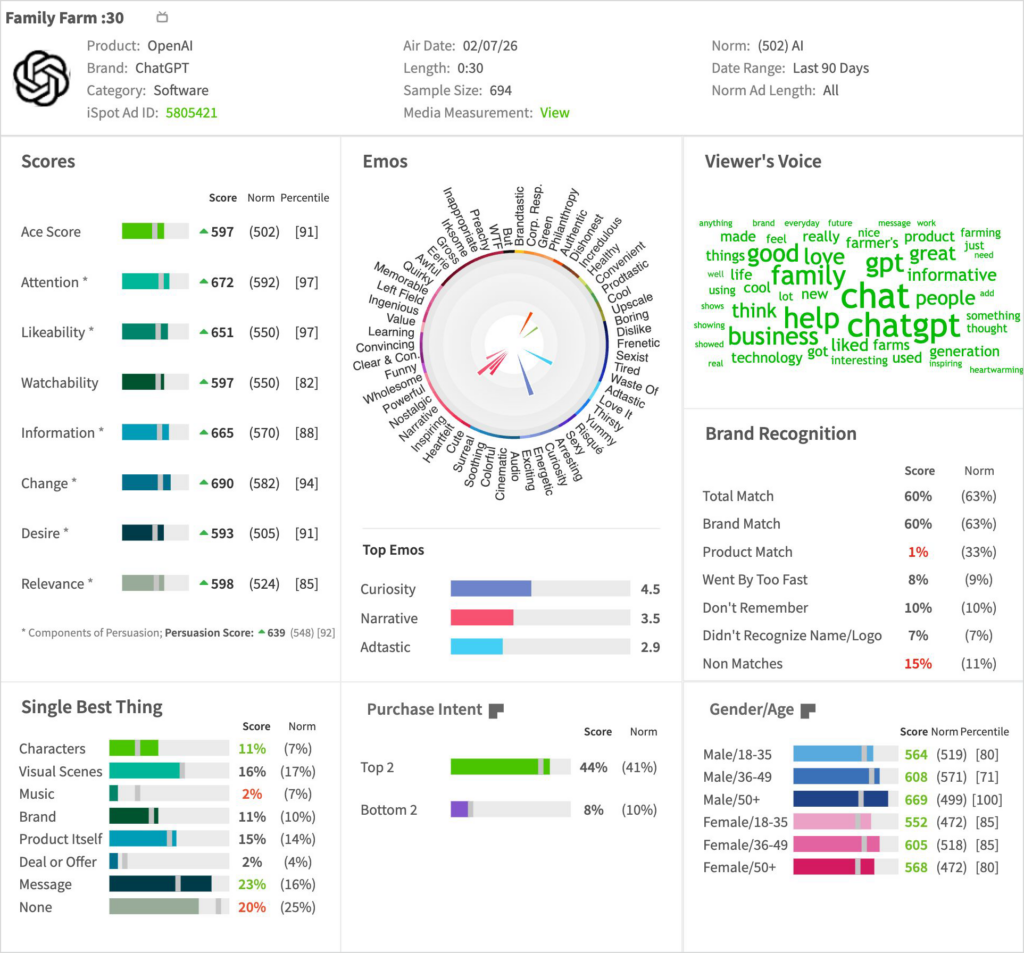
- Recognizing that graphics displaying twelve ads at once can offer less ease in interpretation, below is a summary of the “Family Farm” results, which is how ad-by-ad data presentation appears in iSpot’s UI:
- Open-end verbatim comments are collected from viewers of each ad as well, providing key insights into the why’s behind quantitative results.
- Sentiment on “Family Farm” indicates that this spot successfully demonstrated ChatGPT’s versatility and created emotional resonance through family storytelling that lent easy relatability. The unexpected context expanded some perceptions of the product’s utility. The family legacy/business meets modern tools strategy has potential and could effectively expand ChatGPT’s perceived audience beyond tech-savvy early adopters to mainstream small business owners.
- However, some refinement on environmental messaging might be considered given that sophisticated viewers immediately flagged this as contradictory. Multiple viewers identified the irony of the daughter asking ChatGPT about water conservation while AI data centers consume massive amounts of water and energy.
- The delayed brand reveal was a double-edged sword. While some appreciated the surprise, others tuned out before understanding the message. Some more knowledgeable viewers expressed concerns around AI hallucinations in relation to important (and expensive) business decisions – and especially without accuracy warnings.
- Of course, a smaller segment of viewers simply opposed AI categorically, regardless of the creative execution.
- Open-end verbatim comments are collected from viewers of each ad as well, providing key insights into the why’s behind quantitative results.
Sample comments on the “Family Farm” :30
“I loved this ad. I loved that it showed exactly how the product can be used and how it applies to everyday people and their future and I love that it was about a family business.”
Female 18-35
“I understand where the message was coming from with this ad. I like how they incorporated real life situations to use ChatGPT in. Other than that, it really did not relate to me. I don’t understand any farming terminology, or why you wouldn’t be able to figure that out without the help of ChatGPT, but I’m sure AI made whatever problem they were solving a lot easier, which I can relate to.”
Male 18-35
“I think it’s ironic how she asked how much water she is using on her farm. Meanwhile AI data centers use millions of gallons of water just to answer that question.”
Female 18-35
“I am totally in agreement with this ad. AI technology is going to revolutionize the way we work and how we work, but not the fact that we will work.”
Male 18-35
“It’s really cool that AI can do all that stuff. This ad framed it in a way that makes it seem approachable and relatable to real people (not that I run a farm).”
Female 36-49
“The ad itself is fine, but I personally dislike all AI products. The concept of bringing AI into a family-run FARM when AI damages the environment is especially disappointing to me.”
Female 18-35
“The ad is okay. I do appreciate the feature of the farmer’s family and the focus on their work. However, AI is known to have significant hallucinations, even when you consider the specific voice chat prompts given to ChatGPT in this advertisement, I could easily envision ChatGPT giving some false statements regarding the tasks it’s being prompted to do. So as someone who is familiar with the use of the product, it feels almost disingenuous to advertise to people who don’t know this and would be led to believe by this messaging that the product would truly be able to deliver on what is being shown. Of course, it could deliver 80% of the time probably, but still there would be less of a reaction for me personally if the ad was focused on an area of life that feels less serious.”
Male 18-35
“The story featured in the ad is sweet enough, but then you remember what it’s for. The irony of an AI company doing an ad with a backdrop of the environment and whatever that one part was about ‘water usage’ is not lost on me. AI will ruin us.”
Female 18-35
“Good way of getting customers outside of the tech scene to use and enjoy ChatGPT. However, bringing up water usage in your ad when most of us know how much water it takes to cool the units is brave. Maybe even a bit arrogant.”
Male 36-49
“I don’t like the convergent use in farming with something so environmentally harmful as ChatGPT. It seeks to try to compromise both ideas, but it is contradictory because there could be more reform in protecting farmland and local practices and prioritizing environmental concerns such as water conservation. The two kinds of concepts should not be used together, even if the creators tried to expand the usage of their platform.”
Female 18-35
“I thought it was a good ad. It lets people know some of the things that AI can do. And that it can help regular people with their work.”
Male 50+
“Showing one generation stepping in to take over and using the new technology of the world to build from what her family has done…very inspiring!”
Male 36-49
“It’s nice that AI can be used to assist people with their daily lives, especially with jobs, however, it seems that there’s not enough warning regarding how accurate the responses that come from AI are.”
Male 18-35
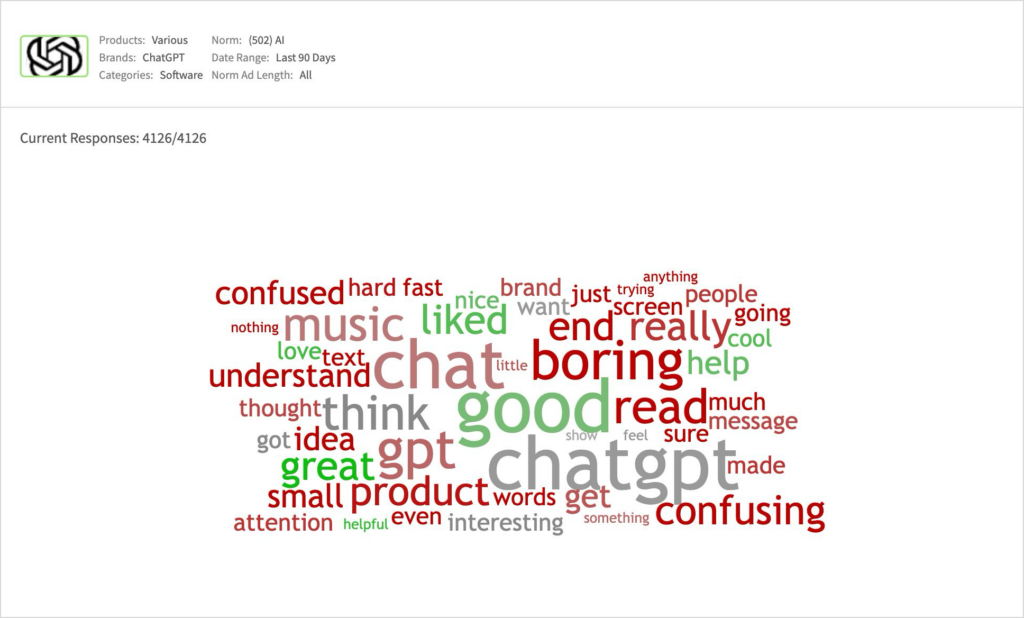
- In contrast, sentiment on the text scroll ads (combined) is represented in the below word cloud where the size of the word indicates frequency of the concept in viewer verbatims and the color represents overall response to the ad by the viewer expressing that sentiment (red being below-norm and green, above-norm):
- This commentary reflects the boredom and confusion many consumers felt while watching the creatives.
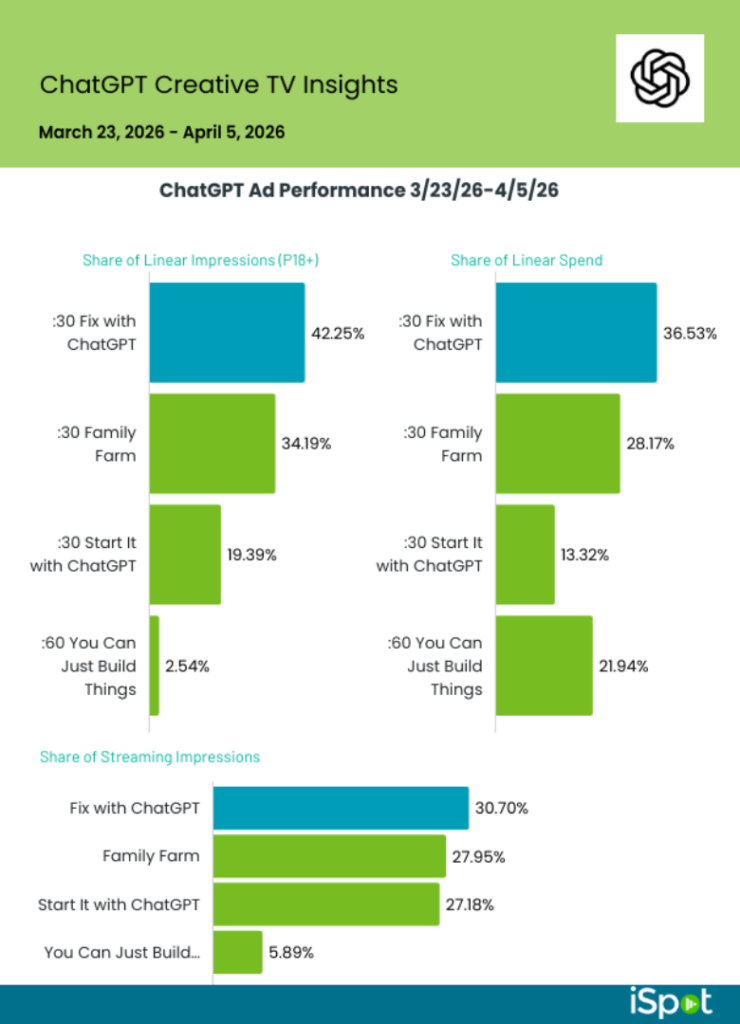
- iSpot Media Measurement reports the majority of national linear Impressions over the two weeks ending 4/5/26 being allocated to “Family Farm” as well as two other ads that were far less resonant and persuasive with viewers:
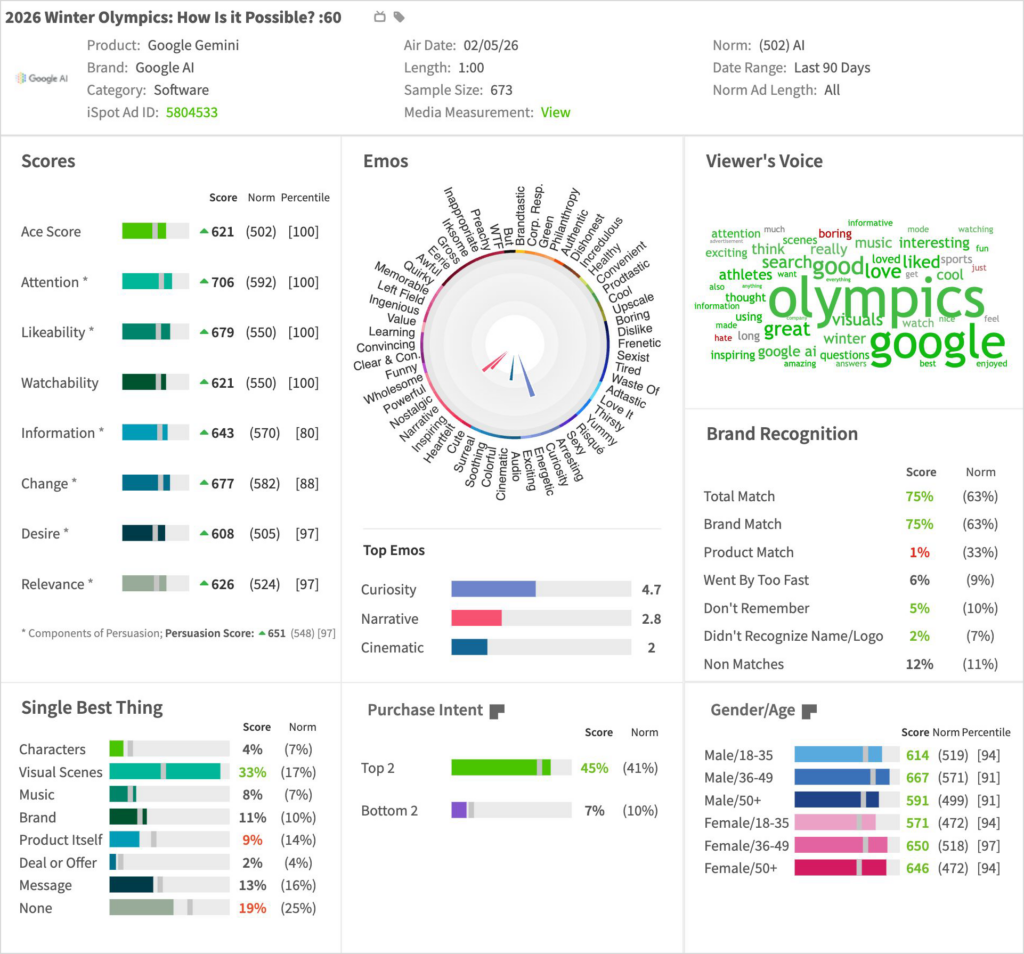
- The best-received AI software ad of the past 90 days was a Google Gemini :60 creative that coupled Olympic visuals with accessible, everyday use cases for human interest:
- This spot reached top-decile response within every age/gender segment and sparked Curiosity in a relatable and Likeable – and Attention-getting manner. Viewers signaled a willingness to watch the ad again (Watchability) while also learning something new (Change, Information).
- “Google AI” branding was clear to the audience and the Narrative persuaded an above-norm 45% to consider the brand.
- This spot reached top-decile response within every age/gender segment and sparked Curiosity in a relatable and Likeable – and Attention-getting manner. Viewers signaled a willingness to watch the ad again (Watchability) while also learning something new (Change, Information).
Ineffective creative, even if delivered to the right audience, results in missed opportunity and performance shortfalls. Great creative delivered poorly also results in failed campaigns.
Schedule a demo to find out how your brand can partner with iSpot to quickly solve both challenges simultaneously, delivering high-performing creative while boosting the effectiveness of planning and in-market execution to achieve—and outperform—campaign objectives.
Creative Agency: Droga5