The Super Bowl can be full of surprises, both on and off the field. But some ad trends have withstood the test of time, even as the cost of Big Game airtime climbs each year.
As a result, brands are increasingly following specific playbooks to maximize the impact—and minimize the risks—around these spots.
What can we expect to see this year? Below are a few key ad trends to keep an eye on before kickoff.
Celebrity Showcase
The use of celebrities in ads has emerged as one of the biggest themes across the last 15 Super Bowls.
In 2010, just 31% of Super Bowl ads featured a famous face. Celebrity ads overtook non-celebrity spots in 2018, and hit a high of 78% of ads in 2020, and remained above 65% every year since. This year’s bevy of teasers are loaded celebrities once again, with Kendall Jenner (Fanatics Sportsbook), Emma Stone (Squarespace), Andy Cohen (Nerds) and Bowen Yang (Ritz) leading a lengthy list of pre-game examples.
But does celebrity guarantee Likeability?
In 2017, iSpot Creative Assessment showed that single-celebrity Super Bowl ads actually had a lower average Likeability Score than the overall norm for the game. The gap closed over time, yet embracing celebrity (one or multiple) seems to have limited correlation to how much consumers actually liked ads.
Download iSpot’s Super Bowl LIX Transparency Report for more.
Funny Fuels the Big Game
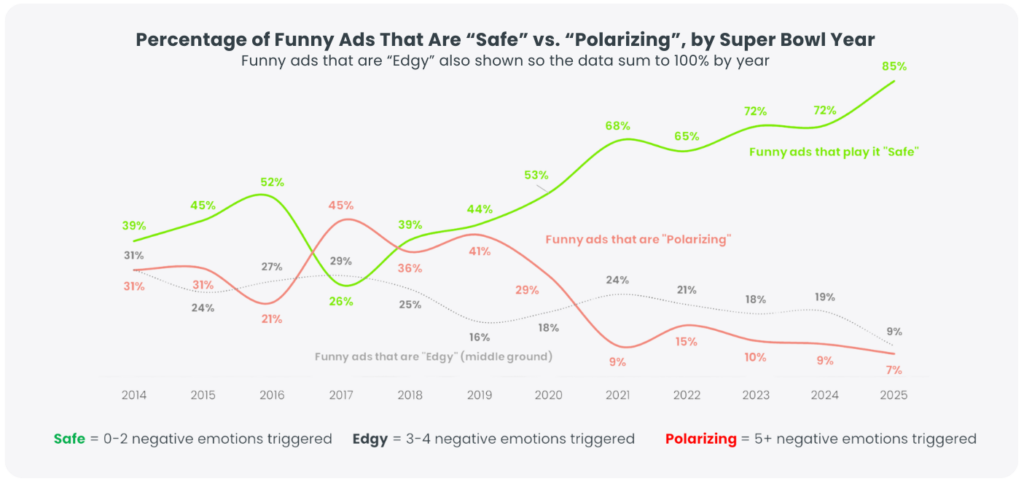
During last year’s Super Bowl, 71% of ads were funny—and more notably, an all-time-high 85% of ads used “safe” humor that was unlikely to rock the boat.
As recently as 2019, 41% of Super Bowl ads were seen to have polarizing humor. Yet last year’s game was just 7%, continuing a sharp decline over the last decade.
During Super Bowl LIX, the funniest ads were all from food and beverage brands, like Doritos, Pringles and Mountain Dew. And as funny ads (safe or not) have grown, heartfelt ads have become less prominent during the game.
Those sentimental spots are no less likeable, though. Last year’s most likeable ad, Pfizer’s “Knockout” actually scored incredibly well for emotions like “heartfelt,” “inspiring” and “narrative.”
Funniest ad of Super Bowl LIX.
Business Outcomes Bowl
“Buy now” has become the name of the game for many Super Bowl advertisers, as food and CPG brands utilize the game’s enormous reach to drive immediate purchases.
During last year’s Super Bowl, industries like candy & snacks, beverages, packaged foods and QSR accounted for 31% of all ad minutes. That was up from 26% in 2024, and these advertisers’ approaches are becoming more centered around specific products instead of simply broad brand awareness.
The recent influx of pharmaceutical ads during the Big Game may also spur even more “buy now” focus, as broad-awareness campaigns for traditionally large industries like automotive have downshifted during the Super Bowl. Those gaps are opening up more space for immediate-purchase brands and tech, among other categories.
Top intent-driving ad of Super Bowl LIX (22% points above category norm).
Leading up to this year’s game, you can check out iSpot’s Ad Center for the latest on Super Bowl ads and teasers. And register for our post-Super Bowl webinar with AdAge and GM where we’ll recap Super Bowl LX ad performance and unveil our new AI platform that forever changes how brands create, measure and optimize video ads.