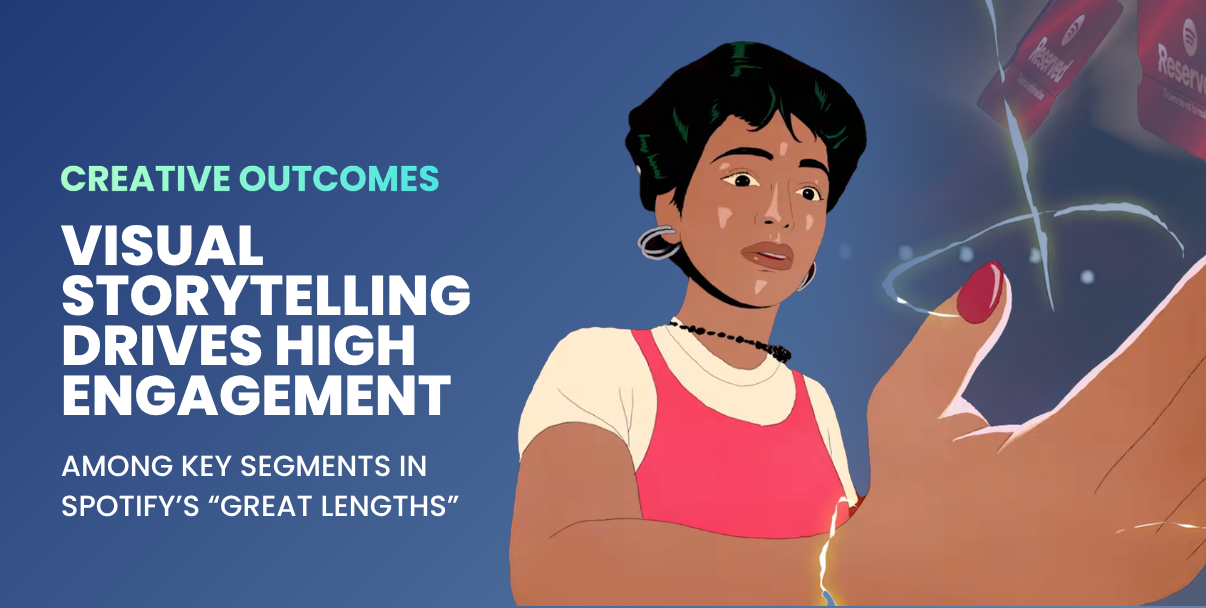
Spotify launched a campaign promoting its Reserved ticketing feature, which gives an artist’s most dedicated followers early access to tour tickets ahead of the general public. The initiative is designed to deepen the bond between artists and their loyal listeners, building on Spotify’s broader role in fueling artist growth and music discovery. The campaign debuted with an initial slate of artist tours, including Rod Wave and Role Model.
At the heart of the campaign is “Great Lengths,” an animated film produced by Remembers and directed by Jocelyn Charles, featuring hand-colored animation, vivid color palettes, and surreal storytelling. The film follows fans going to extreme lengths for tickets—pulling all-nighters, waiting in endless lines, even consulting internet witches—exaggerating today’s concert culture to position Reserved as a smarter, less chaotic path to getting in the door. The campaign is rounded out by an original score from Citizen.
Here’s what iSpot’s Creative Assessment platform revealed on actual viewer response to the spot.
The Details:
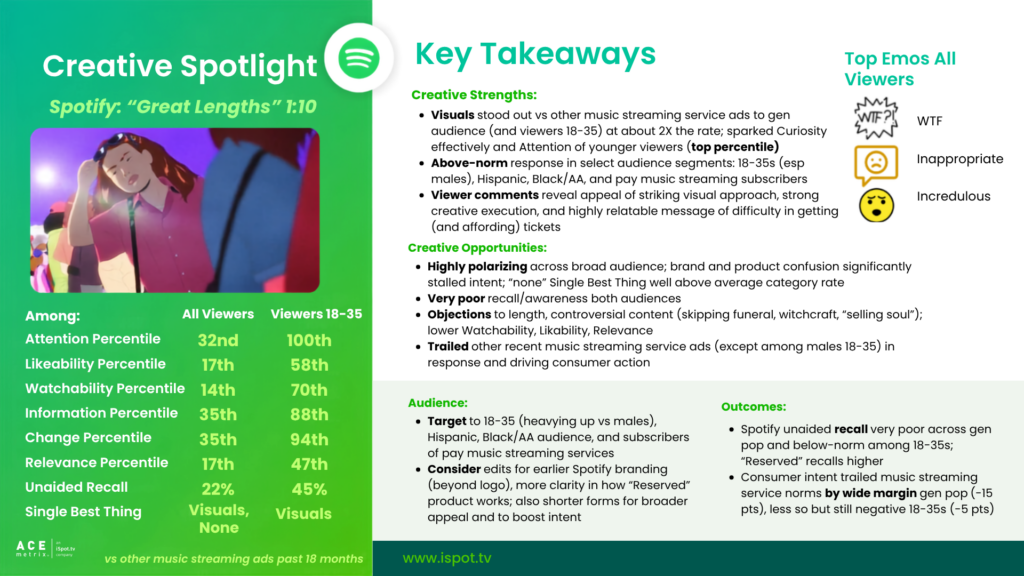
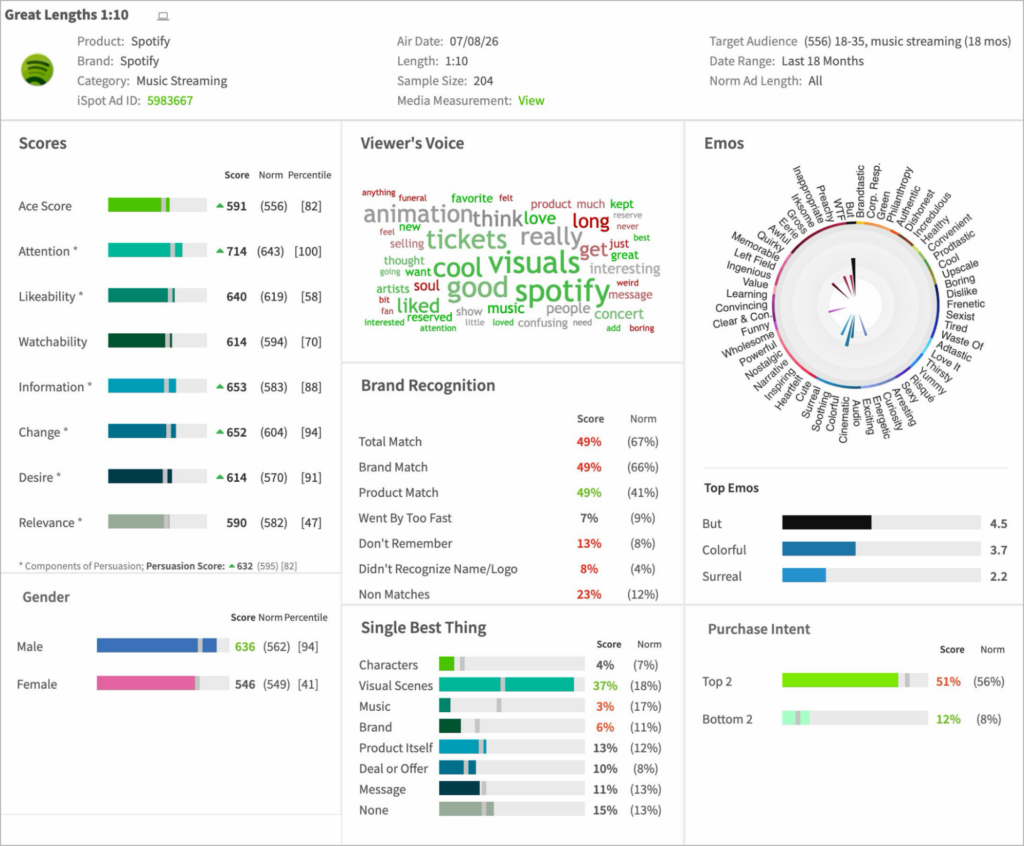
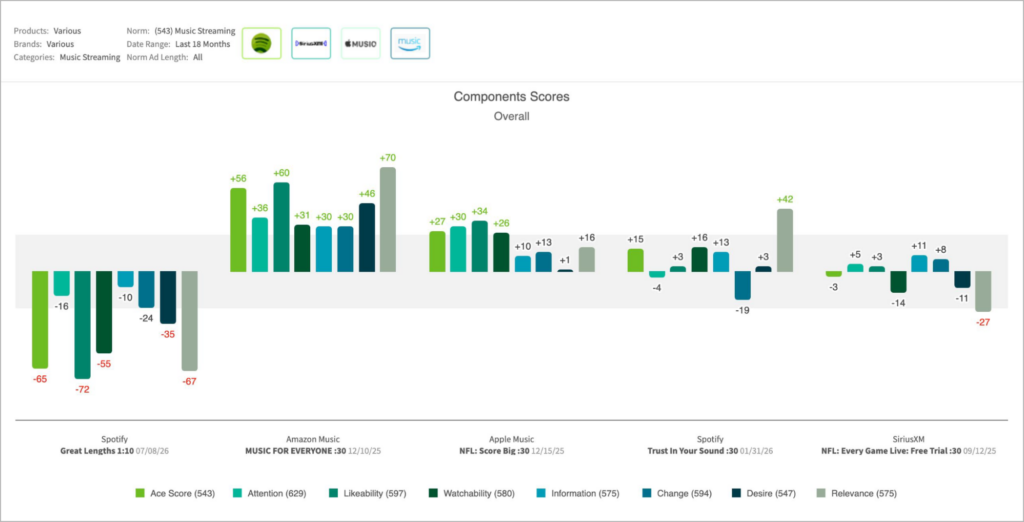
- The :70 “Great Lengths” delivered a fundamentally different result depending on who was watching. Across the full U.S. gen pop audience, overall response landed well below the music streaming category norm (past 18 months)—suggesting media plans target the most receptive segments (discussed further below):
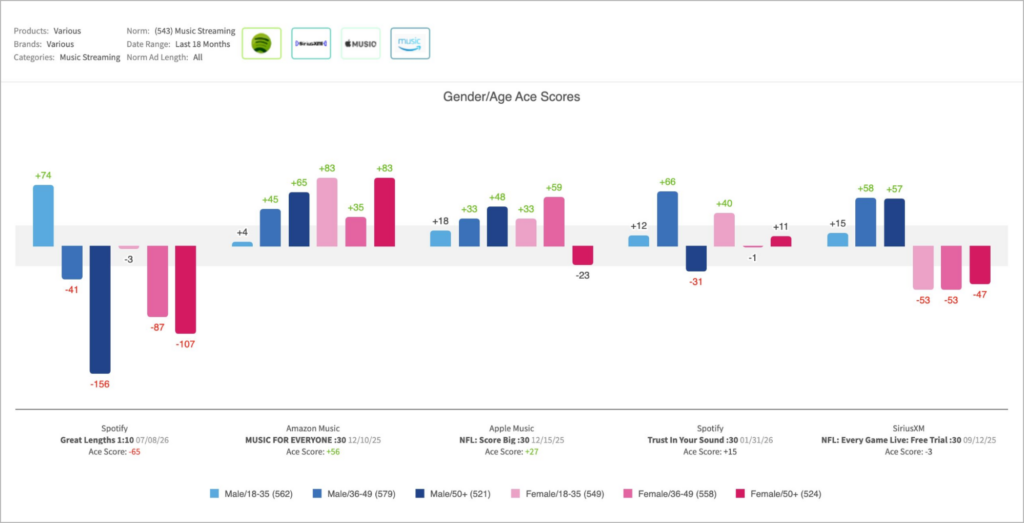
- The spot sparked a polarizing response in the broad audience, with 18-35’s being Spotify’s best audience across age/gender, and males 18-35 an above-norm segment. Reduced Likeability, Watchability, and Relevance reflected this polarity where viewers responded with a ‘love it’ or ‘hate it’ dichotomy.
- Ratings of the ad’s Single Best Thing also reflect the polarization measured, with the visuals standing out at a disproportionately high rate for 30% (nearly double the category benchmark rate), and 29% indicating they found no single aspect of the creative to be a standout element (‘none’ vs an 18% norm).
- Unaided brand recall statistics reveal at least one aspect of this level of viewer disagreement, as only 22% successfully identified Spotify as the advertiser after a full viewing of the spot. Another 22% could not recall a brand or did not recognize the logo while a very high one in two recalled the advertised brand as something else (primarily ‘Reserved’—a clear opportunity to address via quick edits. Textual brand representation and/or audio callouts could be considered here. As is, the Reserved feature is not being consistently linked to Spotify by consumers.
- As is, this spot struggled to convert consumers, with just 34% reporting increased likelihood of visit or purchase, vs a music streaming norm of 49% (-15 pts).
- The spot sparked a polarizing response in the broad audience, with 18-35’s being Spotify’s best audience across age/gender, and males 18-35 an above-norm segment. Reduced Likeability, Watchability, and Relevance reflected this polarity where viewers responded with a ‘love it’ or ‘hate it’ dichotomy.
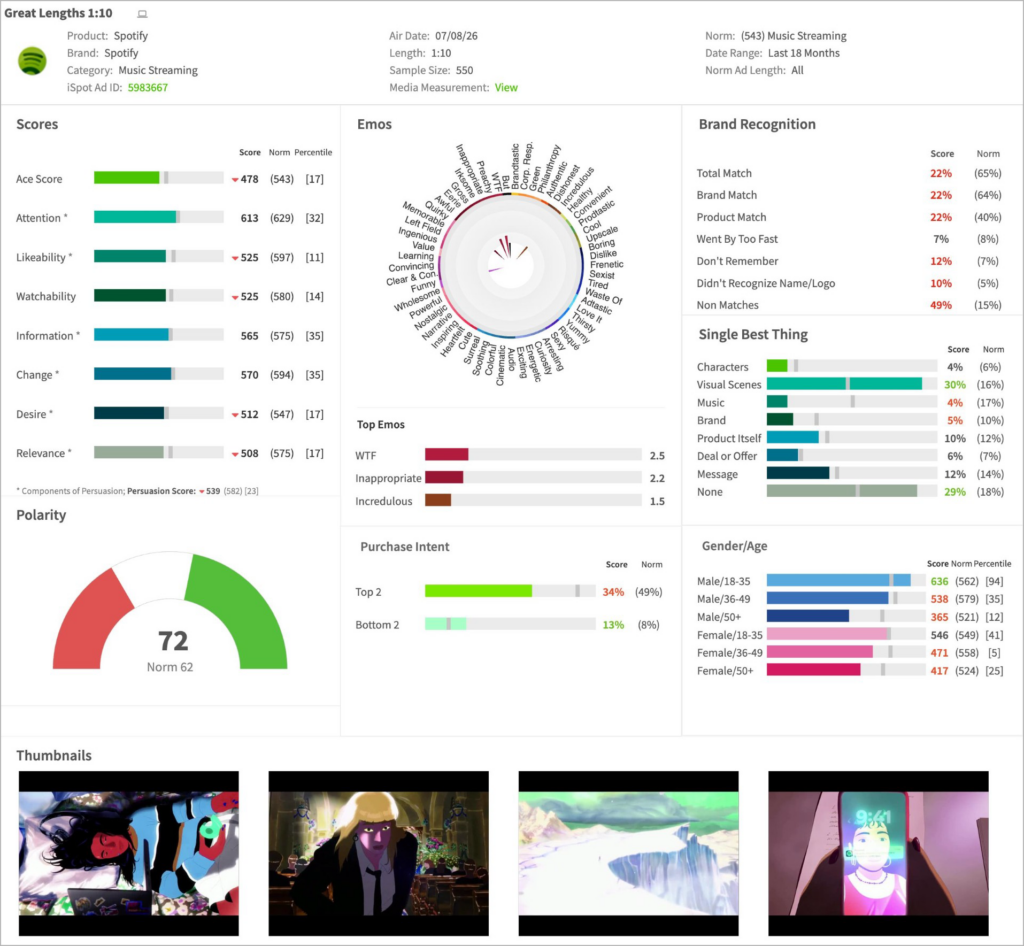
- Emotional profiling of viewer verbatims on the :70 ad reveal several sources of viewer consternation within the full gen pop audience:
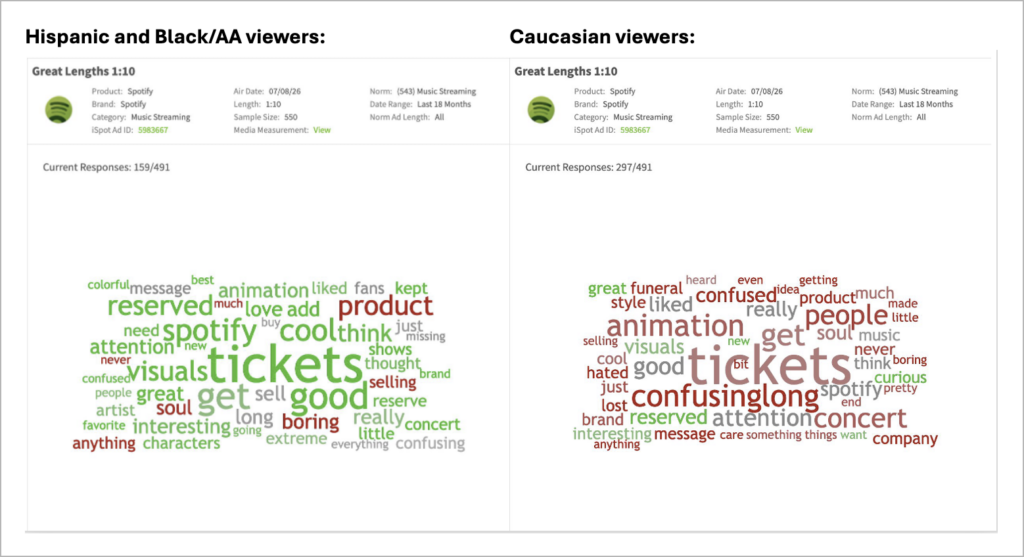
- The longer length felt arduous for some viewers, particularly those that could not decipher what the spot was actually advertising. High levels of confusion were seen, sparking negative-leaning emotional responses (WTF, Inappropriate, Waste of time)—about what was being advertised, what Reserved does, or how it works or relates to Spotify.
- Curiosity was also sparked by the Surreal visuals but the strong creative execution was undermined by content choices that alienated some audience segments. References to “selling your soul,” witchcraft, missing grandmother’s funeral, and dark/occult imagery generated negative reactions (even if intended to be hyperbolic).
- The stunning visual approach and core insight (ticket access is frustrating) resonated well, but controversial scenarios and unclear messaging reduced effectiveness. As such, there is opportunity for shorter form(s) that eliminate the more controversial content, enhance branding and do so earlier, and clarify the product proposition if a broad audience approach is desired.
- The longer length felt arduous for some viewers, particularly those that could not decipher what the spot was actually advertising. High levels of confusion were seen, sparking negative-leaning emotional responses (WTF, Inappropriate, Waste of time)—about what was being advertised, what Reserved does, or how it works or relates to Spotify.
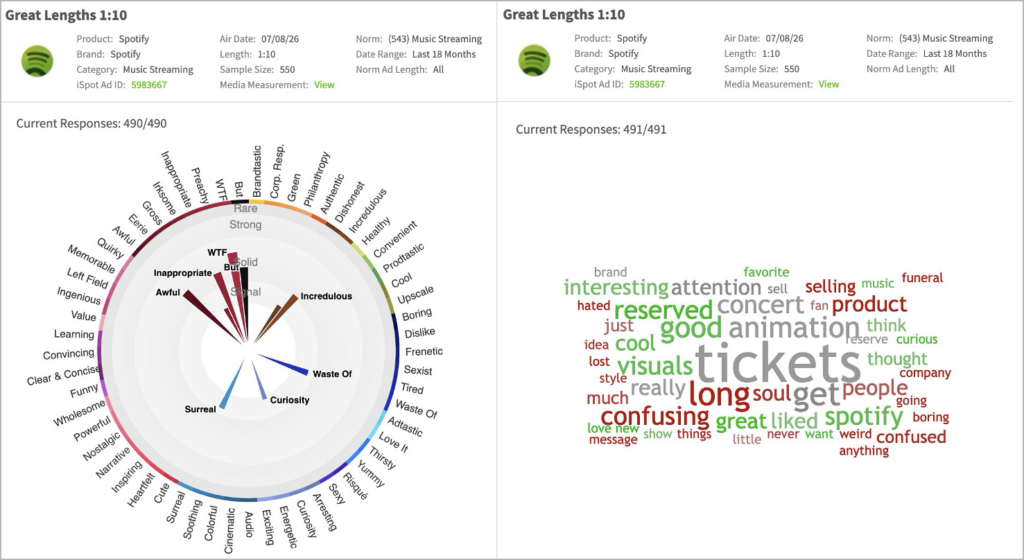
Sample comments on the “Great Lengths” :70
“I liked how it mentions relatable thoughts and had laughable moments with the extreme building and soft relief when revealing the product. I’ve seen a similar ad and thought it was good marketing then as well. Although, some of the scenarios like selling your hair or missing the funeral were odd since it’s out of the ordinary to do both.”
Female 18-35
“I can relate to this ad. Because sometimes I’d do anything to go to a concert like the characters in the ad I too need a way to pay. The ad itself was fresh and new. I don’t usually see ads this unique.”
Male 18-35
“Absolutely ticket prices are so high! I’d definitely be interested in this However, I do not like the witchy stuff as much, or selling souls. I think it paints it in a dark light (especially if you want Christian’s to not feel left out).”
Female 18-35
“Definitely interesting. I feel like what Reserved actually is was lost in the messaging though. Is it a Ticketmaster type deal?”
Male 36-49
“I hated the things fans said they would do to get tickets, and some of the imagery was gross (like taping eyeballs and living in hell). Also, is this a Spotify thing? It had the logo. But if this is real, that’s an amazing service, even if it shouldn’t be necessary because every ticket seller should be fixing the bot issue.”
Female 36-49
“Way too long. There didn’t need to be so many examples, it could’ve arrived at the point much sooner.”
Female 18-35
“I did not like this ad at all, some of the scenes were creepy and saying things like I’d consult my witches or I’d sell my soul are extremely horrendous.”
Female 36-49
“I thought that the ad was entertaining and that I could totally relate when it comes to buying tickets for a concert.”
Female 50+
“I thought it was a really good ad. The visuals were incredible and stunning and the whole thing was cool.”
Male 18-35
“It got me curious as to what it was and I’m still not really sure what it is.”
Female 18-35
“You had me until the “ I’d sell my soul” – you diminished your image in my eyes. I will never use your product because of that 1 part of the ad.”
Male 36-49
“Don’t get me wrong I love Spotify and really like the animation and this new product but the message seems off. It seems a bit dramatic and realistically this makes me feel like less of an avid fan bc i would do none of these.”
Female 18-35
“Excellent and catchy, waiting for the next scene, curious what it was all about. Holds attention.”
Female 50+
“Not a fan of this ad. Animation was decent, a lot of spiritualistic references, (eg. contacting the dead, selling souls to the devil). The importance of the person being able to obtain the tickets on this site could have been executed in other attention grabbing ways.”
Male 50+
“It looked like a mix between light and dark. It started with a light vibe, then around the woman with a laptop, it got pretty dark. Back to light, then somebody was selling their soul. I thought it was quite interesting, a balance of life if you will.”
Male 36-49
“The ad was almost over before I knew who it was for. Spent a long time, repeating the same thought over and over I would have liked to have heard more about the company itself.”
Male 50+
“I liked the different scenarios people would go through for a concert, the visuals were cool, and the voiceovers were easy to understand. The ad was long though, and I was getting bored during it.”
Female 18-35
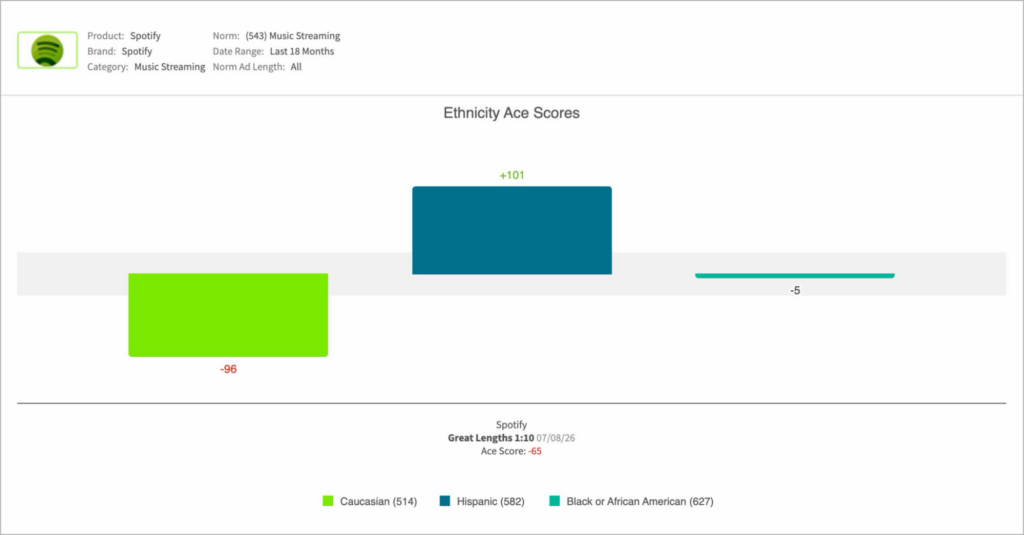
- Hispanic viewers were strongly positive (+101 pts above-norm for this segment), while Black/African American respondents landed at-norm:
- “Great Lengths” missed with Caucasian viewers (-96 pts vs. norm). Media targeting should therefore lean into the Hispanic-audience strength (Black/AA also workable) rather than treating this as a one-size-fits-all buy.
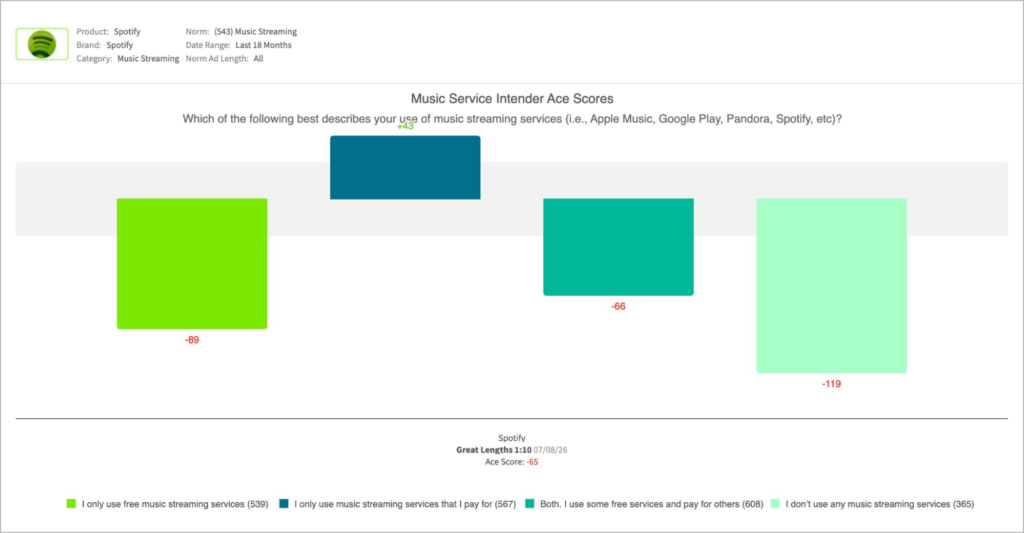
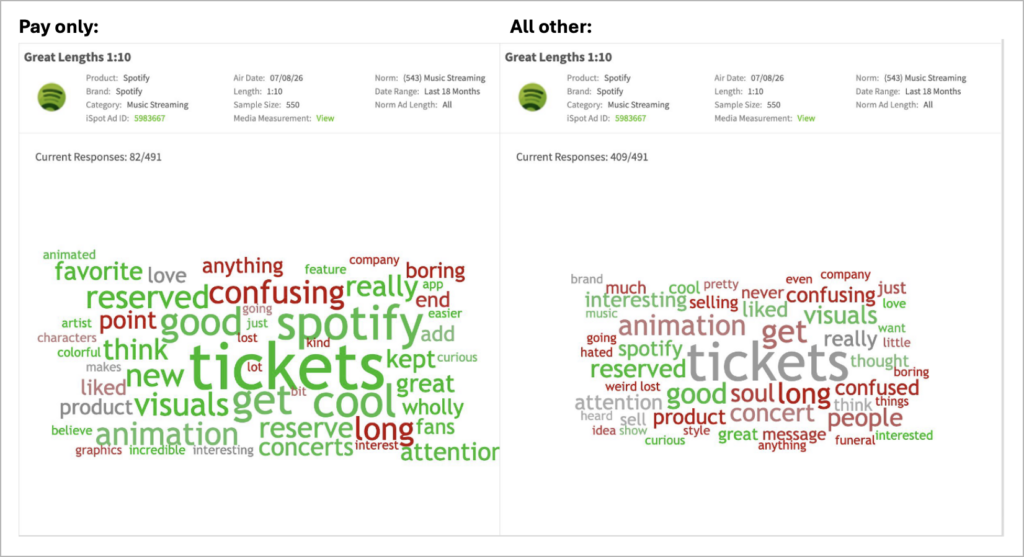
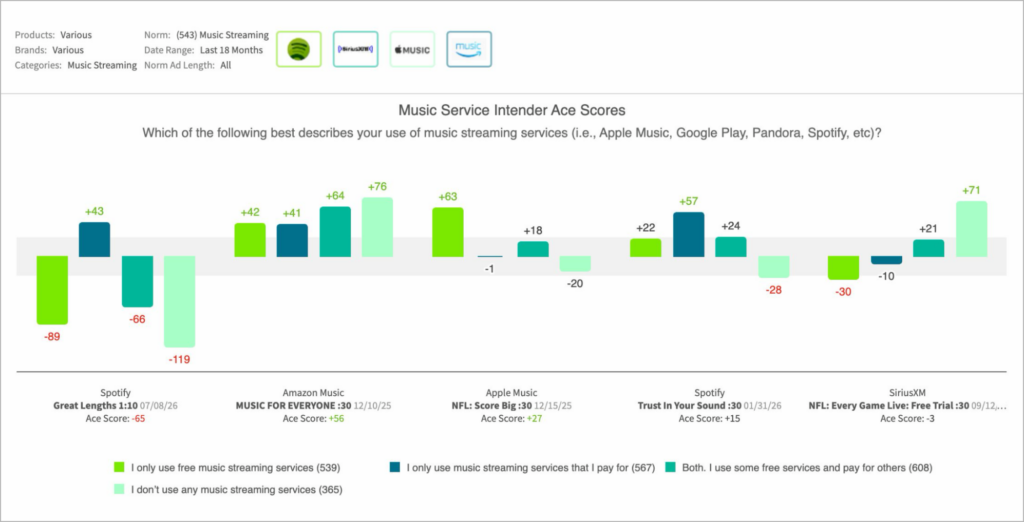
- Likely related to an ability to recognize the Spotify logo (and therefore significantly reduced confusion), those who only pay for music streaming services were another strength segment for “Great Lengths:”
- Every other usage segment underperformed: free-only users (-89 pts), mixed free/paid users (-66 pts), and non-users of any streaming service (-119 pts, the steepest gap in the entire dataset).
- Younger viewers 18-35 also responded positively (particularly younger males), again likely due to reduced confusion related to earlier recognition of what the spot was advertising:
- However, brand and product clarity still suffered (albeit to a lesser degree vs the broad audience), yielding a tempered intent to act (with Top 2 Box intent reaching 51%, still -5 pts below the audience norm).
- For these younger viewers, the visuals stood out at twice the rate of the average music streaming ad and grabbed Attention very effectively (placing in the very top percentile in the category in this regard).
- These viewers also recognized the Change in direction that made the creative stand out and perceived the spot to be more informative than most music streaming ads
- With Desire high, it is likely that a bit more direct clarity in the Spotify Reserved details (exactly what it is and how to get it) could have pushed consideration higher – an opportunity. This approach would also potentially convert more users of other streaming services/non-users.
- However, brand and product clarity still suffered (albeit to a lesser degree vs the broad audience), yielding a tempered intent to act (with Top 2 Box intent reaching 51%, still -5 pts below the audience norm).
Viewers 18-35 Only:
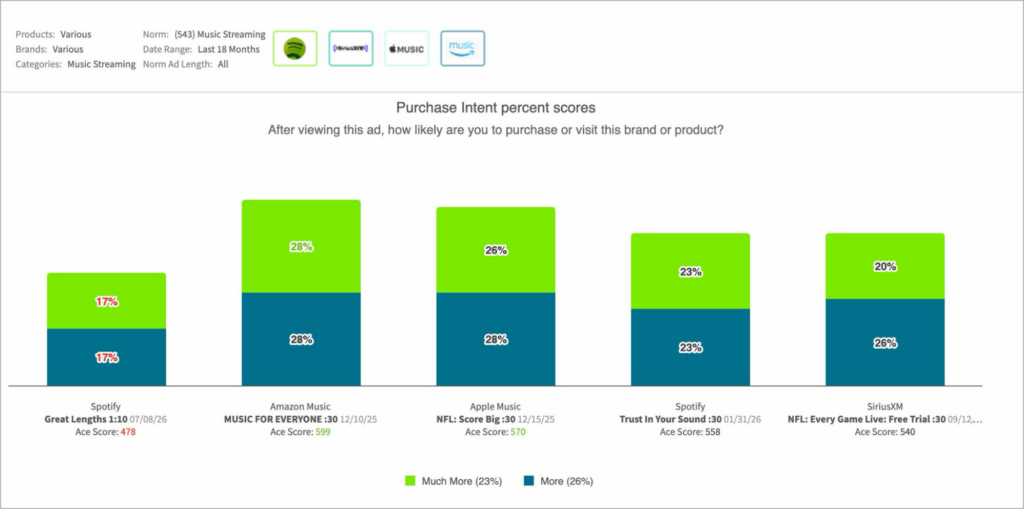
- When indexed vs the best-received spots of other music streaming services over the past 18 months, “Great Lengths” held a clear advantage with males 18-35 and held its own among users of pay streaming services:
- However, the other ads developed broader appeal, resulting in higher overall consumer intent.
Ineffective creative, even if delivered to the right audience, results in missed opportunity and performance shortfalls. Great creative delivered poorly also results in failed campaigns.
Schedule a demo to find out how your brand can partner with iSpot to quickly solve both challenges simultaneously, delivering high-performing creative while boosting the effectiveness of planning and in-market execution to achieve—and outperform—campaign objectives.
Creative Agency: Spotify In-house Team, in partnership with Remembers and Jocelyn Charles.