OpenAI’s new campaign for its voice feature brings the updated ChatGPT experience to life by showcasing its natural, conversational assistant through real-world scenarios. The revamped experience responds to pauses, complex requests, and interruptions, utilizing the advanced capabilities of GPT-5.5.
The campaign aims to demonstrate the tangible benefits of the technology, as well as the ease of use-even for those not schooled in technology-and across an array of everyday tasks.
Here’s what iSpot’s Creative Assessment platform revealed on actual viewer response to ChatGPT’s voice campaign.
The Details:
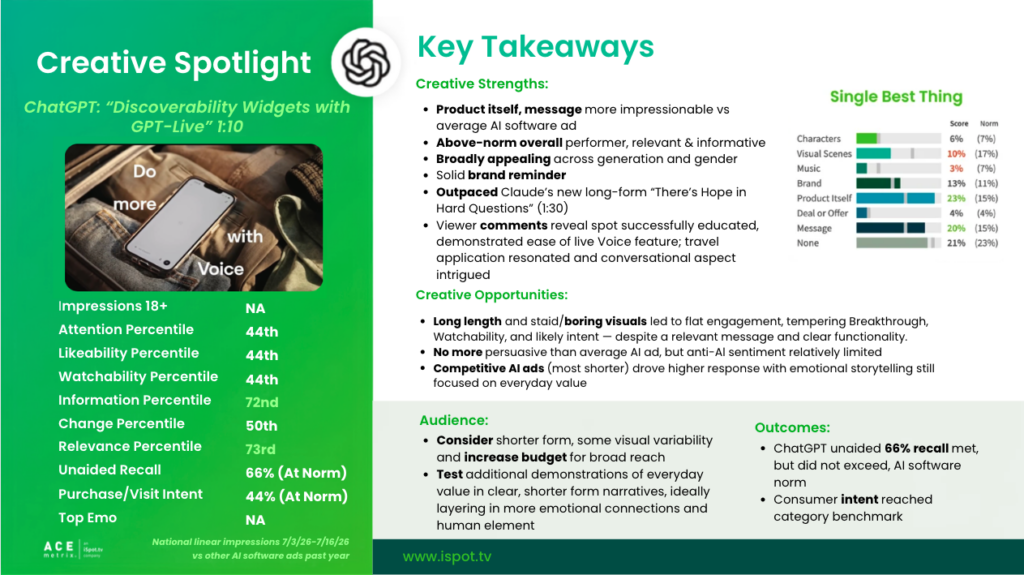
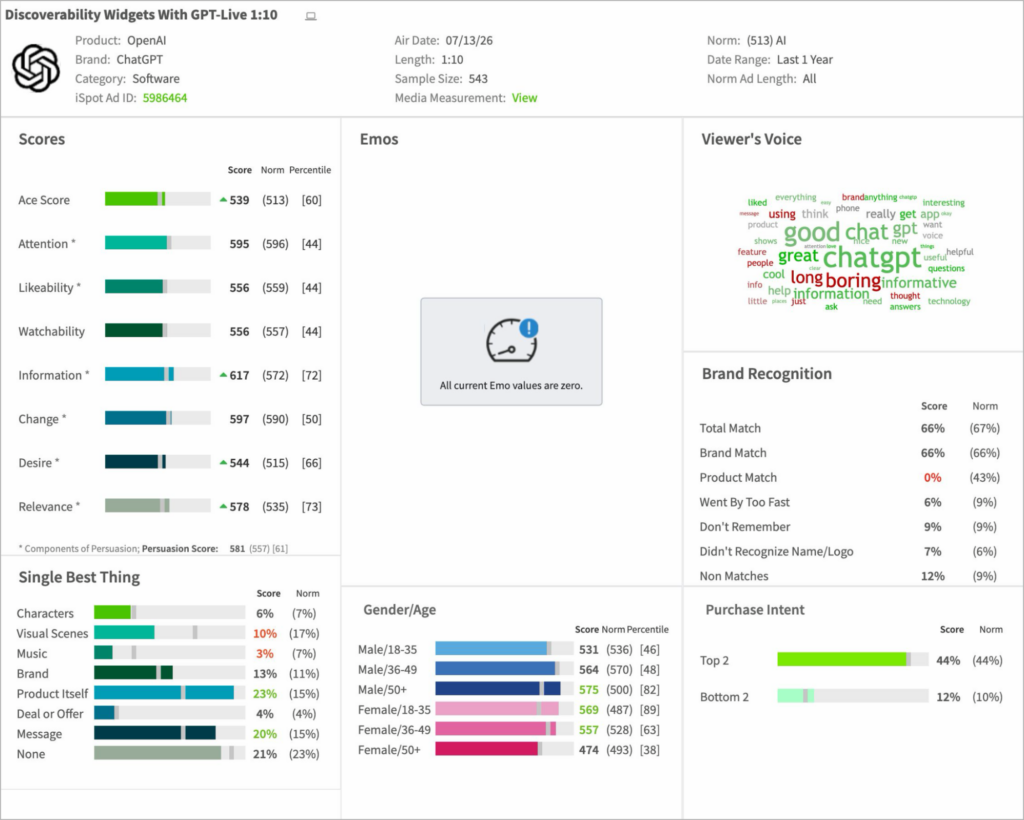
- ChatGPT’s :70 “Discoverability Widgets With GPT-Live” earned above-norm overall response from American viewers vs other AI software ads over the past year, on the strength of the Information delivered and its Relevance:
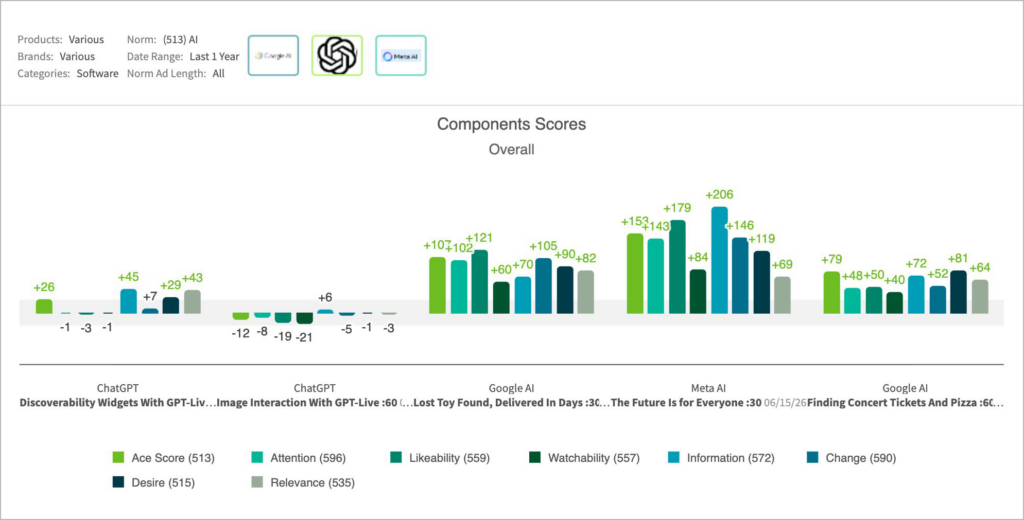
- Information scored +45 pts above norm — the strongest component in the portfolio — making it the primary engine of the spot’s performance, but Desire and Relevance reinforced the story. Both landed as strengths (+29 pts and +43 pts above norm, respectively), indicating viewers connected the demo to something they could see themselves using. This confirms the saliency of the strategy to prove ease of use (even without grandmas!).
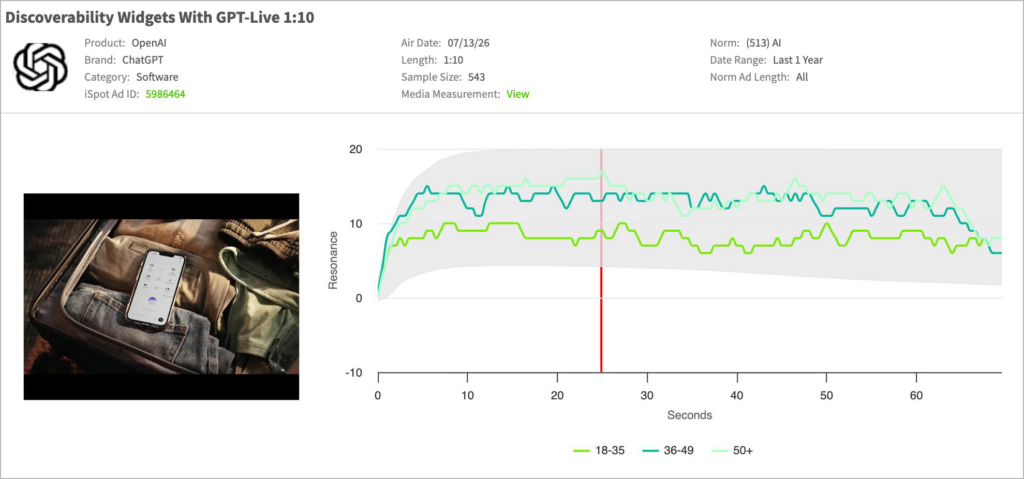
- Breakthrough and Watchability reached, but did not exceed, normative levels, with the rather staid visual focus on the phone being less engaging, especially as the ad wore on.
- Persuasive power reached benchmark levels for the category (44% reporting an increased likelihood of purchase/visit) driven by the rational arguments in the ad, but the demonstration landed as well as, or better, than the average software AI spot across generation and gender, as intended.
- Information scored +45 pts above norm — the strongest component in the portfolio — making it the primary engine of the spot’s performance, but Desire and Relevance reinforced the story. Both landed as strengths (+29 pts and +43 pts above norm, respectively), indicating viewers connected the demo to something they could see themselves using. This confirms the saliency of the strategy to prove ease of use (even without grandmas!).
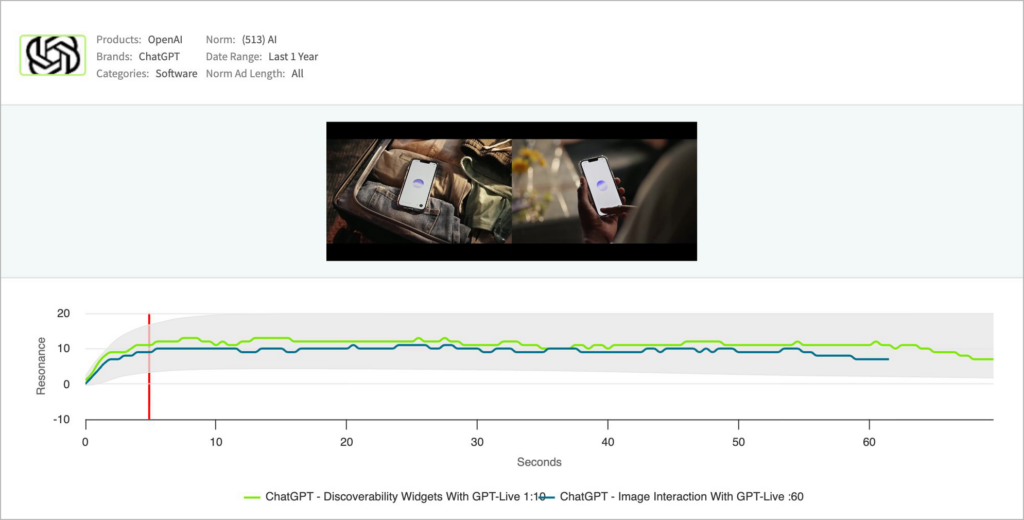
- Second-by-second trace results reveal a bit higher engagement level for the :70 “Discoverability Widgets” creative vs the campaign’s :60 “Image Interaction with GPT-Live” and the highest levels notched within the 50+ audience (typically the more engaged viewers of advertising in general but a key challenge audience for AI in general):
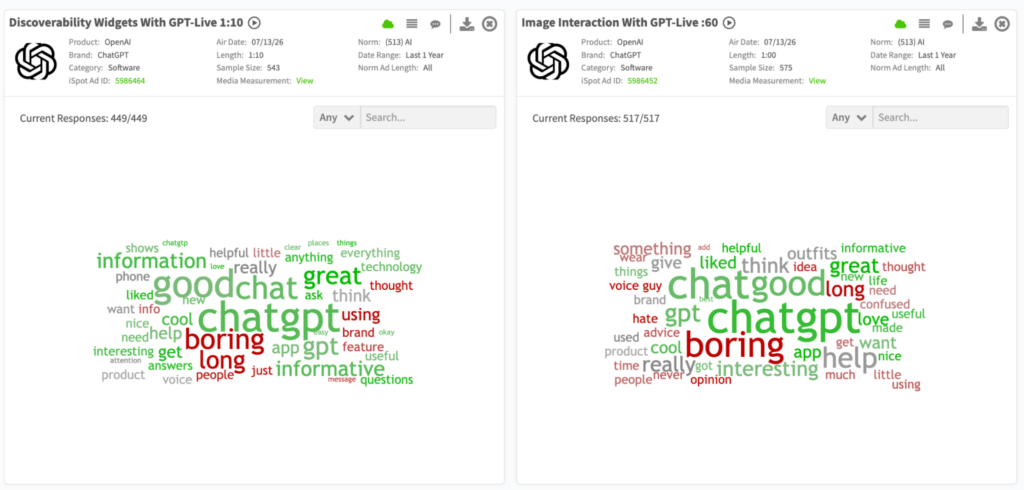
- The :70 spot was perceived as more informative and less ‘boring’ to the general audience, perhaps linked to the travel assistant messaging.
- Viewer sentiment on the :70 “Discoverability Widgets” reveals that the video ad successfully educated viewers about ChatGPT’s voice capabilities, but its length could be significantly limiting its effectiveness.
- Many viewers appreciated the practical, real-world demonstration with the travel planning use case resonating and the conversational aspect opening eyes.
- The most prevalent objection was to the length of the spot, and of course, some anti-AI sentiment was present (as well as some dislike of the voice). Together with a long, flat engagement line (signaling an unchanging experience that got boring for some), there is a clear opportunity to test shorter lengths, still focused on reframing to the human benefit over the technology.
- The :70 spot was perceived as more informative and less ‘boring’ to the general audience, perhaps linked to the travel assistant messaging.
Sample comments on the :70 “Discoverability Widgets with GPT-Live”
“The ad clearly shows that ChatGPT is a fast, smart, and useful tool for everyday life.”
Female 18-35
“It shows you what ChatGPT can do. You can ask the AI anything and it will help you out.”
Male 36-49
“I didn’t like it, I was just staring at a phone on my phone for a full minute.”
Female 18-35
“This interested me as I’m not really familiar with AI and it has me curious.”
Female 50+
“I didn’t like it at all. It was too drawn out. I almost lost focus and they didn’t show the brand until the very end.”
Male 50+
“Over a minute for an ad is super long. You can make this ad and deliver the exact same message within 15 seconds.”
Male 36-49
“I felt it was interesting and informative. I liked how it gave specifics on where to go and suggestions on multiple places, not just one. I also liked how friendly the information person (AI?) was.”
Female 36-49
“Looks super helpful and advanced, interested in looking more into it.”
Female 36-49
“This ad demonstrates the new ChatGPT technology and how it can be used in a way that’s practical.”
Male 18-35
“The voice and focus on the same shot was kind of boring.”
Female 36-49
“It was too long and I’m tired of having AI shoved in my face. I know it exists. If I want to use it, I will. I do not want everything that exists in technology to now feature partially functional LLMs.”
Female 36-49
“I learned about the personal assistant feature. I didn’t know about it.”
Male 50+
“Loved how it displays how it is interacting with the app. Also, how it’s lying on his open suitcase before he travels.”
Male 36-49
“It was fine. Too long though. Most people can’t watch past a minute. Cut it down in half, and only include the actual good info. Maybe add some music.”
Male 18-35
“I didn’t know ChatGPT could do so many things. I have rarely used it in the past, but the ad may make me think that I should use it more.”
Female 50+
“It was simple and straight to the point but showed great advancements that you can use daily.”
Female 18-35
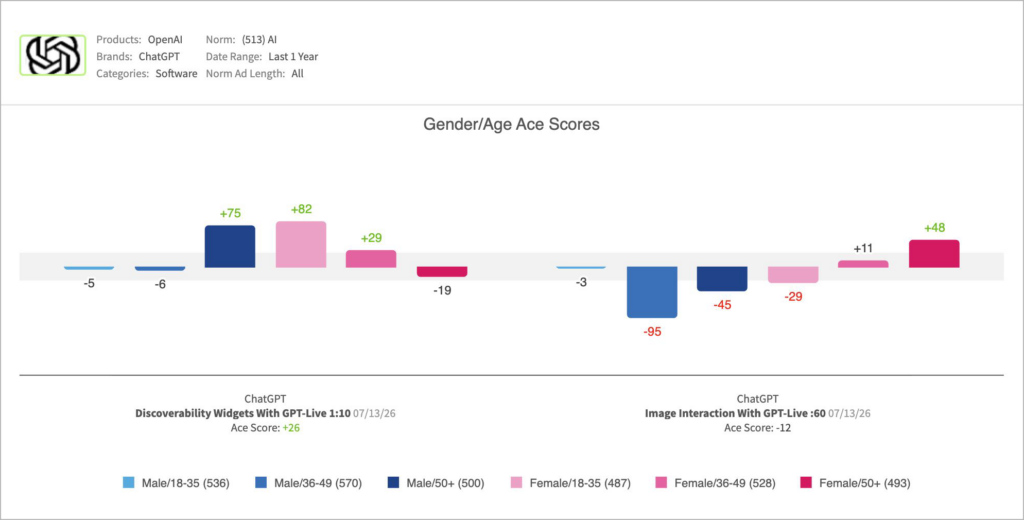
- “Discoverability Widgets” was the stronger creative execution of the two tested. In overall response, it landed +26 pts above the AI category norm and outpaced “Image Interaction” (-12 pts), and the message was more impressionable:
- “Discoverability Widgets” found a more positive audience among all but women 50+, among whom “Image Interaction” connected well.
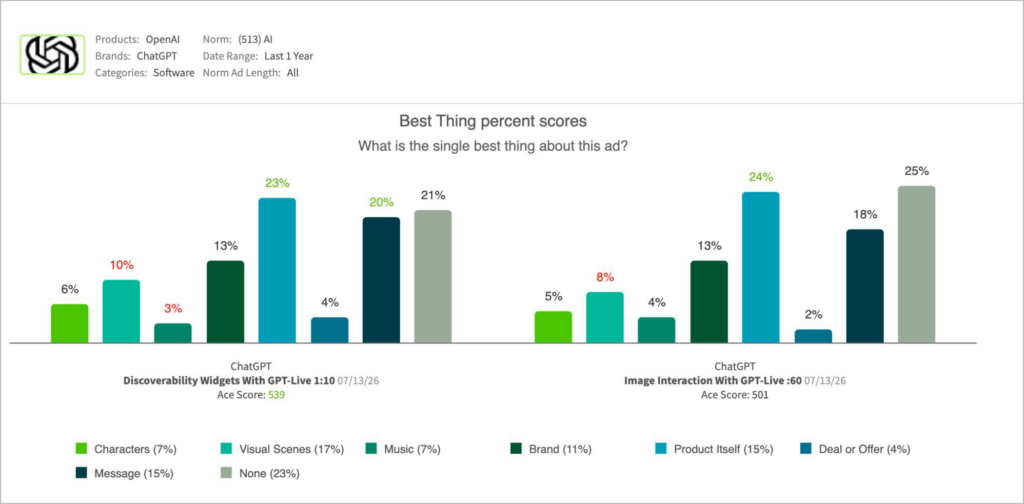
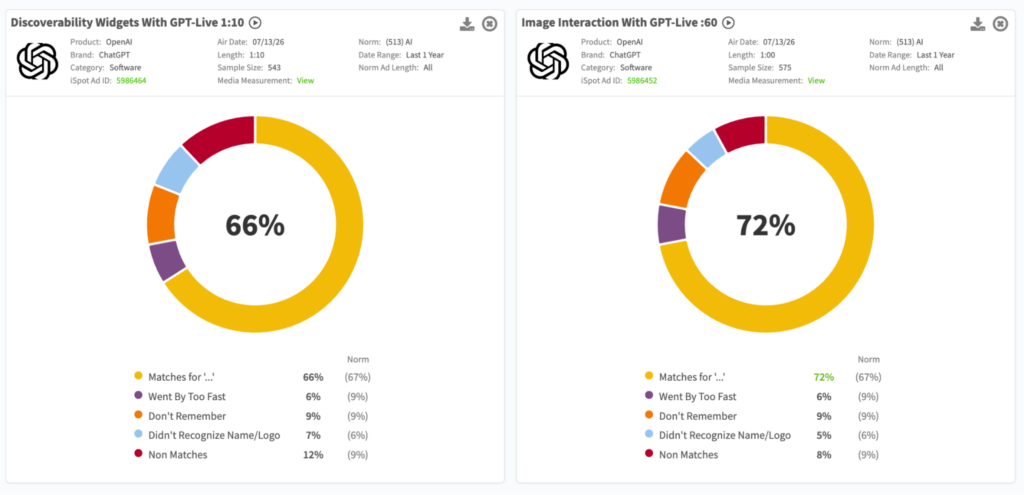
- Both spots successfully linked the ChatGPT brand name to the features presented (66% and 72% unaided recall vs an AI norm of 67%), and each persuaded at similar, benchmark-level, rates (44%-45% Top 2 Box intent):
- As such, ChatGPT might consider shorter lengths for both ads, perhaps with a bit more visual interest, for broader reach media given the achievement of effective demonstrations that intrigued and related to everyday lives.
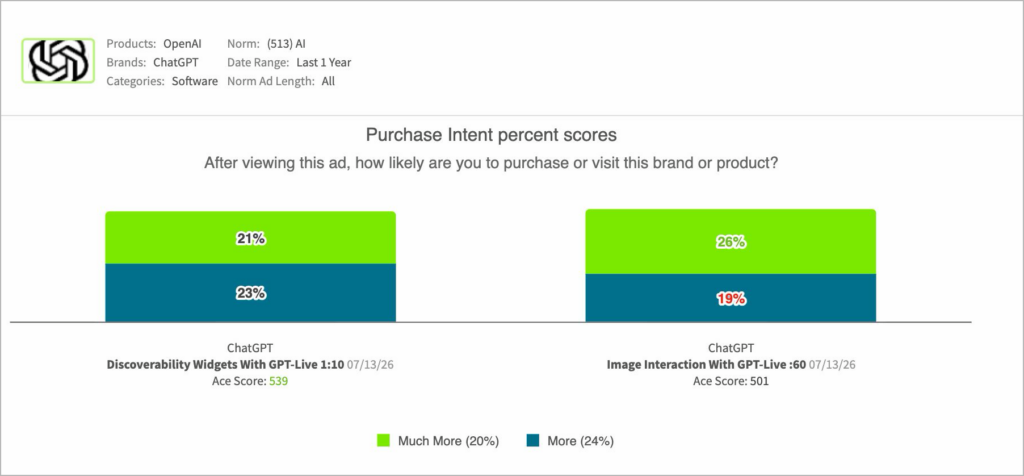
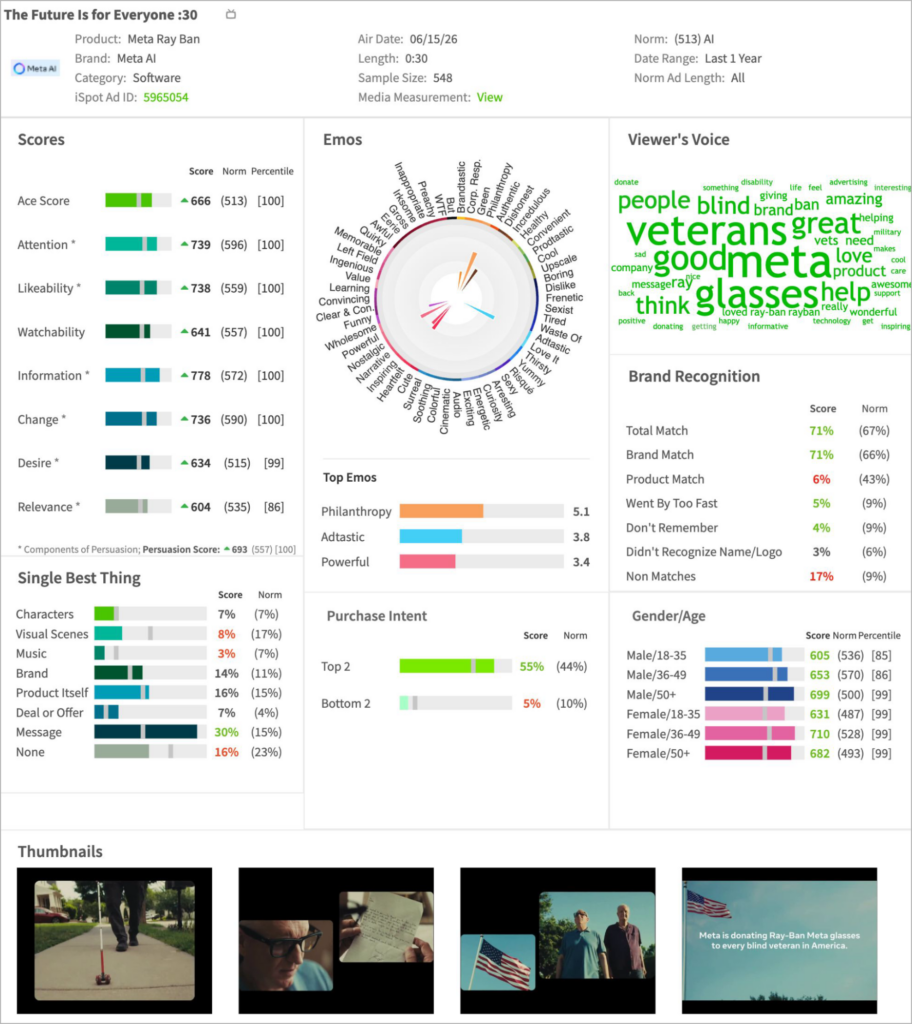
- Google and Meta have also found success in focusing on everyday ease of use in recent ads, with the competitive ads seeing stronger positive response, two in :30 formats:
- However, these recent GPT-Live creatives built similar consumer intent (other than the Meta Ray-Ban glasses spot)—an encouraging result for the communication objective, and opportunity to expand reach with similar demonstrations wrapped up in more engaging and shorter visual content.
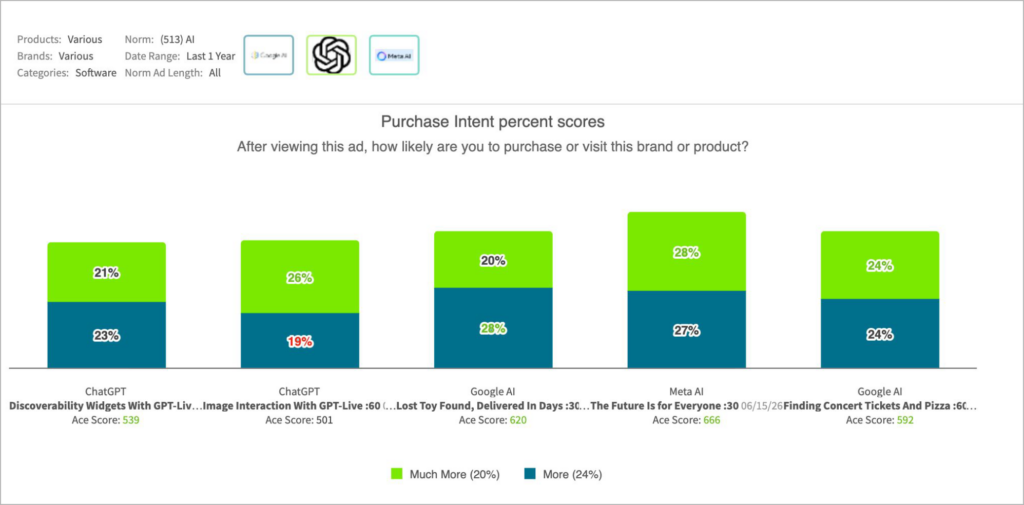
- Meta’s success with the :60 “The Future is for Everyone” featured a sight-impaired U.S. veteran using the Meta Ray-Ban glasses to navigate in the world, with the brand announcing a donation of a pair of Ray-Ban Meta glasses to every blind veteran in America, which drove the notably higher intent:
- This approach built brand favorability and positive emotional connections successfully.
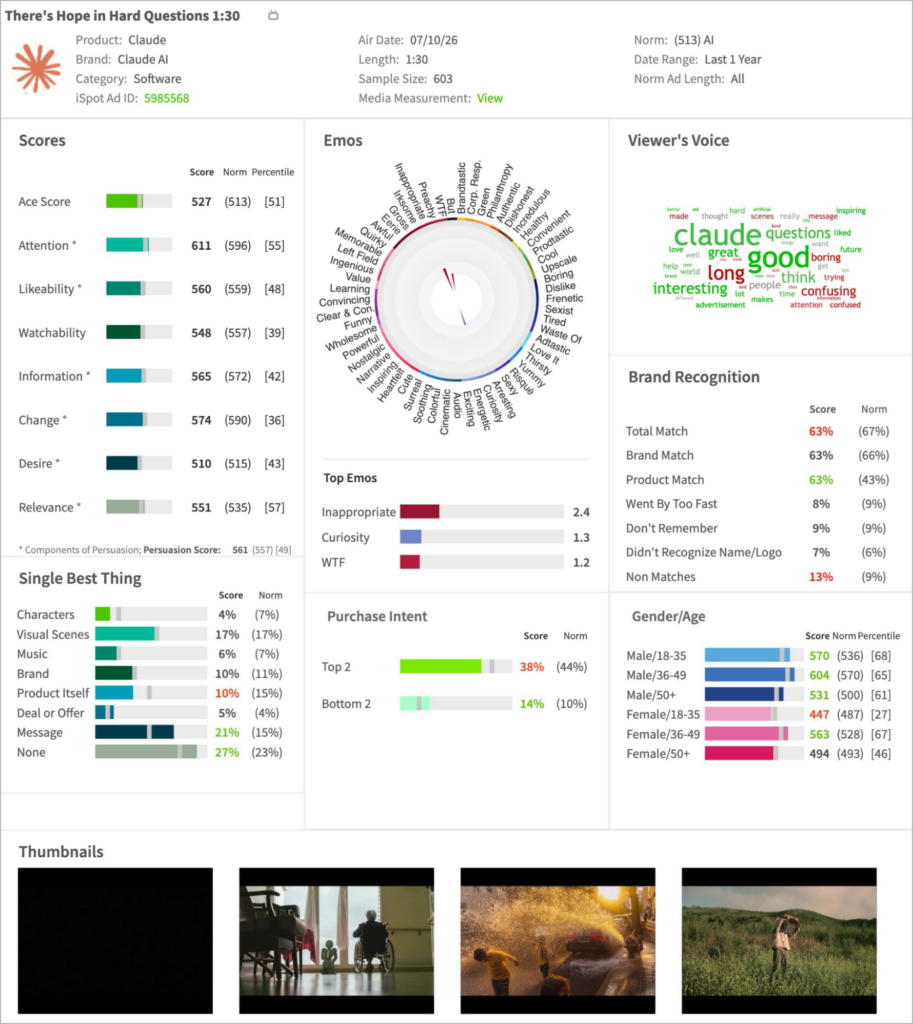
- However, the two GPT-Live spots performed well against Claude’s brand new long-form “There’s Hope in Hard Questions” (also heavily message-based) which American viewers found less persuasive:
Ineffective creative, even if delivered to the right audience, results in missed opportunity and performance shortfalls. Great creative delivered poorly also results in failed campaigns.
Schedule a demo to find out how your brand can partner with iSpot to quickly solve both challenges simultaneously, delivering high-performing creative while boosting the effectiveness of planning and in-market execution to achieve—and outperform—campaign objectives.
Creative Agency: Isle of Any