
Every CMO is walking into 2026 asking harder questions about video ad performance, efficiency, and ROI. And they should be. Budgets are under the microscope, attribution is messier as platforms multiply, and the expectation to prove value has never been higher.
The problem? The answers to those questions live in disconnected measurement tools, defined by different metrics and methodologies from every vendor. Fragmentation isn’t just slowing down your workflow anymore; it’s become a boardroom liability.
When the C-suite asks, “What’s working?” too many teams are stuck reconciling conflicting video ad metrics from different sources. The result: slow answers, half-confidence, and decisions made on incomplete data.
When every dollar is scrutinized and ROI questions come from the CFO, the COO, and the board itself—fragmented measurement becomes the thing that keeps you from getting the resources and trust you need to do your job well.
The teams who win in 2026 won’t be the ones with the biggest budgets. They’ll be the ones who can answer fast, consistently, and with confidence. They’re not stitching together three different vendor reports to explain performance for one campaign. They’re working from unified, ad-level data that accounts for every video ad dollar across metrics, creatives, and investments.
Below are the six questions CMOs will ask about your video ad campaigns in 2026—and how to be ready with answers that hold up.
- Where did the results come from?
- Is our creative actually working—and can you prove it?
- Are we reaching the right people efficiently?
- What results can we tie directly back to our video ads?
- How does our campaign stack up against competitors?
- Is our measurement future-proof—especially as AI evolves?
“Where Did the Results Come From?”
The Pain
Awareness is up across exposed audiences. Engagement metrics suggest the creative landed. But attribution can’t confidently tie either signal back to business outcomes. Somehow with all these measurement solutions running, you still can’t get a reliable answer about what’s actually driving performance.
Why CMOs Ask It in 2026
They’re done watching teams burn time and resources reconciling multiple video ad reports just to answer a basic performance question.
When awareness, engagement, and attribution live in separate solutions—each with different definitions, methodologies, and timelines—teams are forced to manually piece together a narrative after the fact. That reconciliation takes significant time and still often produces answers full of caveats.
When video ad metrics don’t clearly align, confidence erodes. And so does the ability to optimize media, creative, and spend with conviction.
How to Be Ready
Your video ad measurement needs to align metrics across creative, audience, and outcomes with a consistent dataset. Same methodologies. Same data sources. Same standards across all ads and publishers.
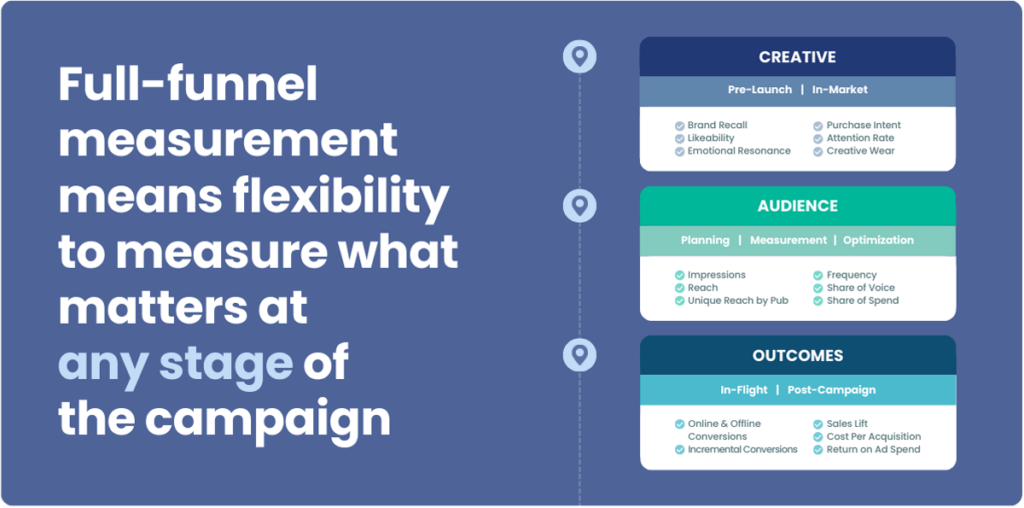
The key is having a measurement solution that uses the ad as the anchor. It’s the only constant across the full campaign lifecycle. The ad is what creative teams build, what media teams place, and what drives consumer action. Not the program. Not the platform. The ad itself.
When you measure at the ad level with a consistent dataset of KPIs, you can finally trace results back to their source with precision.
“Is Our Creative Actually Working—And Can You Prove It?”
The Pain
You launch new video creative and early delivery looks fine. But the real questions come later:

Too often, creative answers arrive late—or disconnected from delivery and outcomes. By the time you see which ads resonated, which wore out, or which failed to move the needle, most of your budget is already spent.
Why CMOs Ask It
Creative drives the majority of campaign effectiveness—anywhere from 56% to as much as 70% according to industry studies. If you can’t prove creative impact, you’re guessing with the most important variable in your campaign.
How to Be Ready
Use a standardized, ad-level framework to measure creative effectiveness—one that evaluates each creative not just on how it resonates, but who it reaches and what it drives.
That means measuring audience delivery and outcomes at the creative level, not just in aggregate. When recall, emotional response, reach, and conversions are tied to individual video ads, you can spot meaningful differences across channels—like a creative underperforming with a CTV audience but over-indexing on conversions in linear. With that clarity, teams can pull or refresh a creative where it’s ineffective, extend it where it’s working, and optimize the campaign without guessing.
“Are We Reaching the Right People Efficiently?”
The Pain
You’re investing video ad dollars across linear, CTV, digital, and social, but no one view shows how those investments work together. Each platform reports success in isolation, using its own definitions and methodologies. You don’t actually know how much of your video budget is reaching new audiences versus reinforcing exposure you’ve already paid for elsewhere. What looks like strong delivery may just be the same impressions showing up under different labels. Which means you’re paying for the same audiences multiple times without even realizing it.
Why CMOs Ask It
CMOs are scrutinizing every video ad dollar, not just how much they’re spending, but where it’s going and what it’s truly delivering. Without visibility across all video ad investments, it’s impossible to tell whether a media plan is expanding reach, reallocating intelligently, or quietly duplicating effort across channels and publishers.
How to Be Ready
Start with a measurement solution that accounts for every video ad dollar you spend—across linear, CTV, digital, and social. When all video investments are measured within the same system, using consistent metrics and methodology, you create a level playing field for true apples-to-apples comparisons across publishers and platforms.
Then focus on incrementality: insights that show where video ad dollars are expanding reach versus quietly duplicating it. When reach is genuinely deduplicated, it’s clear which publishers deliver unique audiences and which are overserving the same viewers you’ve already reached.
Demand publisher-by-publisher deduplication, not just linear vs. streaming comparisons. You need visibility into how much audience overlap exists between Netflix, Hulu, and every other platform in your mix.

“What Results Can We Tie Directly Back to Our Video Ads?”
The Pain
One vendor reports strong brand lift. Another shows declining conversions from the same campaign. Attribution is siloed, slow, and built on proxies that may or may not reflect reality. And you’re left standing in front of your CMO wondering which metric to trust—and which story to tell.
Why CMOs Ask It
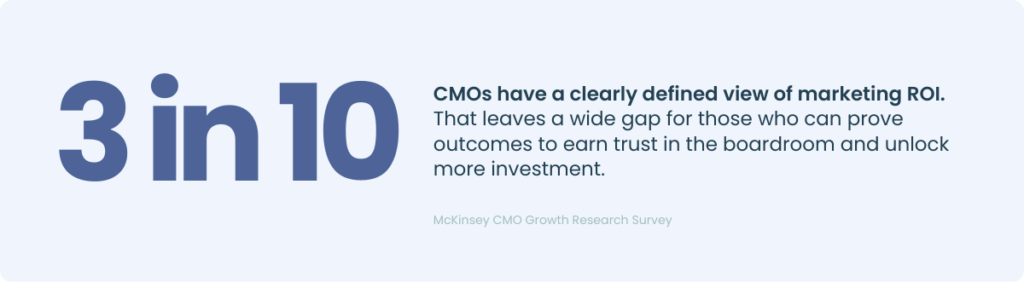
Less than one-third of CMOs feel confident in their ROI data. That’s a massive credibility gap. And without clear proof of business impact, marketing budgets stay vulnerable no matter how hard you work.
How to Be Ready
You need to see which specific ads, placements, and creative variations drive conversions—not just that “the campaign worked overall.”
Separate incremental lift from baseline conversions. Attribution should show what happened because of your ads, not just what happened during your campaign.
Connect exposures to online and offline conversions and ROAS. Whether you’re tracking site visits, app downloads, foottraffic, or sales, your measurement must tie ad exposure directly to the outcomes that matter to your CFO.
“How Does Our Campaign Stack Up Against Competitors?”
The Pain
You’re optimizing in a vacuum. That 15% brand lift sounds pretty good—until you learn competitors averaged 22% in the same period. Suddenly your “win” doesn’t feel like much of a win at all.
Why CMOs Ask It
Growth depends on gaining market share, not just meeting internal KPIs. Without competitive context, you have no idea if you’re actually winning or quietly losing ground while celebrating incremental improvements.
How to Be Ready
Start with benchmarks to understand how your campaign stacks up. Benchmark recall, intent, attention, and share of voice against the category. Use measurement that captures every ad from every competitor with the same methodology across metrics, so comparisons are apples-to-apples.
Then use competitive intelligence to understand why. Track competitor creative and media activity in real time to see where they’re investing, what messaging they’re testing, and how their performance compares to yours across platforms. This visibility turns benchmarks from a scorecard into an action plan.
Finally, look for whitespace and share-of-voice opportunities. When you see competitors pulling back from certain publishers, dayparts, or audience segments—or uncover untapped audiences—you can shift spend quickly to gain ground before the rest of the category catches up.
“Is Our Measurement Future-Proof—Especially as AI Evolves?”
The Pain
AI is everywhere right now. But here’s what most vendors won’t tell you: they’re slapping AI interfaces on top of the same siloed data they’ve always had. Without the right foundation, AI doesn’t solve your problems; it just speeds up bad decisions and amplifies existing blind spots.
And when those systems aren’t grounded in unified, high-quality data, the burden shifts to your team. To make the AI useful for your brand, you’re forced to spend time stitching datasets together, defining rules, and training models, often with incomplete or inconsistent inputs. Instead of saving time, AI becomes another system your team has to manage.
Why CMOs Ask It
They want to invest in systems that will still be serving them in two years. Nobody wants to go through another lengthy measurement vendor evaluation in 2027 because their current solution couldn’t keep up with the market.
How to Be Ready
Look for AI grounded in large-scale proprietary datasets—not synthetic or incomplete inputs. It takes years of R&D to build architecture that delivers reliable AI outputs. Without decades of high-quality, brand-trusted data as the foundation, AI tools produce shallow insights at best and misleading recommendations at worst.
Expect transparency, speed, and the ability to scale across emerging platforms. Black-box AI doesn’t help you explain decisions to leadership or optimize with confidence. The best solutions surface insights instantly through user-friendly interfaces while maintaining full transparency into how those insights were generated.

Remember that unification must be the foundation for AI to work properly. Models built on siloed inputs only amplify fragmentation. Models built on unified data across the full video ad lifecycle—creative, audience, outcomes—close blind spots and deliver answers you can trust to act on.
The Teams Who Can Answer These Questions Will Win 2026
CMOs expect unified narratives. They need to understand what worked, why it worked, and how to scale it—without spending hours reconciling vendor reports or waiting weeks for post-campaign analysis that arrives too late to matter.
Ad-level measurement combined with unified metrics, ads, and investments is the only system that delivers answers with real clarity and confidence. When creative insights connect to audience delivery and business outcomes, you stop defending fragmented data and start driving actual performance.
Marketers who build their video ad measurement strategies around these six questions will be better equipped to make smarter decisions in 2026—and defend them with confidence.
Want the Full Framework? Get the Ultimate Buyer’s Guide to Video Ad Measurement
The guide gives you a step-by-step framework to evaluate your current video ad measurement stack, pressure-test vendors, and get ahead of the curve. Download it now to see exactly what fully-unified measurement looks like, and how to demand it from every solution you evaluate.