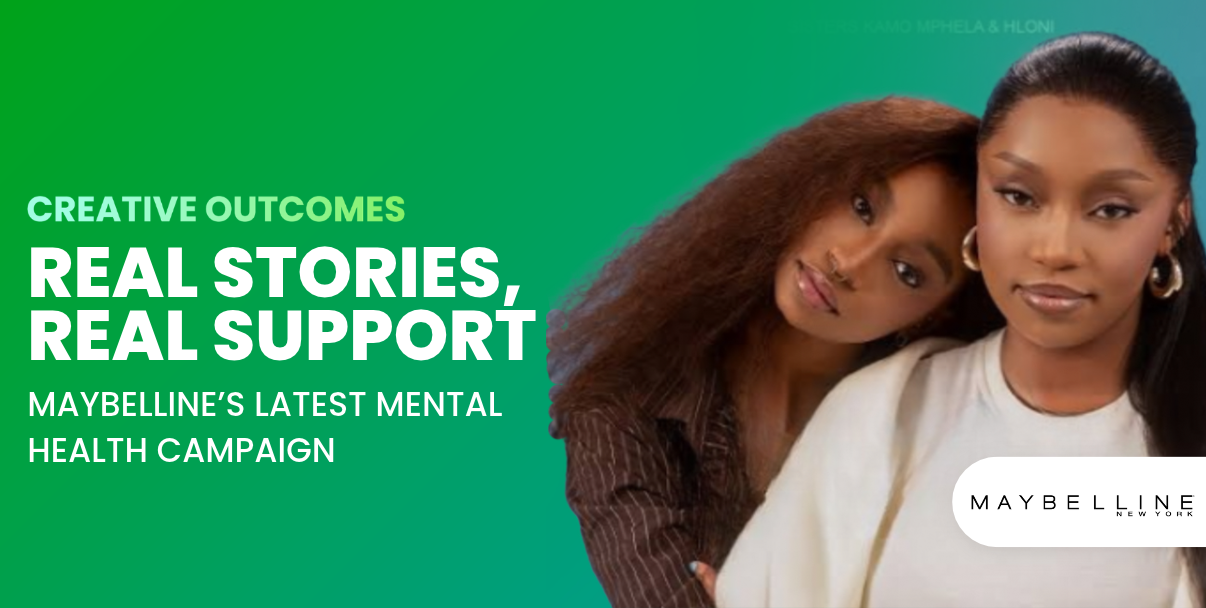
In recognition of World Mental Health Day, Maybelline New York launched “Together We’re Brave,” the latest creative installment under the brand’s long-running Brave Together mental health platform.
Continuing an ongoing partnership with the National Alliance on Mental Illness (NAMI), the :60 spot spotlights real-life pairs, including mothers, daughters, and close friends, sharing personal experiences with anxiety, depression, and the vital role of support systems.
Here’s what iSpot’s Creative Assessment platform revealed on actual viewer response to the spot.
The Details:
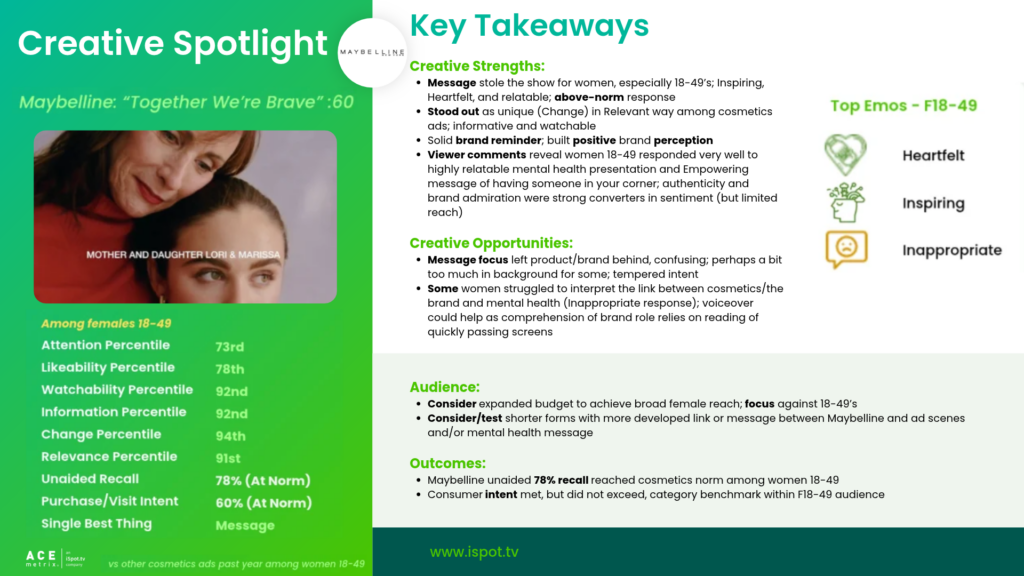
- Across the full gen pop U.S. audience, the :60 “Together We’re Brave” was an above-norm performer that was both informative and indicative of Change, with strong Watchability and Relevance:
- The strength of the spot was centered among the key female audience between the ages of 18 and 49, while still meeting cosmetics norms in overall response across other audience age/gender segments (and beating them among boomer men).
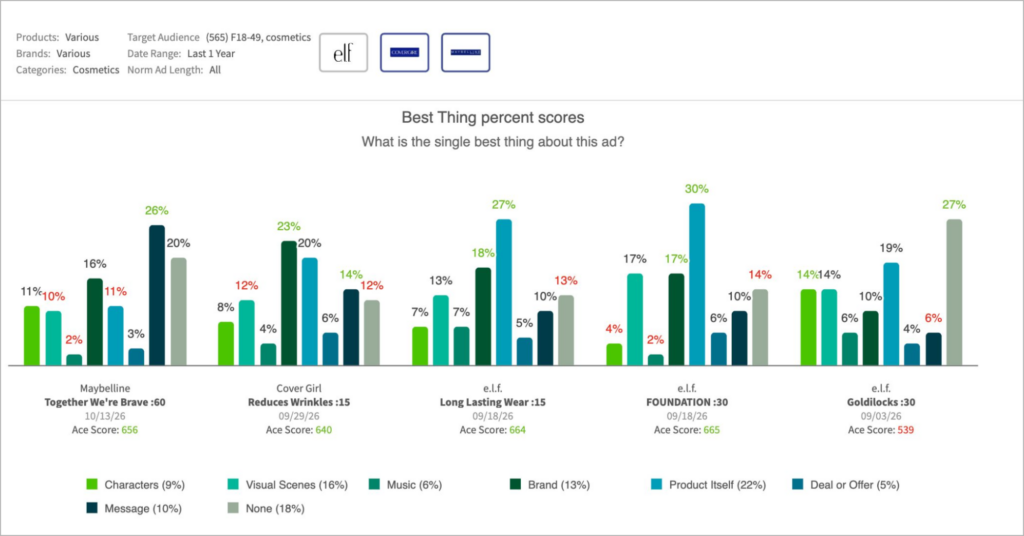
- Viewers overwhelmingly selected the message as the Single Best Thing about the spot, with the brand presence mentioned by just 14% and product below average – reflecting the ’cause’ marketing nature of the video.
- Three in four successfully linked the messaging to Maybelline (outpacing the category average by +5 pts) by the end of the spot.
- The strength of the spot was centered among the key female audience between the ages of 18 and 49, while still meeting cosmetics norms in overall response across other audience age/gender segments (and beating them among boomer men).
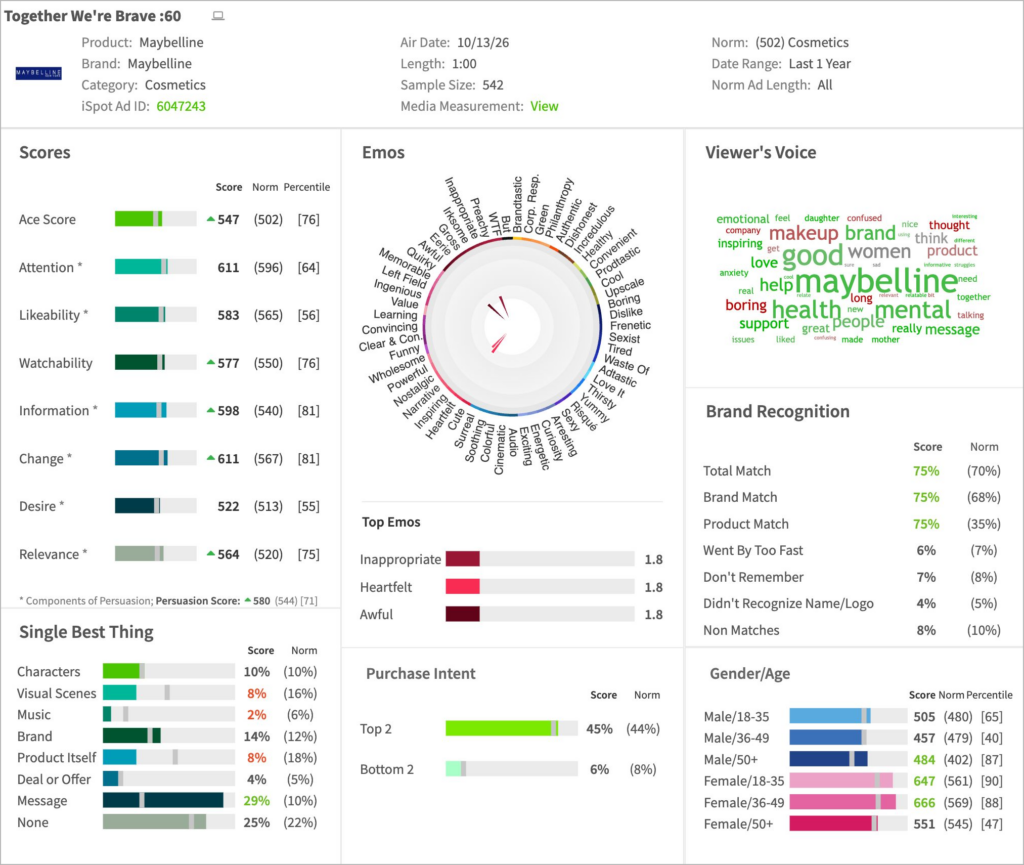
Among women 18-49 specifically:
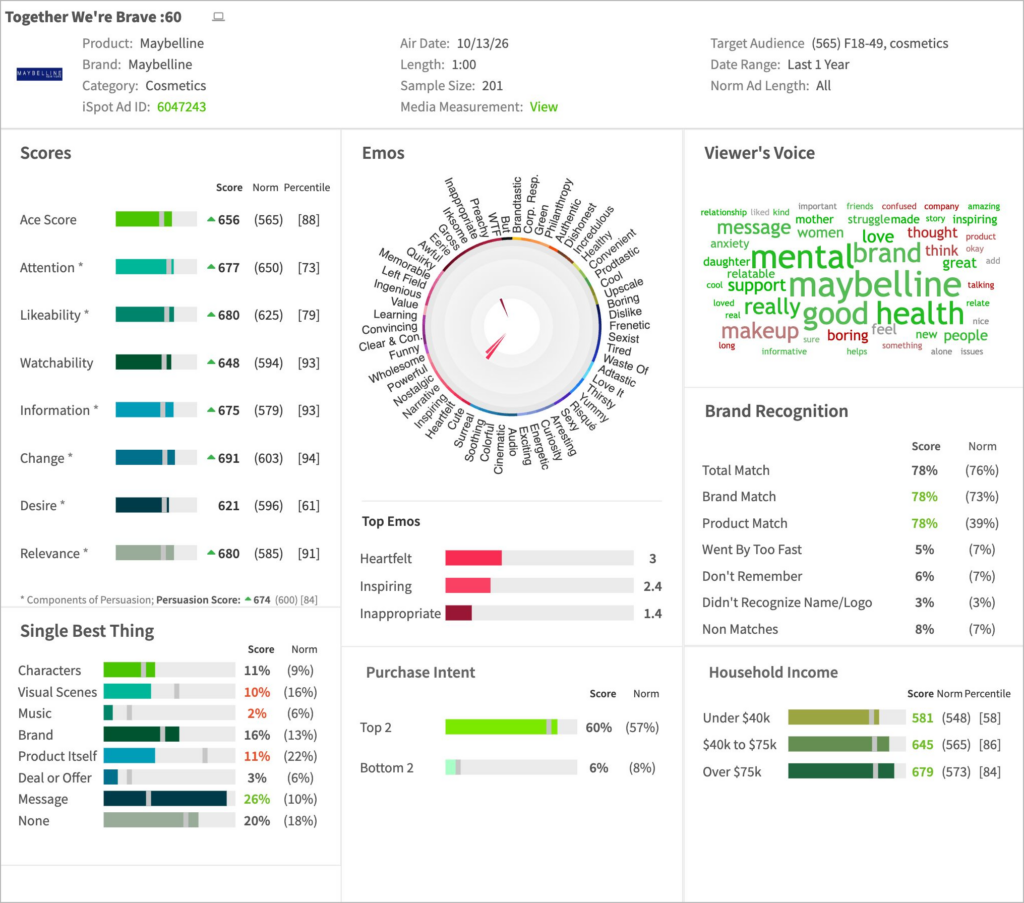
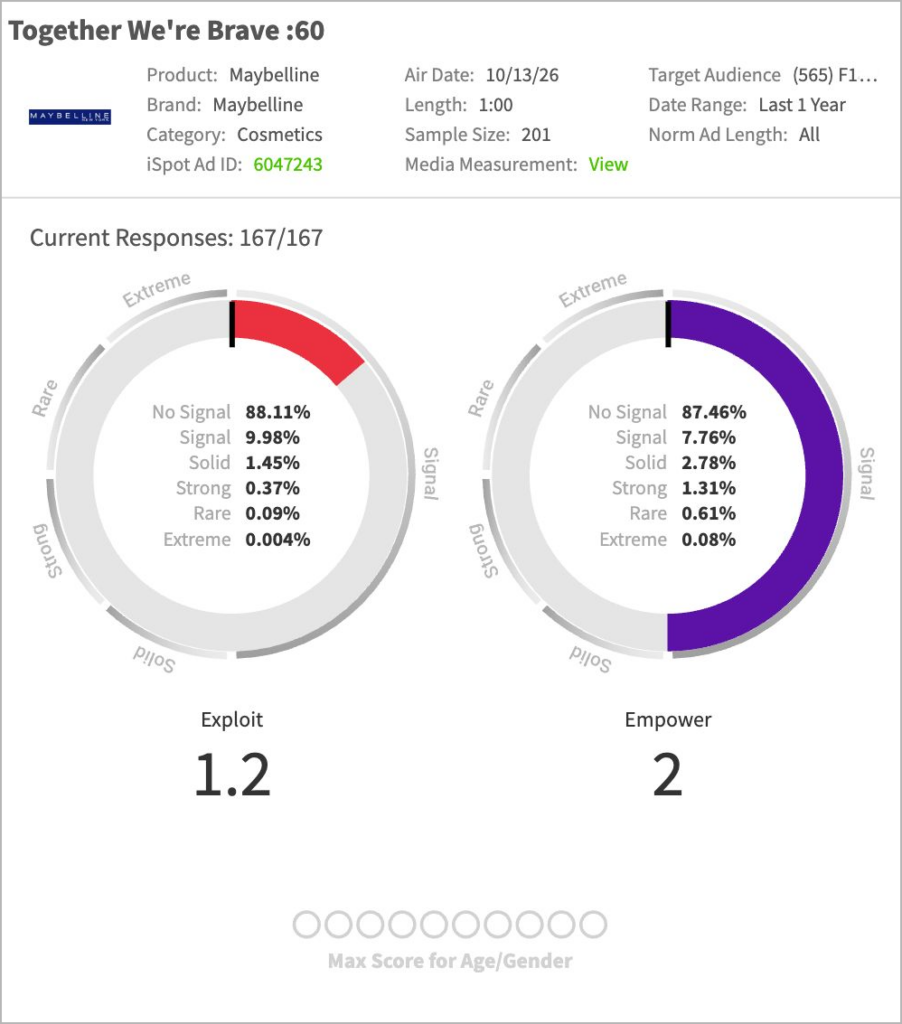
- Women 18-49 responded at even higher levels, noting the Inspiring and Heartfelt message which landed as Empowering more than Exploitative, although small Exploit signal was measured:
- Within this audience, “Together We’re Brave” placed in the top decile of cosmetics ads (past year) in conveying Change, Information, Watchability, and Relevance.
- A normative 78% of women under 50 easily recalled Maybelline as the brand sponsor (unaided), and six in ten reported positive consideration. The latter metric reached but did not statistically exceed the average for the category. Given the lack of product marketing in this creative, this represents a strong showing.
- Within this audience, “Together We’re Brave” placed in the top decile of cosmetics ads (past year) in conveying Change, Information, Watchability, and Relevance.
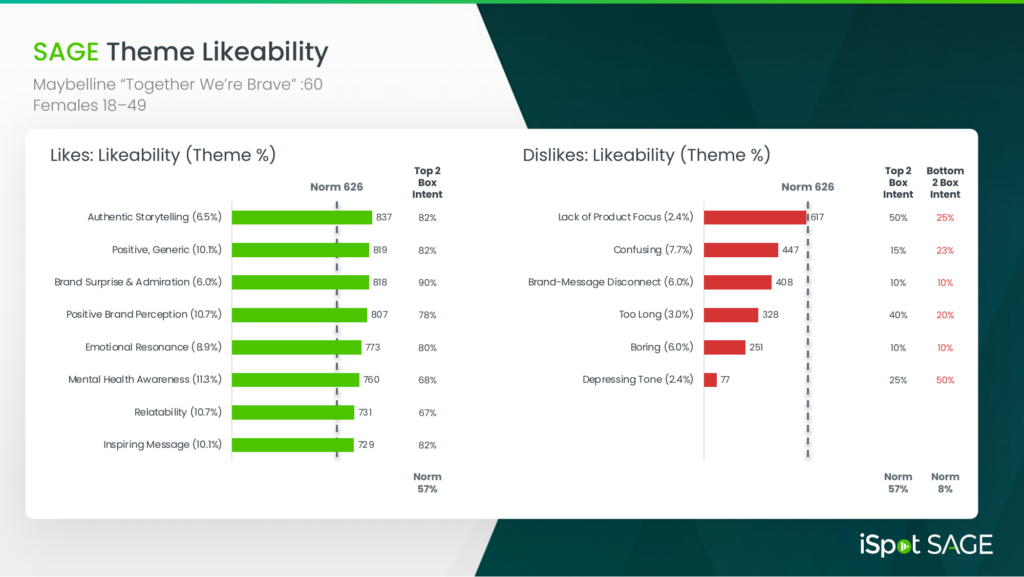
- iSpot’s SAGE Creative AI agent evaluated sentiment among women 18-49 to reveal the key strengths of Maybelline’s newest :60 spot, with the authenticity and inspiration found in the spot leading to warmer feelings towards the Maybelline brand:
- Authentic storytelling (6.5% of F18-49 responses) reached the highest Likeability of any named theme at 837 (category ad-level norm was 626) and also converted well on Top 2 Box intent (82%). The documentary real-people approach was both loved and commercially effective, but theme reach was limited.
- Brand Surprise & Admiration (6.0% reach) also achieved high Likeability and led all themes on driving intent (90%). High love, highest conversion — but again, only 6% reach.
- The Inspiring Message theme saw relatively lower Likeability (729, still above-benchmark) and delivered strong intent (82%) among the 10.1% mentioning the sentiment. Conversely, Relatability (10.7%) delivered 731 Likeability and 67% Top 2 Box —against a category intent norm among women 18-49 of 57%.
- Brand-message disconnect was the primary but limited risk. The 6% of respondents who were confused about or did not understand the connection between a makeup/cosmetics brand and mental health messaging reported intent of just 10% and low Likeability (408). The Confusion theme (7.7%) was the largest dislike segment and similarly collapsed on both Likeability and intent. With Maybelline’s presence and role only presented in text format at the end of a longer ad and on quickly passing screens, this could represent an editing opportunity.
- The Lack of Product Focus dislike theme (2.4% reach) was notable in that its Likeability of 617 was substantially higher than Confusing (447), Boring (251), or Depressing Tone (77). Respondents who wanted more product focus weren’t hostile to the ad; they just wanted something different from it.
- Authentic storytelling (6.5% of F18-49 responses) reached the highest Likeability of any named theme at 837 (category ad-level norm was 626) and also converted well on Top 2 Box intent (82%). The documentary real-people approach was both loved and commercially effective, but theme reach was limited.
Sample comments on the “Together We’re Brave” :60 among women 18-49
“The ad itself was different because I wasn’t expecting a makeup brand to post about mental health so it was refreshing to see.”
Female 18-35
“This ad gives me a more positive feeling about Maybelline. I currently use your foundation and think it’s awesome, but did have a few reservations about potential animal testing done by the brand. I think the brand is taking a dynamic step in the right direction. I love seeing Ana De Armas. I also struggle with anxiety and depression and feel the personal impact the brand is making with its contribution.”
Female 18-35
“This was a good ad that drew me right in. I like the up close shots of the women and their vulnerability telling their stories. It captured and kept my attention. I saw that it was Maybelline in the beginning of the ad and was wondering how it was connected. I saw at the end that Maybelline sponsors and supports mental health which is new to me. It made me like Maybelline more.”
Female 36-49
“I mean I like what you are partnering to do. Mental health is very important, but it’s kinda a boring ad.”
Female 18-35
“I’m glad this brand is doing something so brave by making this ad. It is very nice to see issues not really talked about reflected in ads.”
Female 18-35
“This ad really touched me. I myself struggle with anxiety and mental health so watching this and knowing you’re not alone, that there are people that understand you, feels kind of good.”
Female 36-49
“I was confused because I really wasn’t sure what the ad was for and it said Maybelline, but I didn’t see anything about cosmetics.”
Female 36-49
“I thought it was very relatable for me. It felt good to see people talking about overcoming their struggles with mental health, and I didn’t know Maybelline was involved in any kind of charity work like that and it was surprising and inspiring to find that out.”
Female 18-35
“I don’t understand the connection between makeup and anxiety. The commercial is just too deep.”
Female 36-49
“I know Maybelline is a makeup company. I don’t know what they were trying to advertise here.”
Female 18-35
“I didn’t know that Maybelline supported mental health. I like this commercial and the way the message was portrayed. It seems caring. Beauty and mental health go hand in hand.”
Female 18-35
“Very meaningful. Has details of who to call for mental health help. It’s very moving.”
Female 18-35
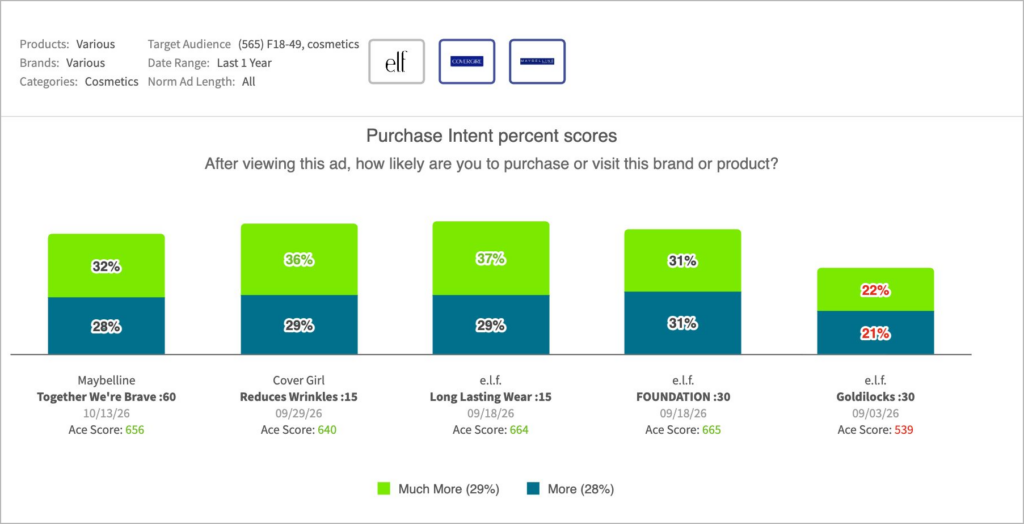
- Not surprisingly, more brand and/or product focused competitive ads tended to drive higher consumer intent:
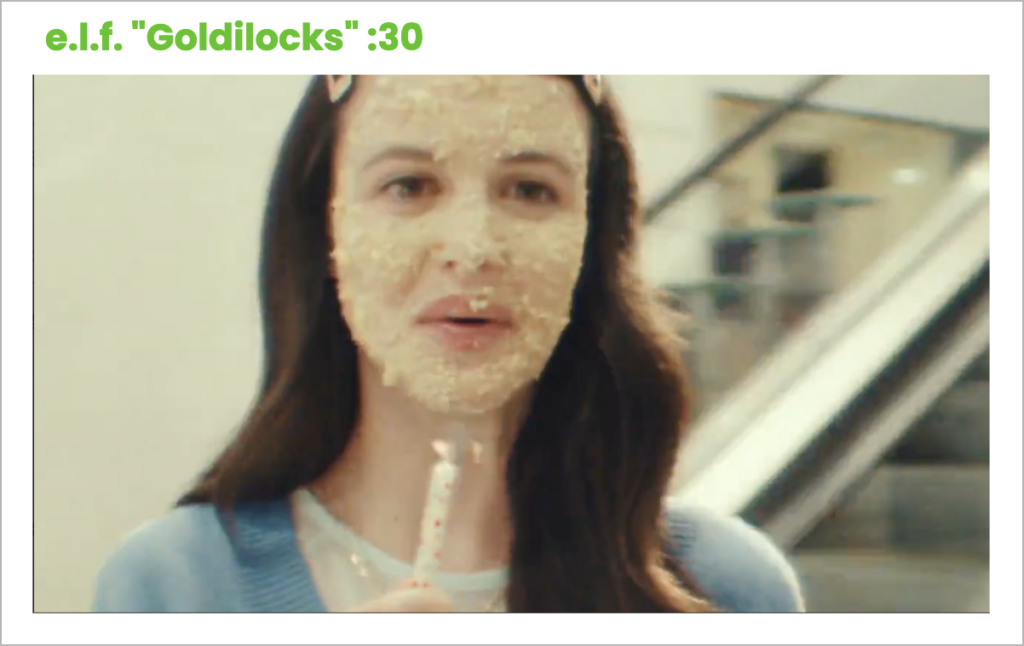
- e.l.f. ‘s attempt at offbeat humor in its :30 “Goldilocks” which referenced ‘Unglammy Valley’ and featured unflattering visuals did not land well with the female 18-49 audience.
- iSpot’s SAGE Media AI agent revealed competitive brand playbooks based on YTD linear media activity:
- L’Oréal Paris (parent): always on, with high volume (about 4,000–5,000 airings a month in active months) and a moderate CPM. It sets the category’s baseline.
- Laura Geller: the clearest direct-response buyer. It spends a steady $0.5-1.1M a month, runs up to 26 creatives at once, and has the lowest CPM in the category ($3.21).
- Revlon and CoverGirl: small but continuous budgets of $0.4–1.3M a month that keep them present all year.
- IL MAKIAGE: the fastest-rising competitor in the second half, with spend climbing every month since June.
- e.l.f. is also a natural head-to-head rival for younger buyers, and like Maybelline it buys at a premium CPM.
- L’Oréal Paris (parent): always on, with high volume (about 4,000–5,000 airings a month in active months) and a moderate CPM. It sets the category’s baseline.
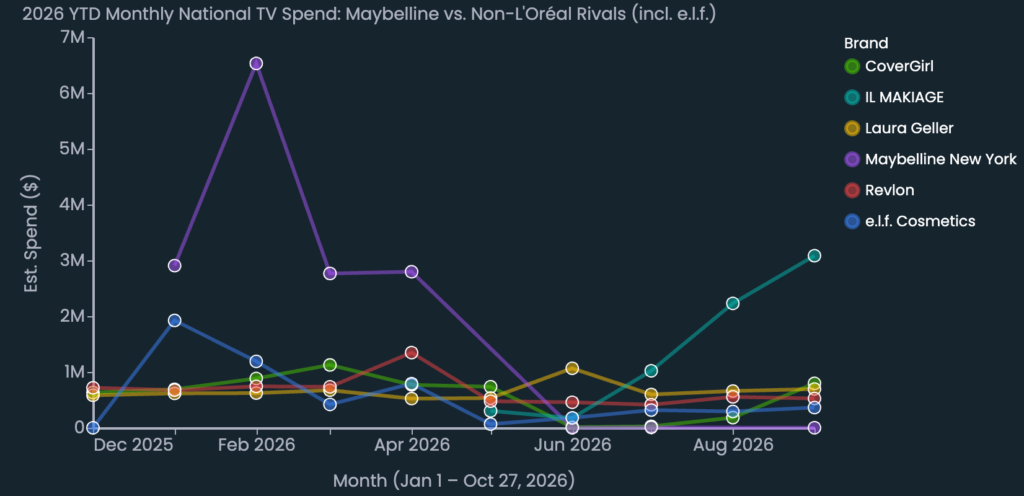
- e.l.f. ran into Maybelline head-on in the spring. It spent $1.9M in February and $1.2M in March, the same months as Maybelline’s lipstick and mascara launches. After that it dropped to about $0.1–0.4M a month:
- e.l.f. paid a lot per spot: about $6,400 per airing in February (302 airings for $1.9M), compared with about $1,340 for Maybelline. That points to some expensive placements (tentpoles or premium programs such as the Puppy Bowl, Milan Olympics, iHeart Music Awards) rather than broad coverage, which fits its $11.40 CPM. However, Univision and NBC’s morning shows took about 40% of the brand’s spend combined.
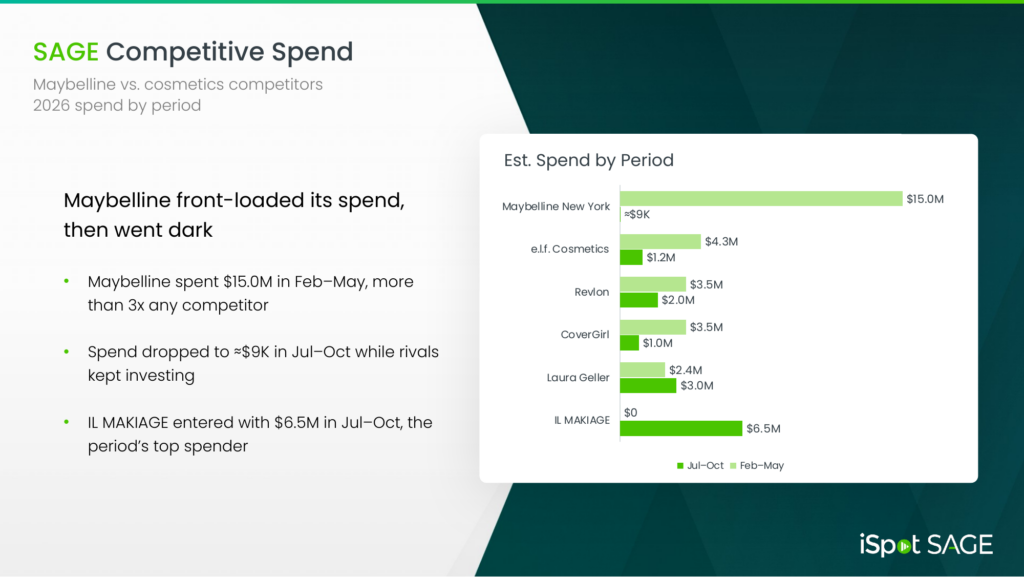
- Spring belonged to Maybelline: from February to May it outspent every rival on this chart by 3.5 to 4 times.
- e.l.f. and Maybelline lean heavily on Univision. Maybelline put 14% of its 2026 spend there, at a $21.97 CPM. Both brands also bought NBC in high-cost, low-volume packages. So in the spring, the two brands competed directly on Spanish-language TV and NBC.
- The second half of 2026 so far belongs to IL MAKIAGE and Laura Geller. Together they spent $9.5M from July to October while Maybelline spent almost nothing.
- e.l.f. paid a lot per spot: about $6,400 per airing in February (302 airings for $1.9M), compared with about $1,340 for Maybelline. That points to some expensive placements (tentpoles or premium programs such as the Puppy Bowl, Milan Olympics, iHeart Music Awards) rather than broad coverage, which fits its $11.40 CPM. However, Univision and NBC’s morning shows took about 40% of the brand’s spend combined.
Ineffective creative, even if delivered to the right audience, results in missed opportunity and performance shortfalls. Great creative delivered poorly also results in failed campaigns.
Schedule a demo to find out how your brand can partner with iSpot to quickly solve both challenges simultaneously, delivering high-performing creative while boosting the effectiveness of planning and in-market execution to achieve—and outperform—campaign objectives.
Creative Agency: Nice and Serious