As the larger media landscape continues to face fragmentation, it’s essential that advertisers have a clear, unified view of their audiences and the signals that help measure campaign performance. Full-funnel measurement, not just performance measurement, helps to create this unified view.
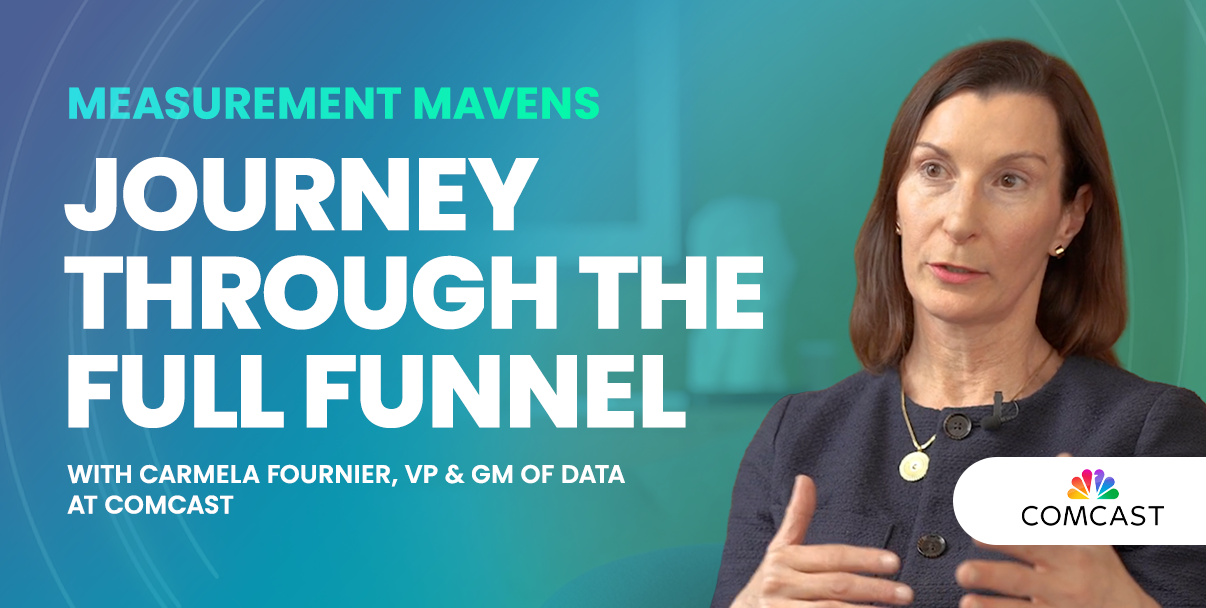
In this Measurement Mavens, Carmela Fournier, VP & GM of Data at Comcast, discusses how her team is navigating fragmentation, connecting deterministic data, and using clean rooms to better understand campaign outcomes. She also offers advice for those entering the advertising and measurement industry, emphasizing the importance of data, measurement, and being comfortable with ambiguity in an era of rapid change.
Watch the full interview:
This conversation has been lightly condensed and edited for clarity.
How are you thinking about fragmentation?
Carmela Fournier: We think of fragmentation really not just around fragmentation of viewership, but also of signals and signal loss. We want to be able to use our deterministic data and work with our advertisers to tie in their first party data to deterministic sources, in order to stitch it together so that we have a unified view of inventory. We want to be able to deliver against that inventory, against the campaigns and the advertiser’s campaign goals.
Fragmentation is really around partnering closely in a collaborative way to drive the outcomes that advertisers are looking for. We also think that utilizing clean rooms is one way that allows for more collaboration to tie the performance, goals, and objectives to the actual results that we can deliver.
How are you thinking about measurement and outcomes today?
Carmela Fournier: We think of it as full funnel measurement, not just performance measurement. We know that TV is a performance medium across the entire funnel. One of the measurement moments we had was really to translate how an increase of brand awareness drove more website visits, consideration, and then all the way down to the bottom of the funnel.
So for this particular campaign that we measured full funnel, they saw an increase of 10x to brand awareness, which translated into a 42x increase of website visits. That translated into 2.3x return on ad spend for that client. They were very pleased with those results, but they had not seen that previously all together, or the relationship between bottom, mid, and top of funnel.
What’s your advice for someone entering advertising and measurement today?
Carmela Fournier: There’s so much change going on right now, and particularly with the increase of adoption of AI, my advice to a new person in this industry would be a couple things. First of all, AI is a powerful tool, but you have to build AI on top of real data, deterministic data. My advice would be to lean into data and measurement and really understand that so that you’re not automating or building conclusions or using AI in a way that is not going to yield the right conclusions or the right optimizations.
The last thing is that with all this change, you really need to be comfortable with ambiguity and be able to navigate that. So in that case, also by leaning into data and measurement, that can be your friend to really help you to navigate and use data to back your conclusions and to navigate the ambiguity.