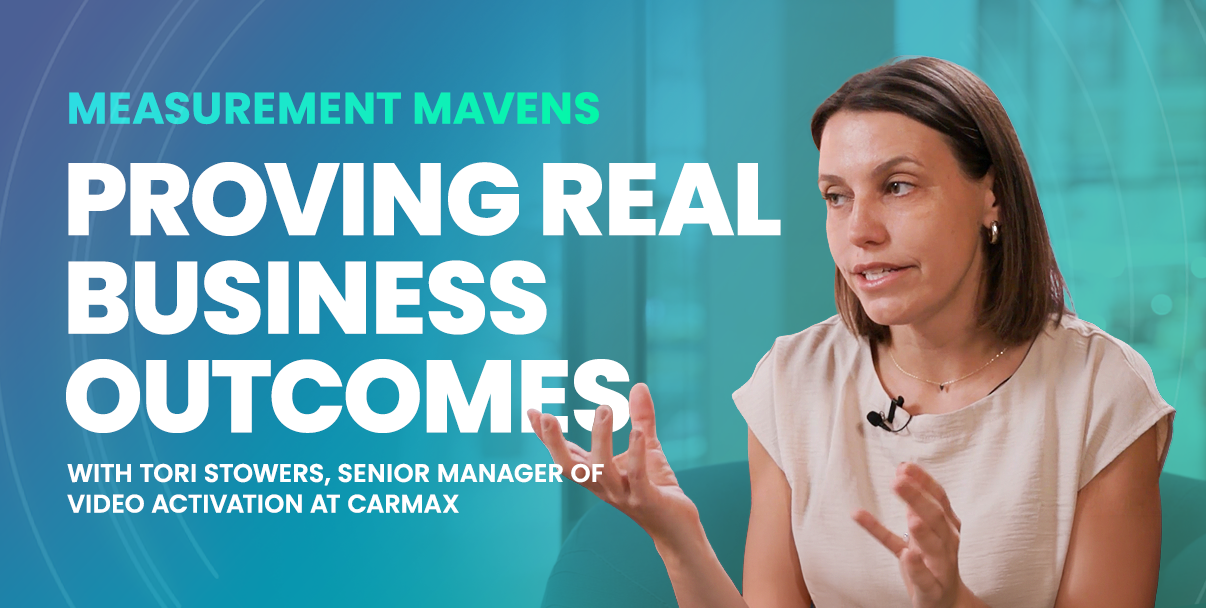
We recently sat down with Tori Stowers, who leads the video and audio activation team at CarMax, the largest used-car retailer in the U.S. Her team is responsible for driving business outcomes across linear TV, CTV, streaming audio and podcasts.
In this Measurement Mavens conversation, Stowers discusses how CarMax thinks about KPIs, why fragmentation requires more consistent and consolidated measurement, and how iSpot is helping the brand connect upper-funnel exposure to lower-funnel business impact. She also shares a recent “measurement moment” around podcast attribution and explains why marketers should keep asking the most important question in media: “So what?”
Watch the full interview:
This conversation has been lightly condensed and edited for clarity.
What KPIs matter most to you and why?
Tori Stowers: The KPIs that matter most to us are the ones tied to real business outcomes. That looks a little bit different across our customer journey and across the different channels we’re operating on.
More specifically, in the TV and brand space, where it’s a little bit harder to get to those outcomes, our team has done a lot of great work and put a lot of analytical rigor behind finding real-time signals that are actually tied to business outcomes.
That includes media proxy metrics like impressions, reach and frequency, in combination with very specific site visitation behavior over time. Those signals are tied to our brand health KPIs, including positive impression, awareness and favorability, which we know also drive sales impact. So it’s very much a KPI and optimization approach where A equals B, which equals C.
How do you view this modern moment of fragmentation? What are some of the opportunities and challenges?
Tori Stowers: Fragmentation is definitely both a challenge and an opportunity for us. Consumers are consuming media in more ways than ever before, but that also gives us the opportunity to engage with them in more ways than ever before.
The way we’re trying to approach fragmentation right now is by looking more holistically across our media. We’re taking fragmentation management out of siloed channel and platform plays and moving it into places where we can address fragmentation more holistically and across channels.
For CarMax, we’re really focused on doing this in two ways. The first is driving consistency in our measurement approaches and how we measure certain outcomes across all these different platforms and channels. The second is consolidation.
Where it makes sense for our media partners and measurement partners, we’re looking for areas where we can have a consolidated view. That not only unlocks efficiencies, but also really helps with our customer journey — understanding where the customer is in that moment and making sure we’re addressing them in the right way.
How important is it to bring platforms like YouTube and other walled gardens into a more holistic measurement view?
Tori Stowers: Big ecosystems, especially walled gardens, are important. Whenever we can knock down those walls to get a more holistic approach and a more holistic view across our media, that’s an unlock for us.
It helps us better understand where the customer is in that moment and how best to address them.
How do you think about measuring outcomes, especially in TV and streaming?
Tori Stowers: It’s critical for any marketing dollar we spend that we’re able to figure out what kind of business value and business outcome it drives for us.
This is much harder when you get into the branding and awareness space. In channels like linear, streaming, audio and CTV, you’re trying to tie exposure at an awareness stage all the way down to the business outcome and the business value it’s driving.
We’ve done a lot of work with our measurement teams to find correlations using media proxy metrics and site visitation behavior. That helps us understand what real-time signals we can use to optimize in real time and make sure we’re on track to drive the business outcomes we need for the company.
We’ve also worked hard to make sure we’re constantly reevaluating and retesting those correlations to ensure they are still correct and still driving the sales impact we’re looking for.
How are outcomes helping bring creative and media together in your business?
Tori Stowers: One of the things that’s really exciting that iSpot has unlocked for us is the real-time signals we’re able to use that we know are tied to outcomes — not only at the partner level or media channel level, but also down to the audience, placement and creative level.
What we’re able to do is bring a lot of the real-time optimization you would normally see in acquisition and lower-funnel media up to brand as well. That includes creative optimization.
That results in things like creative rotations, where we’re able to weight up or weight down certain creatives when we see performance pull through in more real time. We’re also able to iterate our creative, make updates to where we think it can drive the most impact, and test new creative and new approaches in the space.
What advice would you give to someone just entering the marketing or advertising space?
Tori Stowers: The piece of advice I would give is to learn the business and how to tie what you’re doing to the real business outcomes that drive value.
That’s easier said than done in a lot of places. Each business comes with its own complexities and its own customer purchase journey cycles that are really important to learn, so you can bring that lens to your media plans and media approach.
The best marketers I’ve seen are the ones who are able to take media approaches and tie them to the business outcomes they’re looking for.
That can be harder to do in some areas. At CarMax, for example, buying a car is a huge decision and a long-consideration purchase journey. Knowing how to tie an exposure-level impression — even just to drive awareness — all the way down to business impact can take a lot of time.
So it’s really important that you keep asking, “So what?” So what if you drove X amount of impressions at X amount of frequency against an audience? So what?
You have to keep asking that question until you can complete the story and tie what you’re doing to the ultimate business impact.