Snickers, in partnership with agency network BBDO, recently expanded its 16-year “You’re Not You When You’re Hungry” platform into the digital age with the launch of “Hungr.AI.”
The digital activation and accompanying ad campaign playfully frame generative AI errors—such as hallucinated facts or overly agreeable responses—as “hungry moments” that can be resolved with a “digital candy bar” served to the AI agent.
Here’s what iSpot’s Creative Assessment platform revealed on actual viewer response to the spot.
The Details:
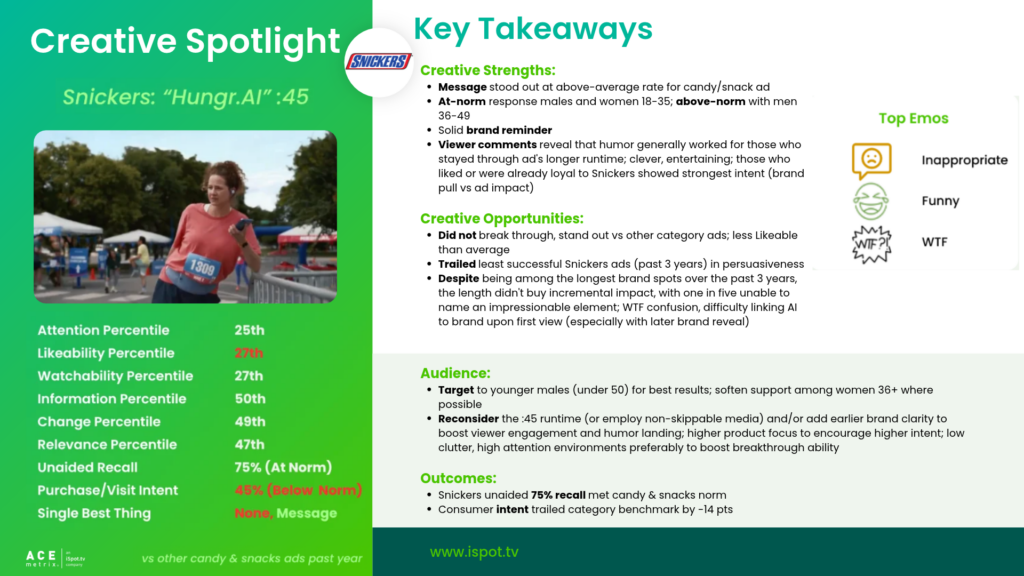
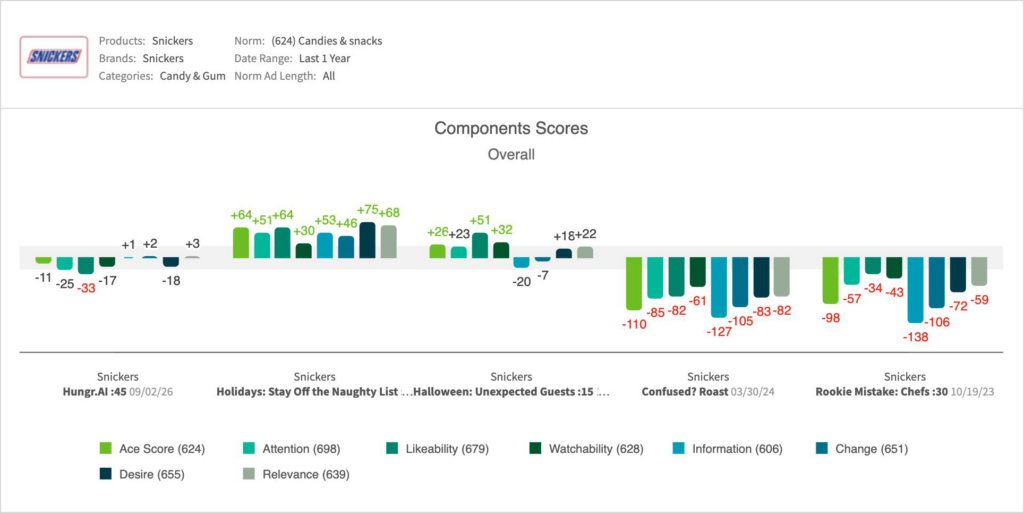
- The :45 “Hunger.AI” landed within normative range of the one-year candy & snacks average on overall response (as measured by Ace Score), at -11 pts under benchmark:
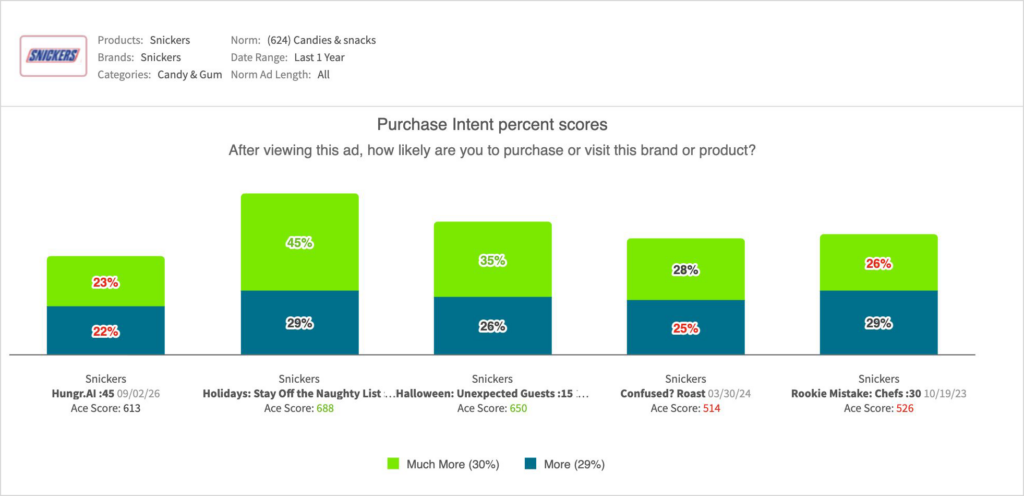
- While U.S. viewers clearly identified it as a Snickers ad (75% unaided recall to reach the category norm), that recognition didn’t translate into an increased desire to buy. After a single view, just 45% reported higher Snickers purchase intent, which trailed the average candy & snack ad by -14 pts.
- This spot struggled to break through as well, with both Attention and Likeability ranking near the lower quartile of candy & snack ads. None of the key creative performance metrics outpaced benchmark levels, but most came within the average spot; not standing out, but not outright failing.
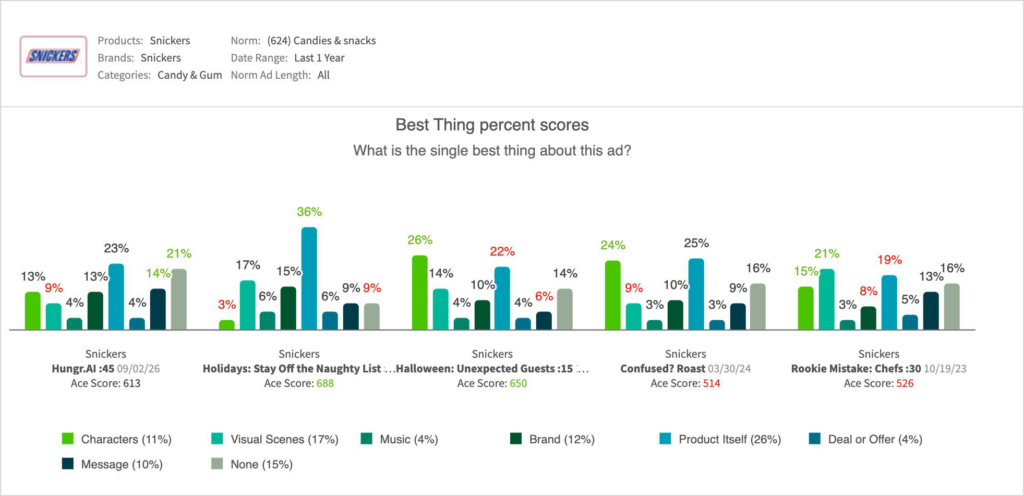
- The bright spot was that the message made a disproportionate impression on viewers, with 14% naming it the Single Best Thing about the creative (vs 10% norm); however, an above-norm 21% walked away with nothing truly memorable standing out (+6 pts above the average category ad). The extended length didn’t buy an incremental impact here.
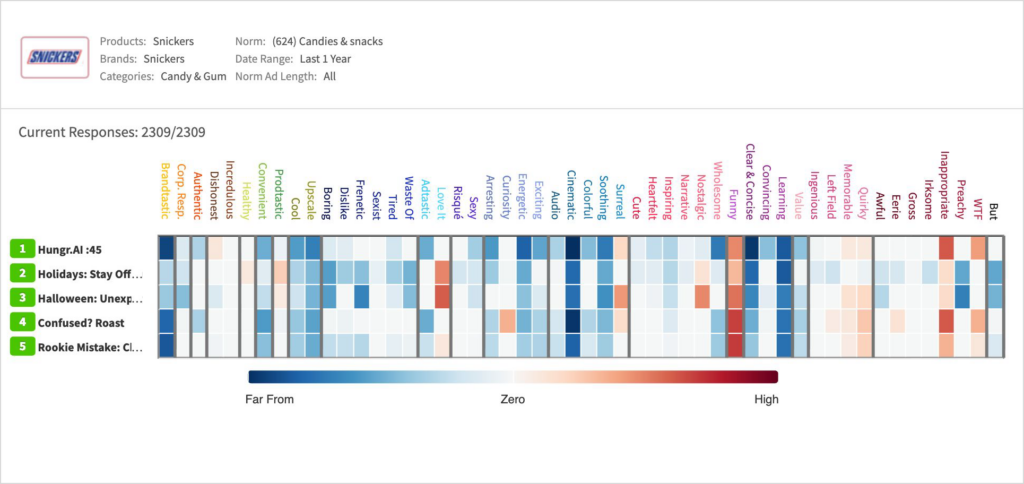
- While not particularly polarizing, the summary word cloud of viewer verbatims on the ad reflects conflicting responses ranging from “funny,” “good,” and “love” alongside “boring,” “confused,” and “confusing.” Tellingly, the leading emotion measured in these comments was Inappropriate ahead of Funny (and WTF not far behind). The strongest emotional reactions the ad generated weren’t just delight or amusement — they were confusion and discomfort. This may be a case where the ‘surprise’ branding not appearing until the second half of the spot (and not with full clarity until the end) worked against the spot.
- Males 36-49 were the standout audience (+51 pts above norm) with good response also measured among males 18-35 (+21 pts). Meanwhile, female 36+ did not connect positively.
- If this creative runs as-is, Snickers might weight media toward males 36-49 and avoid over-indexing female audiences 36+, where the gaps are largest.
- While U.S. viewers clearly identified it as a Snickers ad (75% unaided recall to reach the category norm), that recognition didn’t translate into an increased desire to buy. After a single view, just 45% reported higher Snickers purchase intent, which trailed the average candy & snack ad by -14 pts.
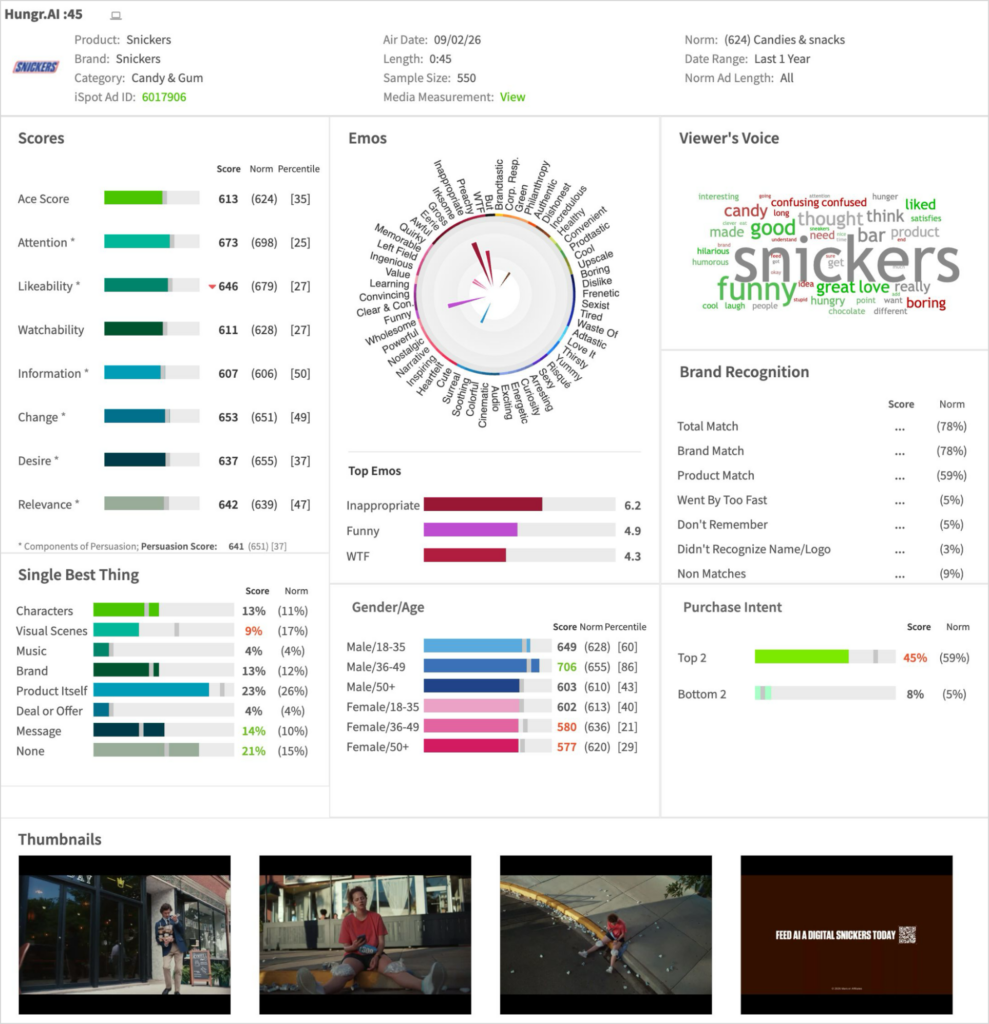
- The iSpot SAGE AI Creative agent evaluated the most prevalent and persuasive themes in viewer sentiment on the :45 “Hungr.AI”, which identified that the largest ‘like’ theme was Humor at 18.5% of respondents — but on persuasion this theme was essentially at benchmark (60%). This suggests that the humor drove laughter but not purchase intent at any higher rate among viewers that found it funny:
- The strongest conversion drivers were smaller, higher-intensity segments: AI Integration (4.6% reach, 77% Top 2 Box theme intent), Clever Concept (5.4%, 73%), and Engaging & Entertaining (8.5%, 71%).
- Subverted Expectations – those being surprised by the narrative – actually tracked below the category benchmark persuasion at 55%.
- Themes are not mutually exclusive (a single respondent’s commentary may reflect multiple themes). Across all of the themes that outpaced the 59% category benchmark intent by at least 3 points, an average 70% Top 2 Box intent was reported.
- The two passive positive themes — Brand Affinity and Positive (general) — together accounted for 20% of respondents and averaged 66% Top-2-Box theme intent. They were above benchmark, but the ad was likely getting credit it didn’t fully earn; Snickers’ brand strength was doing the work here, not the AI creative.
- Four other ‘like’ themes that reflected active cognitive or emotional engagement with the ad — not just passive amusement — represented a high-converting but somewhat narrow 23% of the audience (maximum, depending on overlap of themes within individual comments), averaging 73% Top-2-Box — 14 points above benchmark. Strong signal, limited reach.
- The challenge is that the remaining respondents either landed at benchmark (Humor) or below it (‘dislike’ themes), which pulled the overall ad Top-2-Box intent down to 45% — well below the 59% category average.
- The strongest conversion drivers were smaller, higher-intensity segments: AI Integration (4.6% reach, 77% Top 2 Box theme intent), Clever Concept (5.4%, 73%), and Engaging & Entertaining (8.5%, 71%).
Ad Theme Strength vs. 59% Category Benchmark (Hungr.AI :45)
Sample comments on “Hungr.AI” :45
“I was hesitant at first, especially since AI being mentioned or used in advertisements usually reduces quality for me, alongside my likelihood of actually watching. But then I kept watching and got a laugh when they said AI needed a Snickers.”
Female 18-35
“I thought the ad was for an AI app, but it was actually for Snickers. The humor was very subtle which made it much more enjoyable.”
Male 50+
“It was okay, not bold or funny enough for Snickers. They’re a company that I expect to be the standard of attention grabbing, memorable commercials.”
Male 36-49
“Was it about AI? Was it supposed to be positive or negative about AI? One mention of a Snickers, that was confusing.”
Female 18-35
“It’s hilarious and I like how it features AI because I HATE when I just want a simple answer, but since google uses AI, instead of a straight answer, I get a word salad of conflicting information.”
Female 36-49
“It took forever to figure out what it was for and the product was flashed for a brief moment only once too, so if you blinked you would still be lost on what it was about.”
Male 50+
“I think it was funny how they used the same message they always have, but updated it with current times. Funny Snickers commercial as always!”
Female 18-35
“I didn’t really get the whole phone part of the ad. I would have liked to see more of the product.”
Male 18-35
“It was pretty amusing since everything is about AI now, to move in the direction of it getting hungry and giving bad advice.”
Male 36-49
“Absolutely terrible. AI is awful and I don’t think people should be using it at all. Feeding AI a Snickers? Really stupid. Whoever thought of that should be demoted.”
Female 18-35
“It was boring and didn’t really make sense or flow. It was also kind of depressing.”
Female 36-49
“Snickers was the ad logo. And I love Snickers. I can eat them all day and never get full.”
Male 36-49
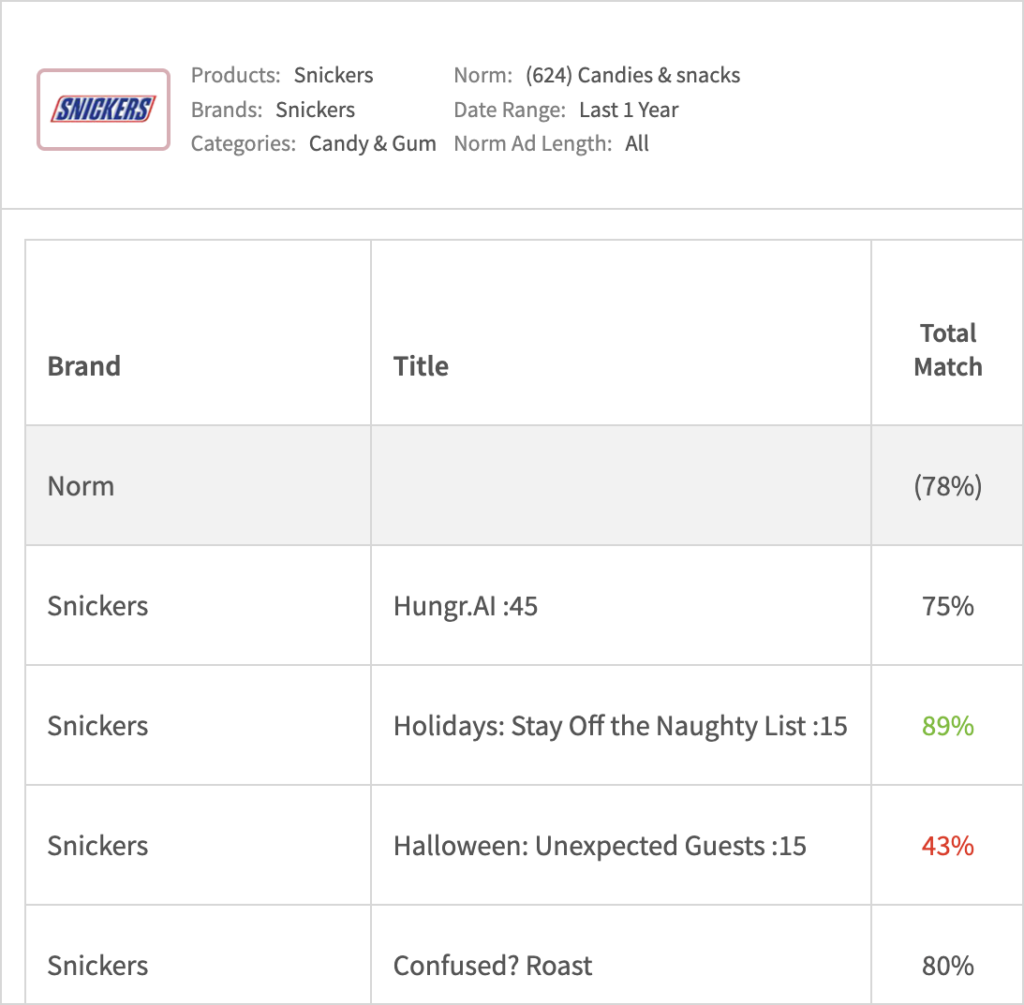
- Compared to the best received and worst received Snickers ads (past three years), “Hungr.AI” held its own on brand recognition and on message as a Single Best Thing driver:
- Snickers’ :15 “Holidays: Stay Off the Naughty List” and :15 “Halloween: Unexpected Guests” beat it decisively on overall response, Top 2 Box intent, and nearly every component score. Even against the two weaker legacy spots, “Hunger.AI” introduced a negative emotional signal (Inappropriate/WTF) that the :30 “Rookie Mistake: Chefs” did not carry at the same intensity.
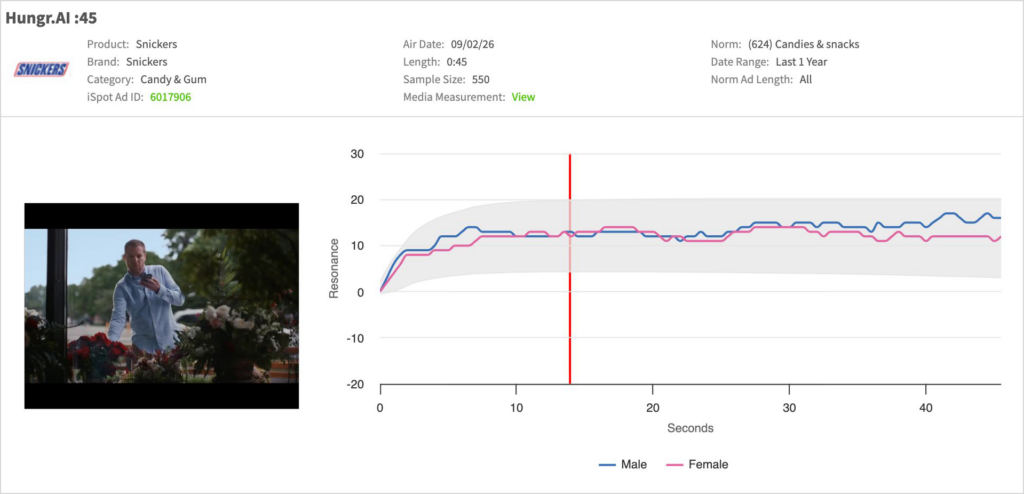
- Flattening engagement among both men and women through the multiple storylines in the :45 “Hungr.ai” prior to the clear product reveal points to potential for a cleaner narrative and brand/product connection in the shorter forms:
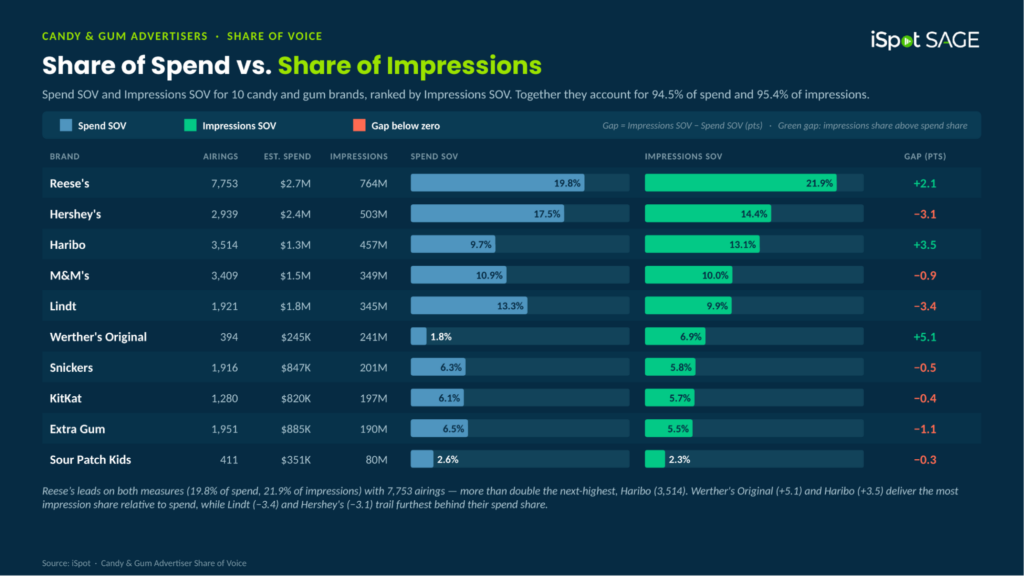
- iSpot’s SAGE Media AI agent summarized the leading candy advertisers on linear over the 30 days ending 9/13/26 with the following insights:
- Reese’s and Hershey’s — both Hershey Company brands — together commanded over 1.26 billion TV impressions in the past 30 days, giving Hershey structural dominance over the entire candy category in this outlet.
- Reese’s alone delivered 764M impressions on $2.68M spend across 7,753 airings — nearly 40% more impressions than the #2 brand. When you add Hershey’s (503M) and stablemate KitKat (197M), the Hershey Company footprint dwarfs every independent competitor. Mars brands (M&M’s, Snickers) and European players (Haribo, Lindt) are fighting for scraps in the mid-tier.
- Reese’s converted 19.84% spend SOV into 21.91% impression SOV — outdelivering its budget — while Lindt burned 13.32% of category spend for just 9.91% of impressions, the category’s clearest efficiency loser.
- Snickers (“Hungr.AI has not aired on linear to date) converted its 6.26% spend SOV into 5.77% impression SOV, suggesting optimization opportunities.
- Reese’s and Hershey’s — both Hershey Company brands — together commanded over 1.26 billion TV impressions in the past 30 days, giving Hershey structural dominance over the entire candy category in this outlet.
Ineffective creative, even if delivered to the right audience, results in missed opportunity and performance shortfalls. Great creative delivered poorly also results in failed campaigns.
Schedule a demo to find out how your brand can partner with iSpot to quickly solve both challenges simultaneously, delivering high-performing creative while boosting the effectiveness of planning and in-market execution to achieve—and outperform—campaign objectives.
Creative Agency: BBDO