Brands are navigating an absolute smorgasbord of channels, platforms, and data signals these days. For Molson Coors, that makes having a clear view of performance and understanding which metrics truly reflect business impact more important than ever.
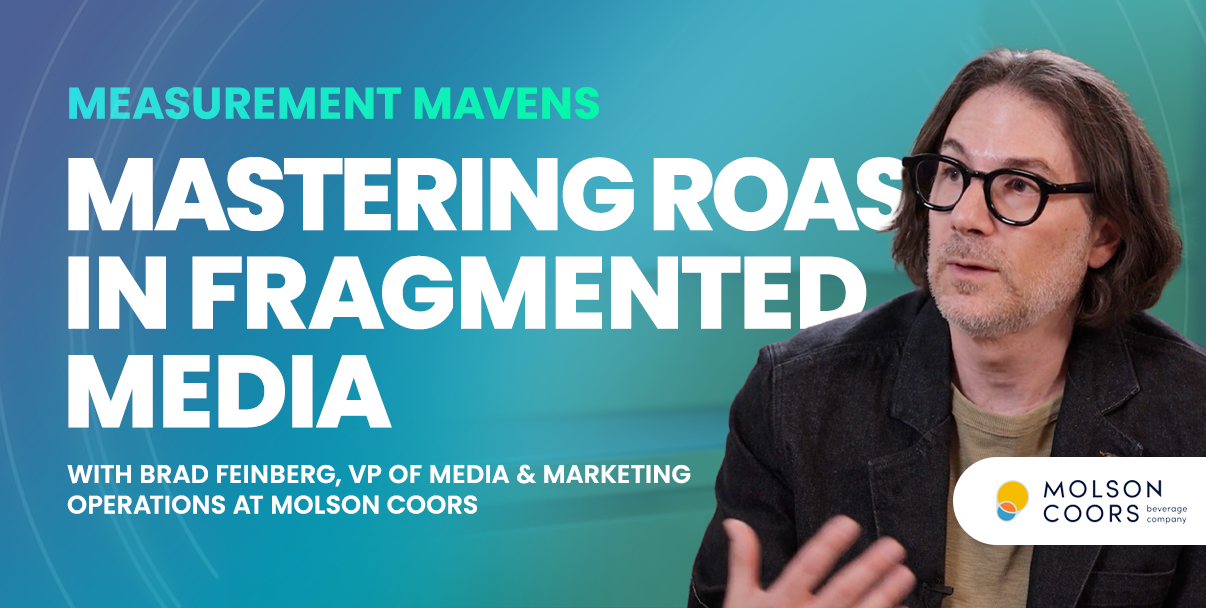
In this Measurement Mavens, Brad Feinberg, VP of Media & Marketing Operations at Molson Coors, discusses the metrics that matter most to the company, how his team approaches measurement across an increasingly fragmented media landscape, and what they’ve learned about connecting media and creative to business outcomes.
Watch the full interview:
This conversation has been lightly condensed and edited for clarity.
What are some of the metrics that matter most to Molson Coors?
Brad Feinberg: There are three that matter the most. The first one is ROAS, which is something we measure in our marketing measurement methodology. ROAS is something we measure on a monthly basis across our suite of brands. It’s the primary source of measurements, the goal by which our brands are charged with. They get a ROAS goal at the beginning of the year in terms of improving upon previous periods. That’s something we take really seriously for the business.
The second is sales lift, somewhat related to ROAS. What we really want to understand is if what we’re doing from a marketing and media standpoint, driving incrementally on top of what we would normally do or what the base is, would deliver.
The last is kind of a combination of the two—we call it marketing effectiveness. We’re looking at per dollar spent per volume and using a revenue-based number. Is the marketing really effective? We’ve aligned with that with our Chief Financial Officer and our CMO to make sure that we’re reporting something that is meaningful as a business impact.
How do you think about the current state of fragmentation, and what may be some of the obstacles and opportunities?
Brad Feinberg: Walled gardens have been the main obstacle for getting a really clear view across the different media channels in terms of driving performance and understanding the universes can be different between those platforms. There are always new forms of media available and it feels like it’s ever changing. Podcasting is an emerging call, it is already massive. From a scale standpoint, the more channels we want to adopt or consider, the more we want to get clear eyes on. Is it driving performance with the metrics that I described earlier?
Fragmentation is always a challenge because not everything can be measured the same. We do try to bring as much—if not all—of our media into one solution. We do this to get better at identifying the right ways at which each channel is performing to drive our overall business. It is important to get as many of those channels into one unified solution to be able to do that. The other missing or complicated piece to that is, obviously we do a lot of local media on top of national media, which we have other methodologies to get that. But there’s no way for us today to look at national plus local holistically in a particular market to see how things are performing. It’s another layer of fragmentation when you think about media.
The more sophisticated we get, the more media channels are available digitally creating new signals. The question is, how do we consolidate all those signals into one solution whereby we feel confident, and the data that they spit out is actually meaningful and accurate to make a decision?
How do you measure outcomes?
Brad Feinberg: We measure outcomes by looking at our media plans and creative collectively to understand what the key drivers are to driving overall performance. Some of the interesting findings there is that we can get very granular to understand questions like, “Is it the actual creative or is it the media that is driving the performance?”
Can we identify a better idea or answer? Is a piece of copy worn out? Is a piece of copy not even worn in yet? Does it need more breathing room out in the world to see how it’s going to perform? Can we get a quick read on something that’s not performing well? What can we do to make adjustments to our media mix to get a better outcome in overall performance? The metrics I described earlier are the key metrics we live by and look at. What we’re doing is dissecting our marketing plans on a channel by channel, placement by placement basis, and even creative basis.
We can look at some of our creative channels, like in social media, and we can actually see which post is performing better than another, and then start to create norms or insights around some of those things. That turns into playbooks for brand teams to operate within a particular channel.
What is one significant measurement moment that you’ve had recently?
Brad Feinberg: One of the things that we’ve learned that I think has been really instrumental and valuable is that brand teams get tired of their creative faster than the actual consumers do. That was a hypothesis that we wanted to play out. We were able to show our brand marketers using the measurement tools we have available that you do not need as much creative as you think you do out in the world, and some creatives just continuously perform–cycle over cycle over cycle.
The brand teams wanted to switch to a new piece of copy, and we would give them direction or some confidence and the fact that they can continue to run that copy longer than maybe they initially had planned. The output of that is really valuable, because it means that the brand teams need to create less, which means they have more money to go invest back into working media versus spending a lot of dollars and resources on creating new things that would not necessarily be required. Now, I know there’s an art and science to that, and there are reasons to put new copy out, especially in our category. But we at least had the data to support if they felt like it was something they can do, they can actually run something a lot longer than they potentially planned.
If you were to meet someone fresh out of school getting into the marketing or advertising industry, what would be one piece of advice that you might give them?
Brad Feinberg: I have a college-aged daughter who is majoring in graphic design and wants to go into marketing, and I have a high school son who’s a junior in high school who also thinks he wants a career in marketing. This hits home for me because I have these conversations with my own children all the time.
One of the things I say to them is that they actually have to run towards or embrace AI, versus feeling like it is something that is scary or is the wrong thing. I blame the education system on that because I think a lot of these college and high school kids are being taught to not use AI, and I understand why because they want to protect.
They want the kids to learn on their own and not kind of learn from AI. However, I think those that come up in marketing and understand how to prompt and how to read the material, how to code—but through natural language processing—and understand the models are going to have a leg up, because I do think that’s what both brands and agencies are looking for. It’s a new skill set for the future of marketing. If you don’t have those skills, I think you’re going to be potentially on the outside looking in.
What are you most excited about moving forward?
Brad Feinberg: I’m most excited about the combination of creative and media into one solution at your fingertips to help you make better decisions. It kind of goes with what I was describing earlier: the right signals to make the best, most competent decision for the business. Having those two things together, I think it is like chocolate and peanut butter. You can’t break the two apart.
I was excited to see the advancements in what iSpot is doing to bring those things together and the level of granularity by which you can start to dissect some of that information and get to the heart of whatever that question may be.
The second is just the expansion into more channels. It was exciting to see what iSpot’s doing with YouTube, what’s potentially on the horizon with some other big household name brand channels that I know we would all like to see where it’d be available in-platform because the more of the big players that are there, the more useful the information.