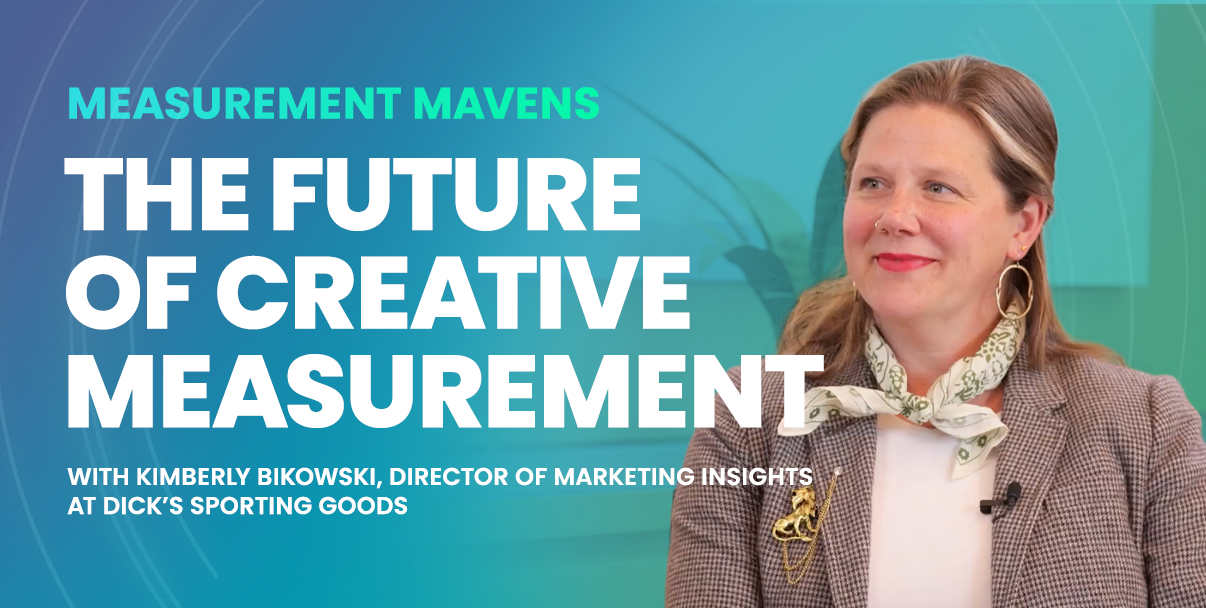
Kimberly Bikowski, Director of Marketing Insights for Dick’s Sporting Goods, has over a decade of experience in product development and marketing insights. At Dick’s, Bikowski told us, they prioritize the integration of media and creative – and that integration has been instrumental in refining Dick’s demographic targeting. She also emphasized that becoming an iconic brand hinges on staying consistently present across multiple touchpoints — from social media to in-store experiences — while tracking key metrics like impressions, frequency, and repeat purchasers to ensure customers remain engaged and continue to choose Dick’s Sporting Goods.
After a recent demo guiding Bikowski and others through iSpot’s new creative measurement integration, we sat down with Bikowski for a longer conversation about what KPIs keep her up at night and how to break down the barriers keeping creative and media siloed.
Watch the full interview:
This conversation has been lightly condensed and edited for clarity.
What KPIs matter most to you, and how does iSpot factor into that?
Kimberly Bikowski: We’ve been using Ace metrics for about 12 years, and I would say that from the time that we started utilizing Ace metrics for a creative measurement, it’s really kind of changed throughout the years on what KPIs are really important to us. The KPIs that we tend to look at is brand recall — verbatim.
It’s very important for us to really understand from a creative perspective what the audience is saying about different creative measures that we take. We do a lot of pre-testing. Within the pre-testing, those KPIs, especially the brand recall, the awareness, even the emos, and also the custom questions are really important for us to be able to ground ourselves in what’s doing well and what’s not doing well. We’re able to take that back to our creative leadership, and they’re able to kind of make some of those changes before it goes into full production.
What have you learned that’s particularly relevant to your work with regard to the verbatim?
Kimberly Bikowski: Verbatim for us are really important. We do take a ton of time to sit and comb through and read through all of the verbatim, because there are certain different nomenclatures that people use that can throw one audience off versus another.
One of the things that we’ve looked at with verbatim is one of our brands — a female brand — and being able to look at the verbatim and understand from her point of view that we weren’t connecting with her as much. The comments that we were getting within the verbatim were, “This doesn’t really feel like the brand that I used to know.” So we’re able to take a lot of those verbatim back and say, “Hey, it’s not coming from us. It’s coming from the voice of our customer that she’s not feeling connected to the brand. What can we do from a creative perspective to bring her back in?” Or do we need to even look at what we’re doing from a brand perspective to see, are we getting off point of what we are originally creating a brand for?
How do you see the evolution of creative and creative measurement? What are some of the opportunities and challenges that you see today?
Kimberly Bikowski: I would say that one of the biggest things is just the efficiency. Things are getting so much faster. And for us, we’ve not taken the stance of putting AI within our advertising. But AI has really helped us be able to pre-test before, and our turnaround time is a lot faster. Being able to generate different things and understand what’s working and what’s not working really helps us up-front on the creative brief. I would say AI has really helped us just speed up some of that creative process time.
What were some of your reactions from the demos today, or even what’s going through your mind in terms of the value creation associated with bringing media and creative closer together?
Kimberly Bikowski: It was amazing. It was so exciting to see. The platform was just so easy when we were taken through it. I think one of the things that I’m most excited about is that a lot of times, media and creative work into separate silos, and it’s not until hindsight that those things come together.
I think one of the biggest things I’m looking forward to with that integration is being able to understand what audiences are reacting to the different creative that we have out there. Creative is not always meant for just a general population, but is this creative really leaning in towards our female customer who’s 35 to 45? If it is, what platforms is she on? Should we be looking at our media on platforms that she’s on more so than a gen-pop perspective? So I think that we’re going to get a lot more efficiency, especially when it comes to who we target with audience.
What’s a more recent “Aha!” measurement moment that you’ve had?
Kimberly Bikowski: One of the biggest ‘aha’ moments is that awareness doesn’t always equal consideration. I think that a couple years ago we were very strong on wanting to increase aided awareness. We want to increase brand awareness. Then you start realizing that you can put noise in the market, but the ultimate thing is, are people going to then consider you when they have the option of spending a dollar with you, or a dollar with somebody else? So I think that was the biggest ‘aha’ moment of like, we can put out great media, but really we need to be able to convert people and convert people into having consideration for us over our competition.
When you think about some of those more up-funnel metrics that define outcomes, what does that look like to you?
Kimberly Bikowski: Clicks are definitely important. Also we look a lot at frequency. So, is the frequency there? Are we top of mind? We’re really trying to look at how we can make ourselves an iconic brand. And in order to become an iconic brand, how frequently are you in somebody’s lives? And that could be from a social perspective, that could be from in-store — bringing them in-store from a traffic perspective. But it could also just be, like, these other touchpoints. That’s really where some of our measurement is: impressions traffic, also repeat purchasers. Do we have lapsed athletes or is that getting reduced because people are more top of mind and people continue to come in to shop with us?