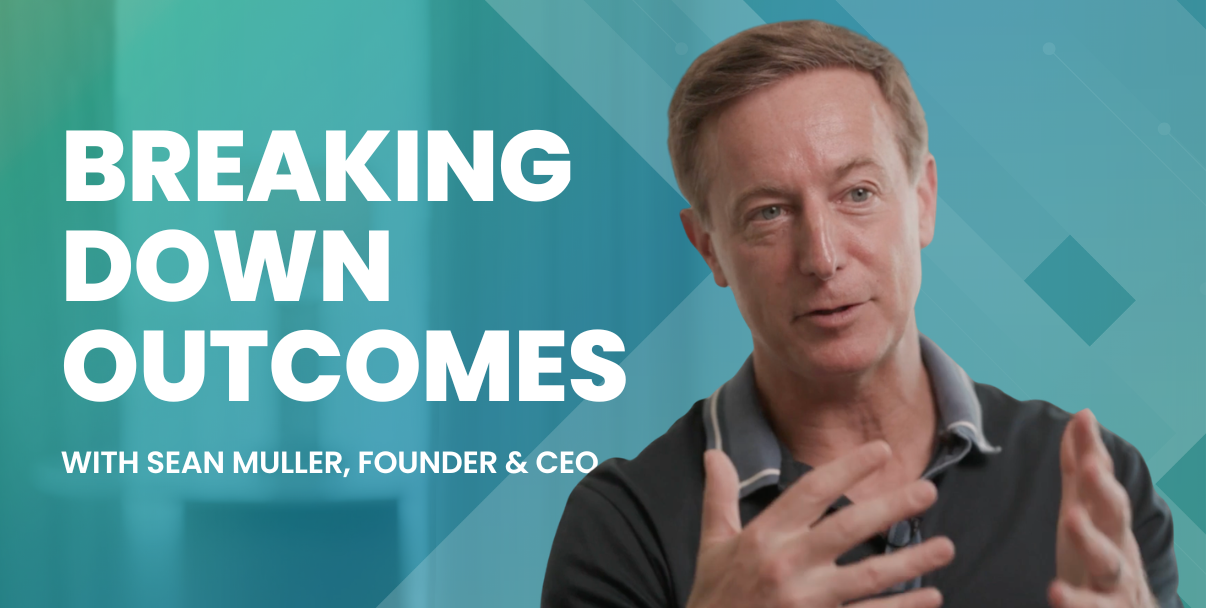
The rapidly accelerating evolution of the modern television and video advertising landscape. With linear viewership contracting and streaming, YouTube, and social video expanding exponentially, advertisers are clamoring for outcomes-based measurement and optimization. So we sat down with iSpot Founder and CEO Sean Muller, whose focus spans the entire cross-platform media lifecycle, to get some answers to our burning outcomes-based questions.
Muller spoke directly to the operational complexities facing today’s Chief Marketing Officers and analytics leaders as they navigate unprecedented media fragmentation, showcasing how iSpot tackles these challenges by utilizing real-time automated ad detection, an extensive footprint of tens of millions of smart TVs and set-top boxes, and advanced deduplication capabilities to eliminate wasted spend and surface incremental reach.
Watch the interview with iSpot Founder and CEO, Sean Muller. Full transcript below.
Obviously, the word on everyone’s lips right now is “outcomes.” How is iSpot’s outcome offering unique and how are you thinking about outcomes today?
Sean Muller: There’s a big difference between outcome signals and outcome measurement. There are a lot of outcome signals out there, and they’re actually pretty easy to acquire. Acquiring outcome signals is fairly easy—if you have money, you can go acquire them. The first-party signals are a little bit harder to acquire because you have to establish relationships with the advertiser.
But outcome measurement is really a whole different field than outcome signals. In outcome measurement first you have to start with: what are you measuring and what are you assessing? In this case we’re measuring TV and video and the effectiveness of each.
So, first, you’ve got to have a system that measures TV and video audiences and delivery that’s trusted by the industry. That already narrows it down to less than a handful of companies right there.
But then secondly, you need to bring the outcome signal and match it to the same identity spine that the audience measurement is matched to.
And then you’ve got to do both multi-touch attribution to account for all the touch points, and then you’ve got to do lift measurement. You got to have both of those things.
Now typically you’ll have to spend many, many years refining those methodologies and strategies as the marketplace starts adopting them, because the marketplace is going to want to really test out the methodologies and the consistency of the data across all the different platforms that are buying.
And then once they trust it, get the marketplace to actually act on it.
So outcome measurement is actually quite complex. Outcome signals are just a small portion of what it takes to put an outcome measurement together.Ultimately, an advertiser needs to adopt an outcome measurement solution that sits across all their media buys and allows them on an apples to apples perspective, to allocate their dollars across the publishers and the DSPs and then optimize within those channels.
And that takes many, many years. At iSpot, we launched our outcome measurement first back in 2017— that’s nine years ago. And we had to go through many, many years of working with many, many advertisers to vet the methodologies and the lift modeling, building control groups, and getting the marketplace to trust it. Nine years to get hundreds and hundreds of the largest TV and video advertisers to trust and adopt our outcome measurement
What does it take between creative, audience, and outcomes? What does it take to make outcomes work?
Sean Muller: I mean what it takes to make outcomes work, number one is robust audience measurement that spans all of TV and video in a unified, deduplicated manner. That’s step one in order to get to an outcome solution that’s going to be used by advertisers.
Number two, obviously you need to understand the right outcome signal by industry, and a lot of times it’s the first party outcome signal. So that has to be integrated with the same ID spine.
Number three, you’ve got to have robust methodologies for the measure, both a conversion rate and a lift number, and provide that for each publisher, each TV network, each DSP in a very, very consistent way.
And then number four, you got to have marketplace adoption.
And what I would tell you is all those things are hard. Maybe the easiest part is just acquiring the outcome signal.
What’s the role of creative in outcomes?
Sean Muller: Creative adds an interesting dimension in outcome measurement because in the old world where we measured purely audiences, the creative didn’t matter, right? You just strictly looked at the audience that was exposed.
Now that we’re bringing an outcome component, the creative has massive bearing on outcomes whether you’re measuring conversion rate or lift. That is another reason why advertisers need an apples-to-apples solution when you’re traversing publishers and TV networks, because you’ve got to look at the same creative and how it’s performing across all of these different channels.
As a publisher, if you want to offer outcome measurement, you need to have a baseline of conversion. You need to have a baseline of lift, and you need to have a baseline for the creative as well.If you don’t have those, it’s going to be really hard to offer an outcome based guarantee or even an outcome based measurement.
And that’s why it’s nearly impossible for publishers and DSPs to offer their own outcome solution, because the advertisers want that to sit across all their buys in a consistent manner.
How does optimization with Roku work?
Sean Muller: We have optimization deals with multiple publishers and DSPs, but Roku is a great example of one where, in addition to providing the measurement of how Roku buys perform from a conversion and an incremental perspective, we actually send Roku an outcome signal with the permission of the advertiser because it includes their first-party data.
That allows Roku to place the buys against audiences that are more likely to convert based on our outcome data, and then that gets verified by our outcome measurement to ensure that they yielded higher conversion rate and higher lift.That’s how outcome optimization works.
We also have a very similar audience optimization where publishers can reach more deduplicated audiences. So in other words, audiences that were not reached via other platforms.
Is iSpot being used as a currency for transactions?
Sean Muller: The primary way iSpot is used today is as a decisioning currency, or an allocation currency, for how much to spend across different publishers and networks and walled gardens.
Now we’re also being used today as a currency for outcome-based guarantees, so the industry is starting to shift a little bit more into outcome based guarantees.
It’s a little more complicated with outcome-based guarantees, because you need to have established baselines for the advertisers, for the creative, and you need to understand the performance across a lot more than just any one publisher.That’s slowly making its way into the marketplace.
But the big, big thing that’s coming now that there’s an established system of record for audience and outcomes, is outcome-based optimization.I predict outcome-based optimization is what’s going to be the biggest thing in the marketplace.Transactional currency will be distributed across the publishers themselves. That’s our point of view on where this is all headed.