
Peloton is shifting its focus from high-intensity output to the pure enjoyment of exercise with its latest creative campaign starring Hudson Williams. The breakout star of Heated Rivalry leads a minute-long cinematic spot that reclaims the phrase “Let Yourself Go,” reframing it as a liberating invitation to find personal freedom through movement.
The campaign, created in-house, marks a strategic pivot for the brand, utilizing a non-sports celebrity for the first time to headline a major push. Directed by Bethany Vargas and set to the iconic rhythm of David Bowie’s “Fame,” the ad follows Williams as he fluidly transitions between a Tread+ run and floor-based strength training.
Here’s what iSpot’s Creative Assessment platform revealed on actual viewer response to the spot.
The Details:
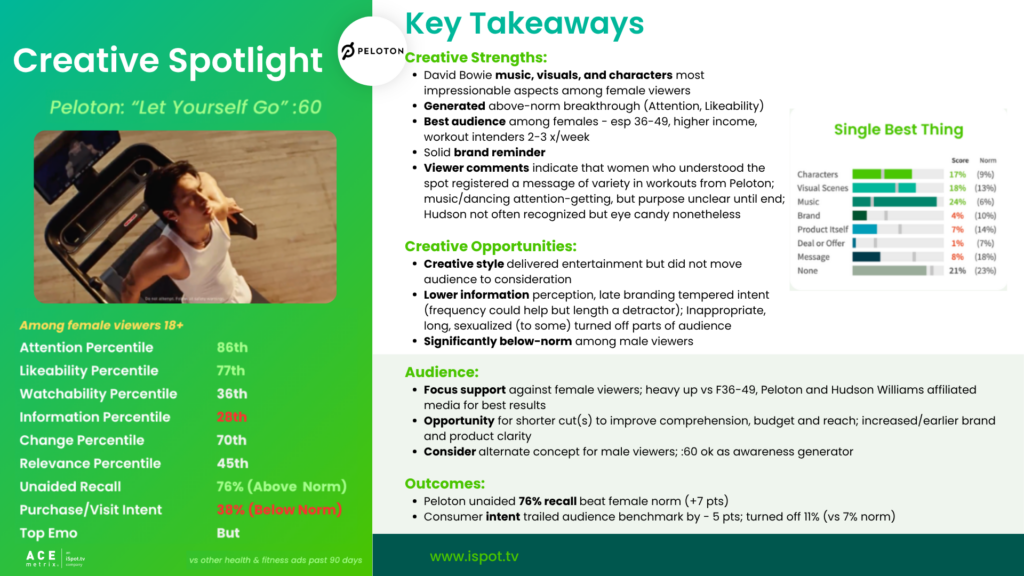
- The :60 “Let Yourself Go” found a much more positive audience among American women, resonating at normative levels for the health & fitness category (past 90 days) overall, and above-norm among F36-49:
- Male viewers did not connect with the creative which points to targeting opportunities as well as different executions to capture this half of your potential audience.
- Of course, the new ad will also surely resonate if placed on programming owned/featuring Williams and/or Peloton.
- Male viewers did not connect with the creative which points to targeting opportunities as well as different executions to capture this half of your potential audience.
Among female viewers:
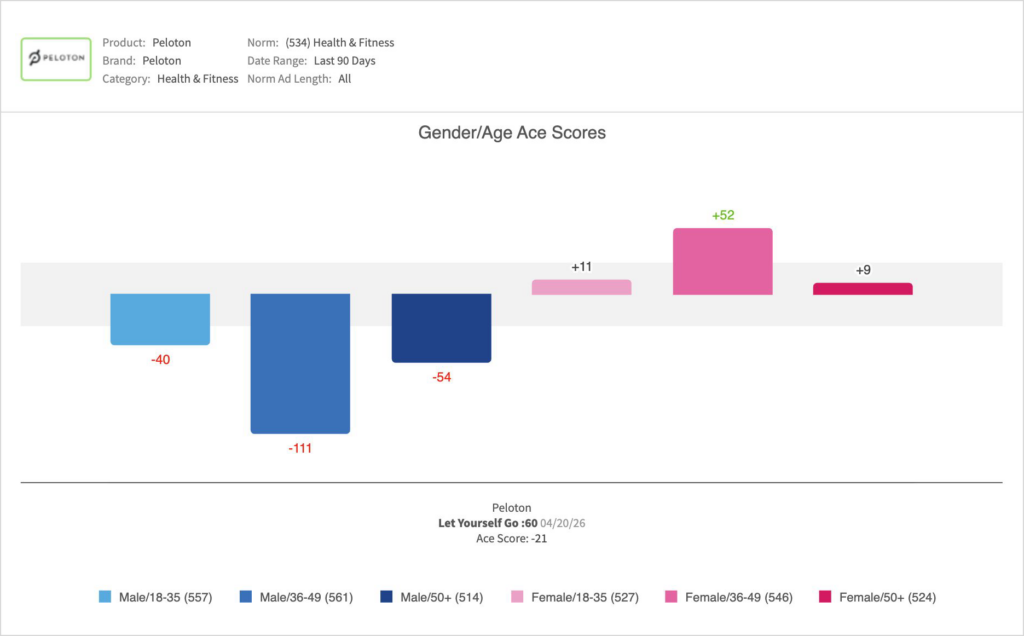
- This spot was an at-norm overall performer among female viewers with selective creative strengths — but a purchase intent gap that demands attention:
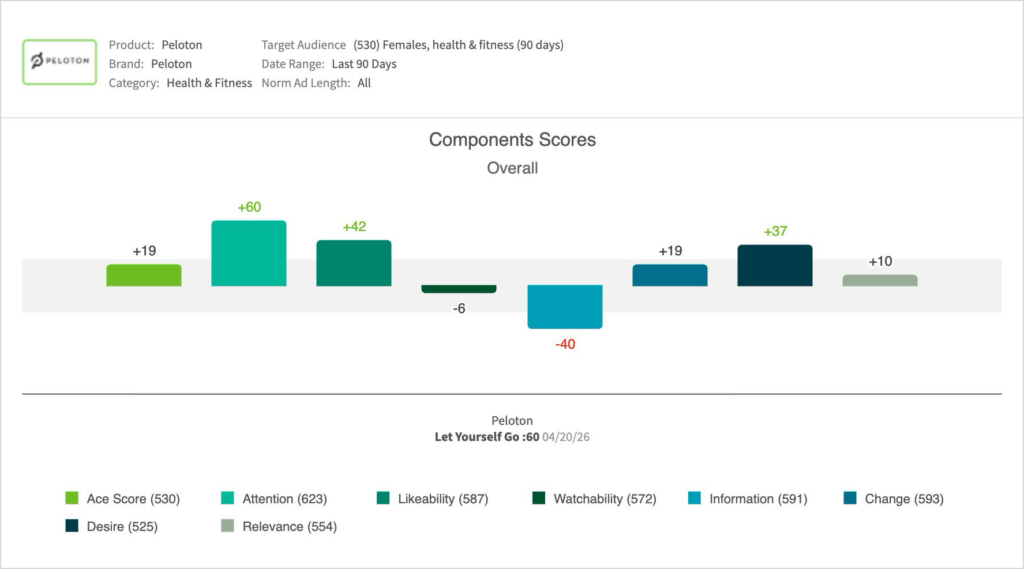
- The overall Ace Score came in +19 pts above the audience norm, reflecting a competent but not exceptional execution for the female audience.
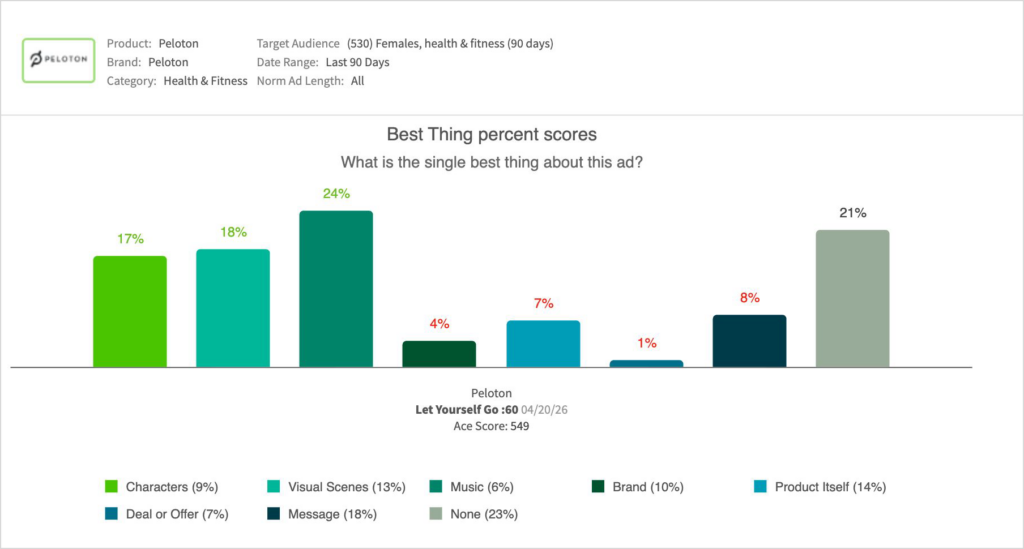
- “Let Yourself Go” was very successful in breaking through, earning Attention and Likeability above benchmarks, driven by the music (24% vs. a 6% norm ), visuals (18% vs. 13% norm) and characters (17% vs. 9% norm) in ratings of the Single Best Thing about the spot. This creative profile suggests a highly entertaining asset for women.
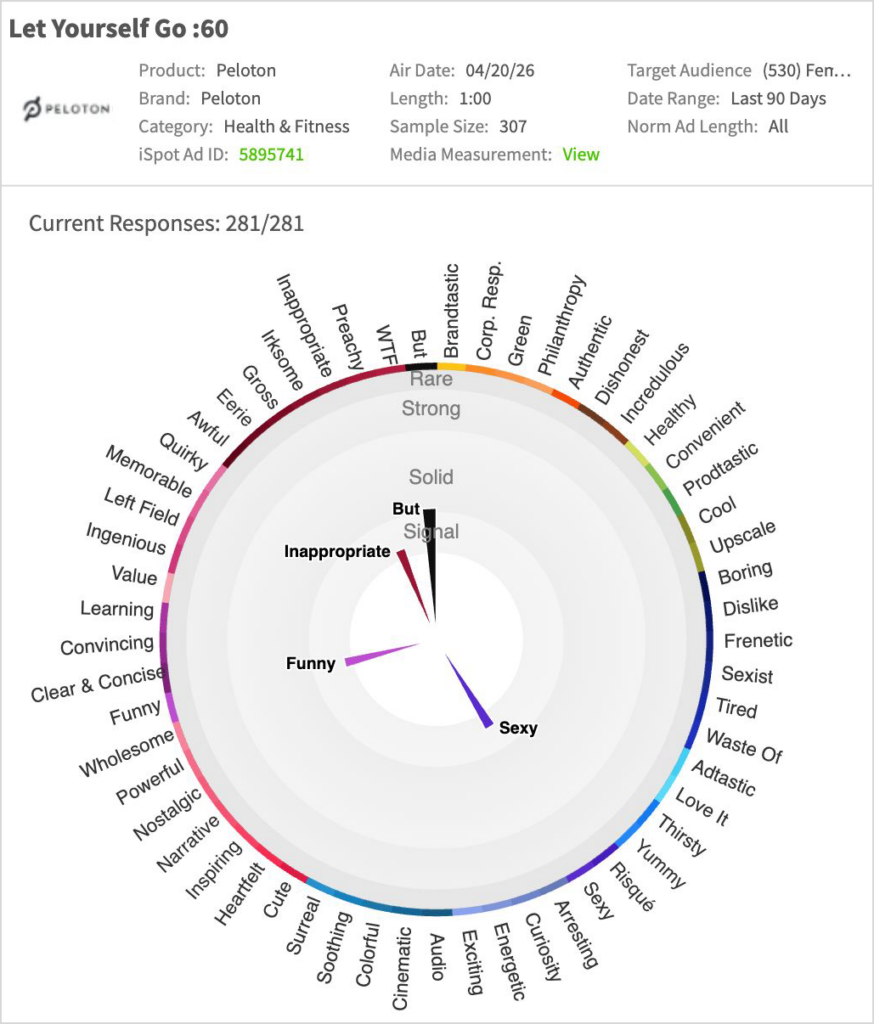
- However, the vague nature of what was being sold, lack of product specifics, and very late branding led to an Information score that trailed norms by -40 pts. The top emotions expressed in viewer comments reflect the Sexy and to some, Inappropriate nature of the presentation, with internal conflict (But) signaling other confusion or reservations.
- The overall Ace Score came in +19 pts above the audience norm, reflecting a competent but not exceptional execution for the female audience.
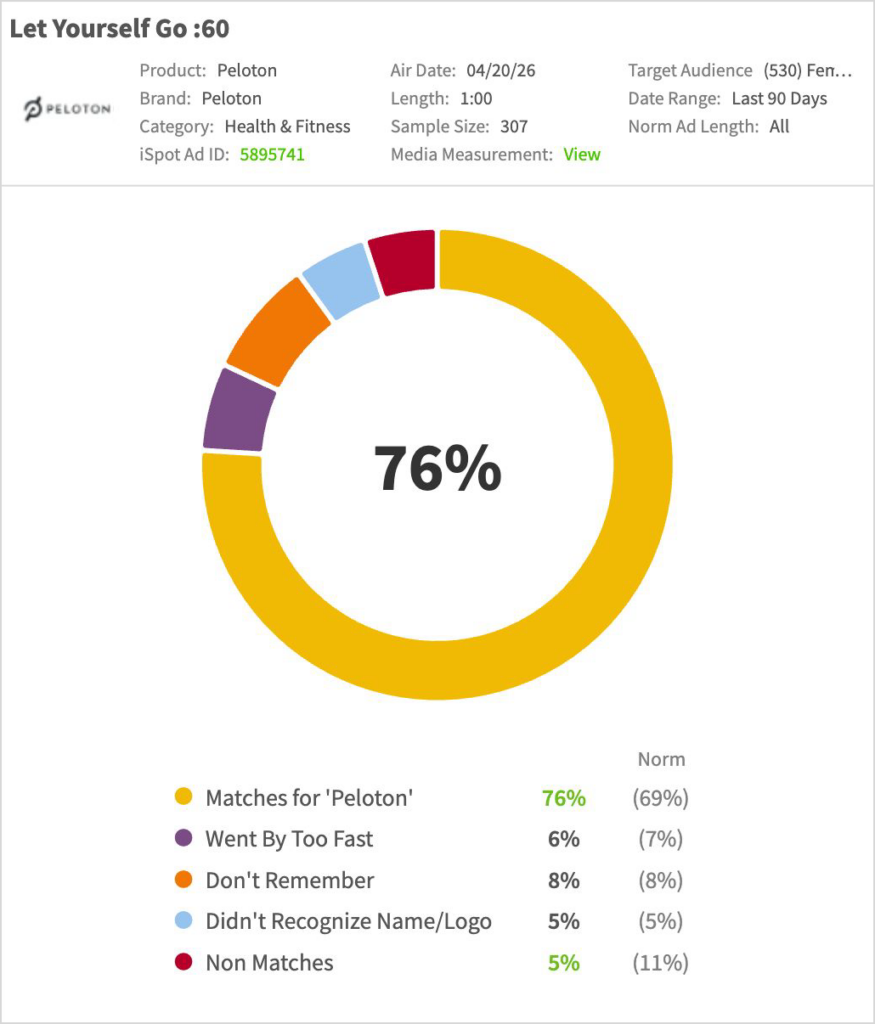
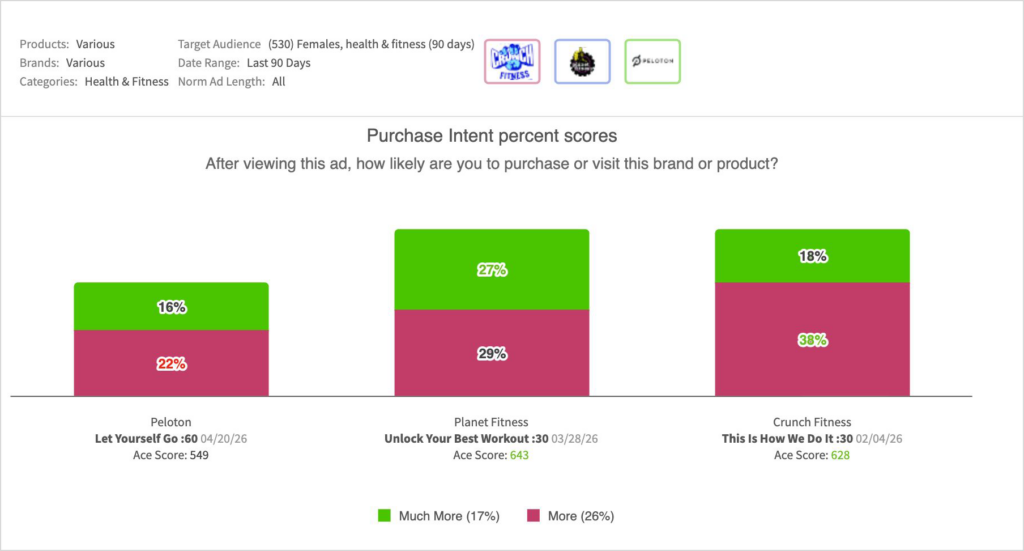
- Despite the limited branding, an above-norm 76% of women recalled the brand on an unaided basis immediately after seeing the spot (+7 pts above average). As such, the creative made a positive brand impression; however, this impression did not translate into consideration:
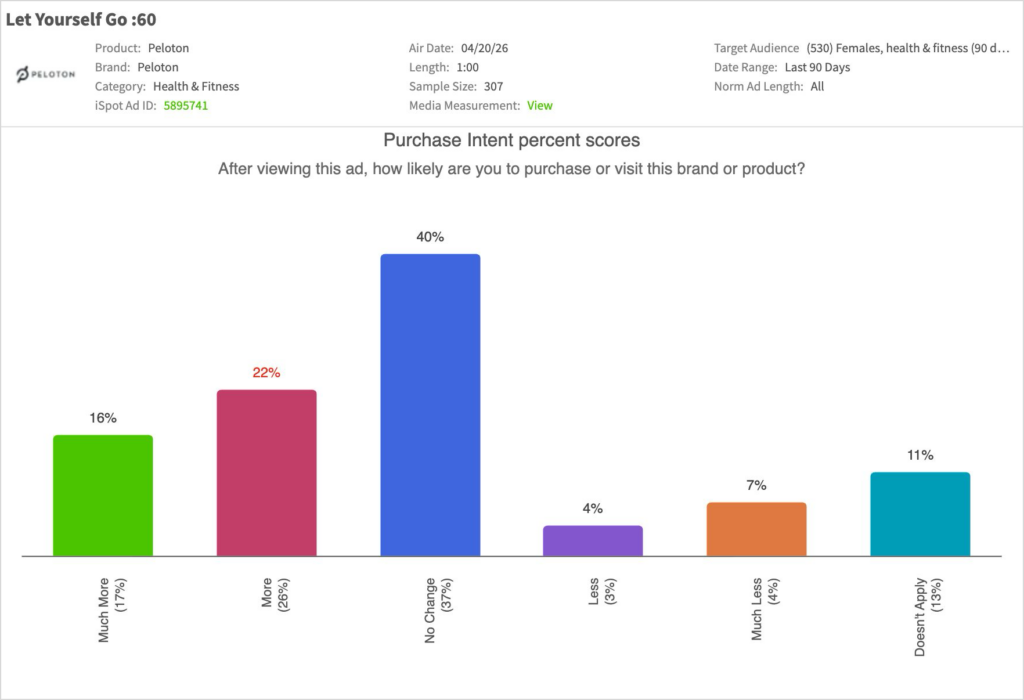
- Just 38% of women reported increased likelihood of considering Peloton as a result of the ad (trailing norms by – 5 pts), and an above-average 11% (vs 7% norm) reported being turned off by the spot.
- Female sentiment on the :60 “Let Yourself Go” indicates that the ad sacrificed clarity for creativity. The execution was bold and generated emotional responses, but the delayed brand reveal significantly undermined its commercial effectiveness (while additional views could help bolster this impression, the longer form could work against the brand as skipping/inattention likelihood increases).
- The male lead (Hudson Williams, not always recognized) generated the breakthrough strength achieved among female viewers along with engagement and memorability. The David Bowie music choice successfully created energy, nostalgia, and emotional engagement as well. However, a significant portion of women had no idea what was being advertised until the final seconds with few brand cues tracking earlier in the spot for anyone not already well familiar with Peloton. In this sense, the ad was simply preaching to the choir.
- For better impact, the brand could introduce Peloton branding far earlier and/or use clearer cues such as a continuous logo, show equipment more prominently and earlier, etc.
- For those who followed the spot/when the message landed, it effectively communicated Peloton’s ecosystem beyond just the bike. The dancing, treadmill, and strength training sequences successfully conveyed variety.
- Perhaps not surprisingly, the prominent sweat visuals generated polarized reactions and a small portion found the creative overly sexualized and/or too long. For these consumers, and especially females who do not generally wish to be sexualized themselves, substance (more explicit fitness benefits and results) over style could improve credibility if a concern to Peloton.
- In today’s attention economy, 60 seconds without clear product context tests viewer patience. This creative concept didn’t evolve enough to justify the length for some women, pointing to opportunities for shorter forms which could also allow for optimizing the budget and/or reach in broader media.
- Just 38% of women reported increased likelihood of considering Peloton as a result of the ad (trailing norms by – 5 pts), and an above-average 11% (vs 7% norm) reported being turned off by the spot.
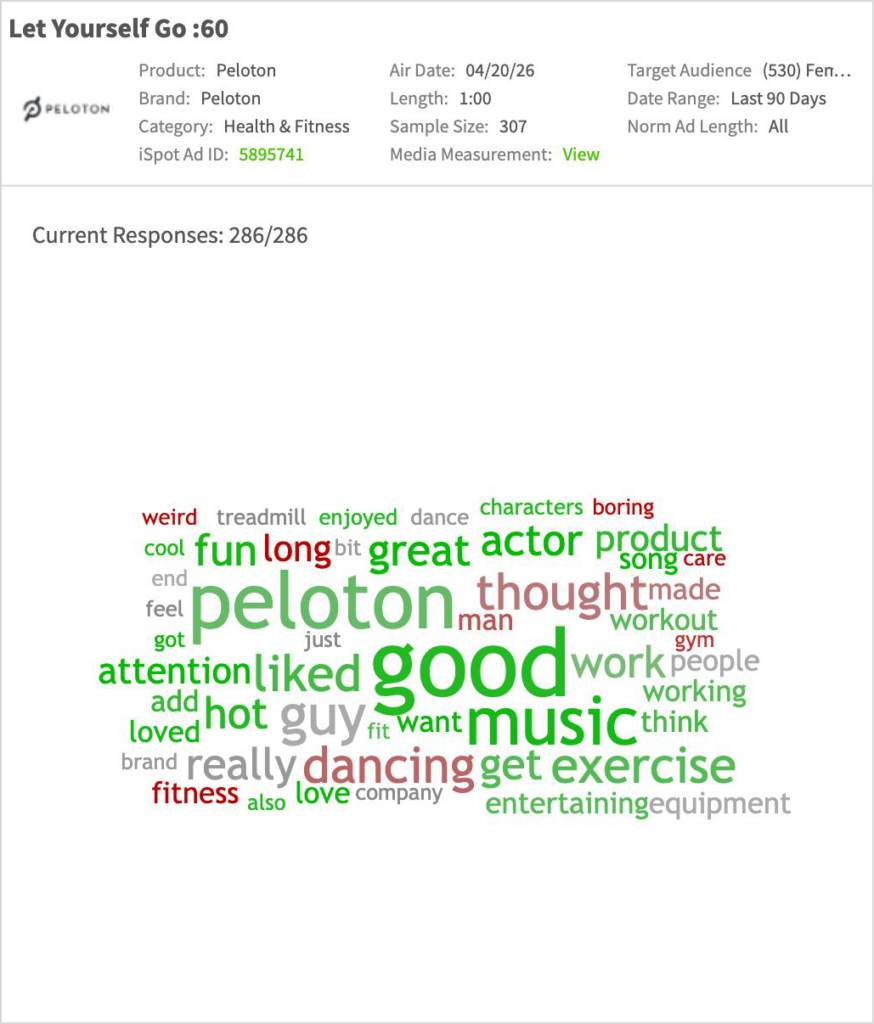
Sample female comments on the “Let Yourself Go”:60
“I think it was a good ad and got the message that Peloton is more than a machine, but allows for multiple exercise experiences.”
Female 36-49
“I have seen this ad a million times and will fully watch it again every single time. I love Hudson Williams, and the direction for this ad is so fun and inspiring.”
Female 18-35
“At first, I was not sure what to think and then I realized it was the actor for Shane Hollander from Heated Rivalry and got really excited. I loved seeing him enjoying the workouts and different styles of movement. It made me want to get back to working out again.”
Female 18-35
“This was a good ad. I feel like I could get a good workout. I loved the characters, the playfulness, and the hotness. The song sold it for me.”
Female 36-49
“Too long and too sexualized. You guys are the fitness company, not a look hot naked company.”
Female 36-49
“It was a good ad. I liked the characters and their various demonstrations of workouts. Peloton seems to be saying it’s multifaceted.”
Female 18-35
“It was confusing. Were you selling men’s white underwear? Or deodorant? I couldn’t tell.”
Female 50+
“This ad feels very pretentious and not appealing to a wider range of fitness goals.”
Female 18-35
“I thought it was about dancing, idk, it was too long and too confusing.”
Female 18-35
“I thought it was a Hanes or some kind of underwear commercial.”
Female 36-49
“It made me happy to watch. It doesn’t make me want to purchase it, but it was entertaining.”
Female 50+
“I don’t like the weird sexual vibe of the ad, but the dancing to ‘Fame’ was the better part.”
Female 18-35
“Who is Peloton and what are they selling? I’m confused. All I watched was a man dancing and exercising?”
Female 36-49
“It gets boring just watching this one guy exercising. The assumption is we’re ogling him as he works out, but it just goes on and on and on without letting us know that the ad is for something other than some kind of exercise.”
Female 50+
“I didn’t really like it and was confused about the product. At first, I thought it was a boxer commercial.”
Female 18-35
“Didn’t get the point of it. I was wondering if his clothes were being promoted or a machine.”
Female 36-49
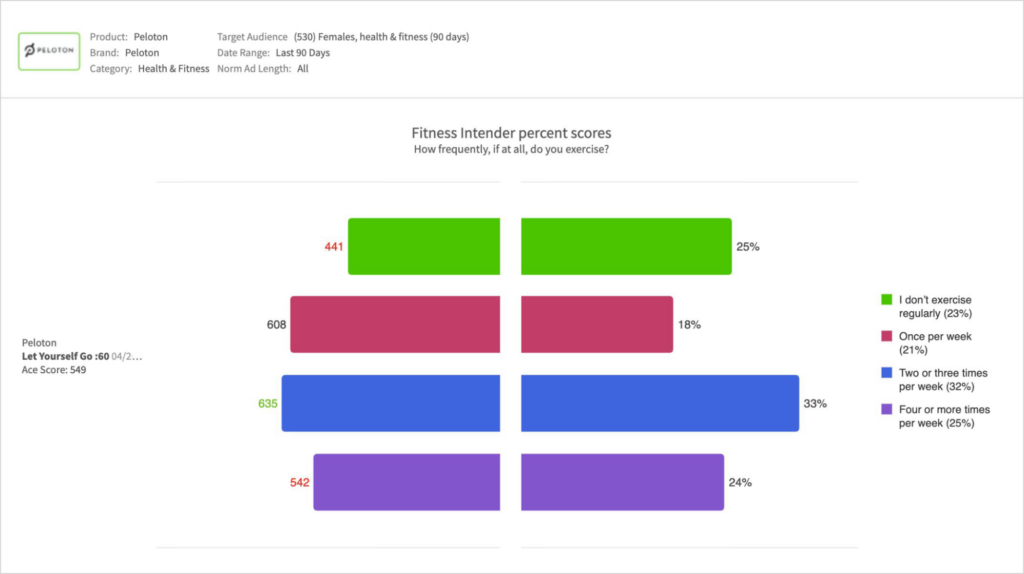
- As alluded to earlier, current exercisers responded more positively to the :60 “Let Yourself Go” with your best audience being those working out 2-3 times per week (33% of women):
- More serious athletes (4+ workouts/week) did not respond as positively, which is not surprising given the stylized delivery over substance.
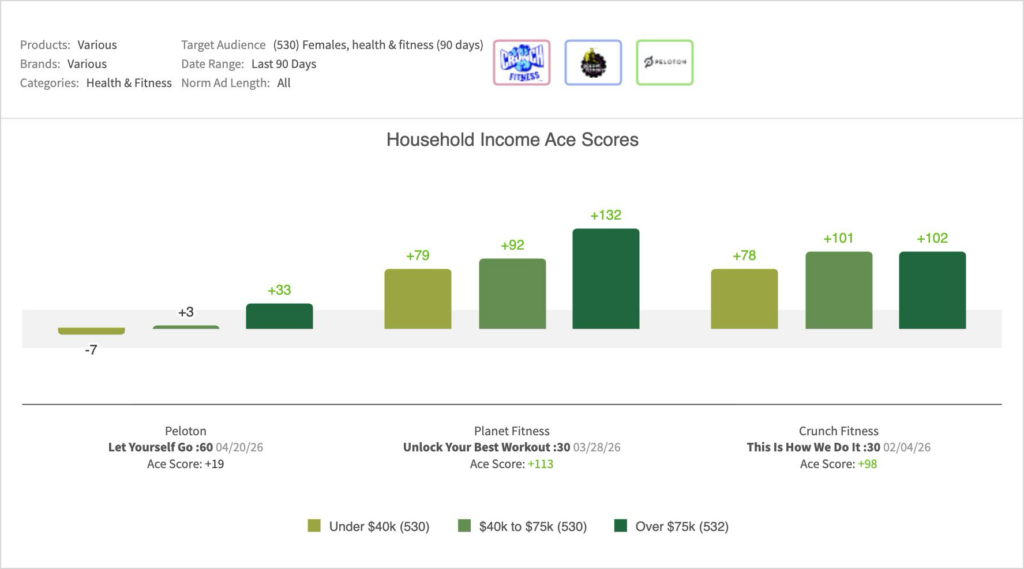
- While more economical across income levels, both Planet Fitness and Crunch Fitness released ads recently that resonated quite well with female viewers:
- Of course, Planet Fitness was all about the deals the brands offers while Crunch Fitness featured nostalgic music and dance scenes similar to Peloton’s spot, but in more of a ‘Friday night party’ gym atmosphere (and a low price point).

- While the David Bowie music landed well with male viewers, this execution otherwise did not resonate at all with American men as a group:

Ineffective creative, even if delivered to the right audience, results in missed opportunity and performance shortfalls. Great creative delivered poorly also results in failed campaigns.
Schedule a demo to find out how your brand can partner with iSpot to quickly solve both challenges simultaneously, delivering high-performing creative while boosting the effectiveness of planning and in-market execution to achieve—and outperform—campaign objectives.
Creative Agency: Peloton